Luxury Outdoor Kitchens in Manatee County: My Blueprint for a 30-Year, Hurricane-Resistant Build
As a designer and builder of high-end outdoor living spaces, I've seen a recurring, expensive mistake in Manatee County that costs homeowners tens of thousands in premature repairs. The biggest failure point I identify in luxury outdoor kitchens, from the waterfront estates on Longboat Key to the sprawling homes in Lakewood Ranch, isn't the grill or the appliances—it's the insidious degradation of the core structure from salt spray and relentless UV exposure. A beautiful kitchen can look like a wreck in under five years if the substructure and material science are ignored. My entire approach is built around a single principle: creating an outdoor kitchen that performs like a marine vessel. It must withstand constant humidity, airborne salinity, and intense sun without compromising its structural integrity or aesthetic finish. This isn't about just choosing "outdoor-rated" materials; it's about a holistic system designed specifically for the unique coastal environment stretching from Anna Maria Island to the banks of the Manatee River.My Diagnostic Framework for Coastal Durability
Before I even sketch a design, I perform a site-specific environmental audit. The biggest error I see is a "one-size-fits-all" approach. A project east of I-75 has a vastly different set of environmental stressors than one facing directly onto the Gulf. My proprietary methodology, which I call the Structural Integrity Matrix, analyzes three key variables: proximity to saltwater, direct sun exposure hours, and potential wind load during storm events. I once had to completely gut a two-year-old outdoor kitchen in a beautiful Lakewood Ranch home because the builder used a standard galvanized steel stud frame. From the outside, it was perfect. Internally, rust had completely compromised its load-bearing capacity.Material Specification Beyond the Obvious
The difference between a 5-year and a 30-year outdoor kitchen lies in details most builders overlook. It's not just about using stainless steel; it's about using the right grade and understanding how different materials interact.- Structural Framing: I exclusively use either welded T6061 aluminum framing or concrete block (CMU) construction. Unlike steel studs, aluminum forms a protective oxide layer and will not rust. Wood framing is an absolute non-starter due to moisture and termite risk.
- Hardware and Fasteners: This is my biggest "pulo do gato." Every single screw, bolt, and fastener must be 316L marine-grade stainless steel. Using a lower grade like 304, or worse, coated steel, invites galvanic corrosion, especially where it meets the aluminum frame. I insist on using nylon or polymer washers to isolate dissimilar metals, preventing the electrochemical reaction that disintegrates fasteners over time.
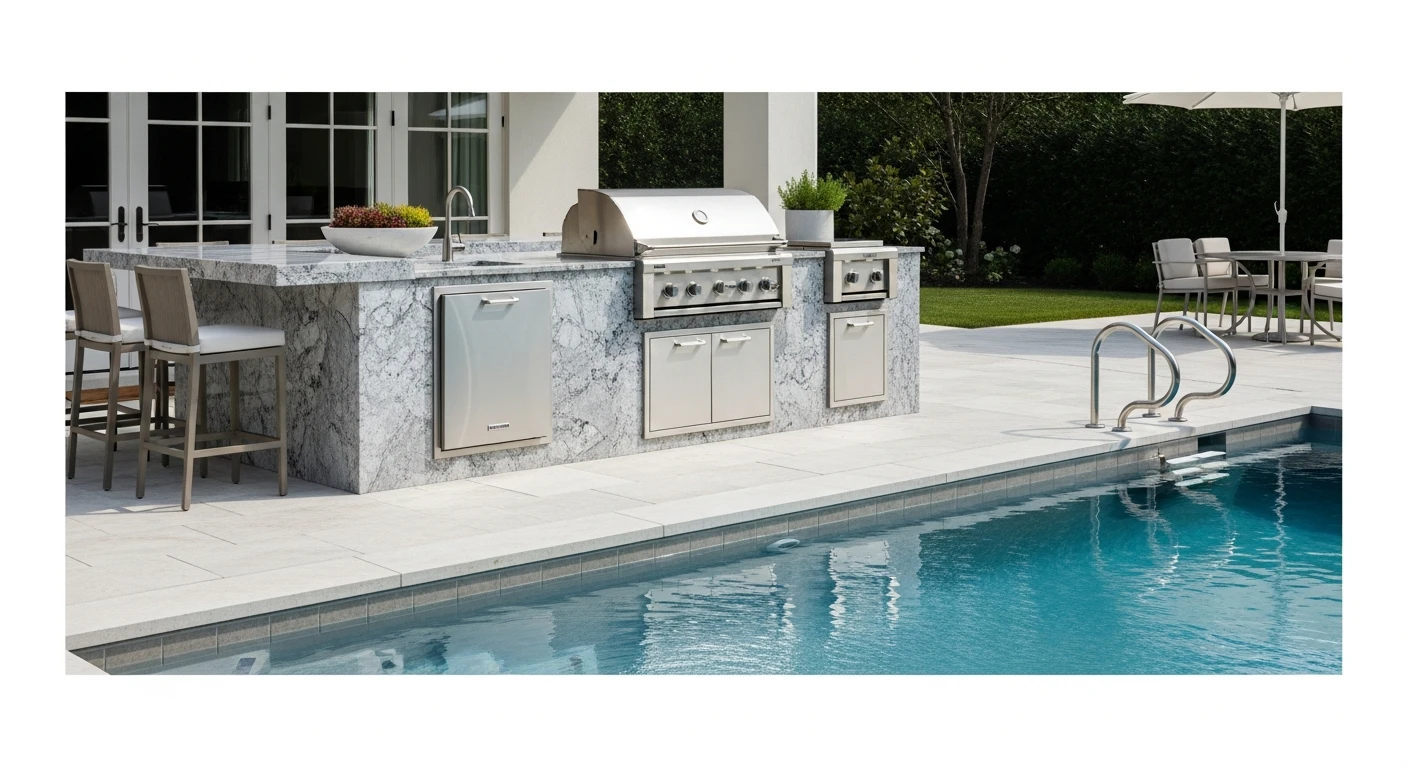
- Countertop Selection: While granite is popular, its porosity makes it susceptible to staining and requires constant sealing in our humid climate. I steer my clients toward sintered stone surfaces like Dekton. These are non-porous, completely UV-stable (their color will not fade under the Florida sun), and have a thermal shock resistance that granite can't match.
- Cabinetry and Cladding: Forget wood. My go-to is either powder-coated stainless steel cabinetry or high-density polyethylene (HDPE) marine-grade polymer. For the exterior cladding, a cement board substrate like HardieBacker is mandatory before applying any stone or stucco finish to prevent water intrusion.
The Phased Implementation Protocol
A flawless result depends on rigid sequencing and obsessive quality control at each stage. Deviating from this process is how subtle, long-term failures are born.- Phase 1: Foundation and Framing: The concrete slab must have proper pitch (a minimum 1/4 inch per foot slope) for drainage away from the house. The framing is then anchored using 316 stainless wedge anchors, not standard zinc-plated ones.
- Phase 2: Utility Rough-In: All electrical wiring must be in liquid-tight conduit with weatherproof boxes and GFCI-protected outlets. Gas lines are pressure-tested for 24 hours at 1.5 times the working pressure before any cladding is installed. This is a critical safety check I never compromise on.
- Phase 3: Substrate and Cladding: I apply a topical, roll-on waterproofing membrane over the entire cement board shell before the final finish is applied. This creates a monolithic barrier, ensuring that even if the outer cladding's grout fails, the core structure remains dry.
- Phase 4: Appliance Integration: Every appliance is installed according to the manufacturer's clearance specifications for ventilation. A common mistake is building the structure too tight around the grill, which can lead to overheating, component failure, and a voided warranty. A minimum 6-inch clearance to combustible materials is my baseline.
Precision Calibration for Peak Performance and Safety
The final 5% of the work is what separates a good kitchen from an exceptional one. This involves calibrating the systems for Manatee County's specific conditions. For example, a powerful grill needs a properly specified vent hood, especially if it's under a lanai roof. My rule of thumb is to calculate the grill's total BTU output divided by 100 to determine the minimum Cubic Feet per Minute (CFM) the vent hood requires. Installing an undersized hood is not just ineffective; it's a safety hazard. I also perform a final check on all appliance gas connections with a digital manometer to ensure perfect pressure delivery for optimal performance. Given the corrosive potential of our coastal air, are you certain your builder has considered the galvanic reaction between the grade of stainless steel in your grill and the fasteners used in the supporting frame?Written by

Tags
high end outdoor kitchen designs
modern luxury outdoor kitchen
high end outdoor grills built in
kitchen bbq grill
outdoor kitchen luxury
Luxury Outdoor Kitchen in Manatee FL FAQ
What kind of foundation do I need for a luxury outdoor kitchen, and can I just use my existing patio?
Your outdoor kitchen requires a dedicated, reinforced concrete slab foundation at least 10 cm thick to support the immense weight of stone countertops and heavy appliances. Placing heavy structures directly on an existing paver or thin concrete patio often leads to cracking and an unsafe, unlevel cooking surface within a few seasons. Improper foundation work is a primary cause of structural failure, leading to costly repairs like releveling the entire unit and fixing cracked gas or water lines that were stressed by the shift.
How do I choose between a built-in grill and a standalone one for a high-end setup?
A built-in grill offers a seamless, integrated look and superior stability, but it permanently fixes the layout of your kitchen and makes future upgrades or replacements significantly more complex. Standalone cart grills offer flexibility, but they create gaps in countertops and can feel less permanent. A critical factor people miss is serviceability; a built-in unit may require partial deconstruction of your counter for major repairs, whereas a standalone grill can be easily moved or swapped out, a key consideration for equipment with an average lifespan of 8 to 12 years.
Are stainless steel cabinets really the best option for outdoor weather?
Marine-grade 316 stainless steel is the superior choice for outdoor cabinets due to its enhanced corrosion resistance, especially in coastal or poolside areas with salt and chlorine exposure. Many homeowners opt for the less expensive 304-grade steel to save money, only to find rust spots appearing within a few years. While powder-coated steel offers color options, any scratch that penetrates the coating becomes an immediate entry point for rust, compromising the structure much faster than the raw, corrosion-resistant surface of high-grade stainless steel.
Do I really need a ventilation hood for my outdoor grill?
A ventilation hood is essential if your grill is located under any type of permanent roof, pergola, or covered structure, as required by most local building codes. Without proper ventilation, smoke, grease, and carbon monoxide can accumulate, creating a fire hazard and staining your overhead structure with a thick, grimy film. A common mistake is under-sizing the unit; the hood should be wider than the cooking surface to effectively capture all emissions, especially in windy conditions, preventing long-term discoloration and potential structural damage from grease buildup.
What are the most common points of failure in an outdoor kitchen's plumbing system?
The most frequent plumbing failures occur from freeze-burst damage to water lines that were not properly winterized and drained before the first hard frost. Even a small amount of trapped water can expand and crack pipes, leading to significant leaks and water damage inside the cabinet structure once thawed. Another critical failure point is the drain line for the sink; using improper materials that degrade with UV exposure or installing it without a proper slope can lead to clogs and foul odors, turning your luxury space into a maintenance headache.
Beyond the grill, what appliances are most prone to issues in an outdoor environment?
Outdoor refrigerators and ice makers are the most problematic appliances due to their constant battle with ambient heat and humidity, forcing their compressors to work much harder than indoor models. A common oversight is failing to provide adequate ventilation clearance around these units as specified by the manufacturer, often leading to premature compressor failure. This is a critical detail, as a failing refrigerator can struggle to maintain a food-safe temperature, posing a health risk in addition to the eventual cost of replacing the entire unit.