
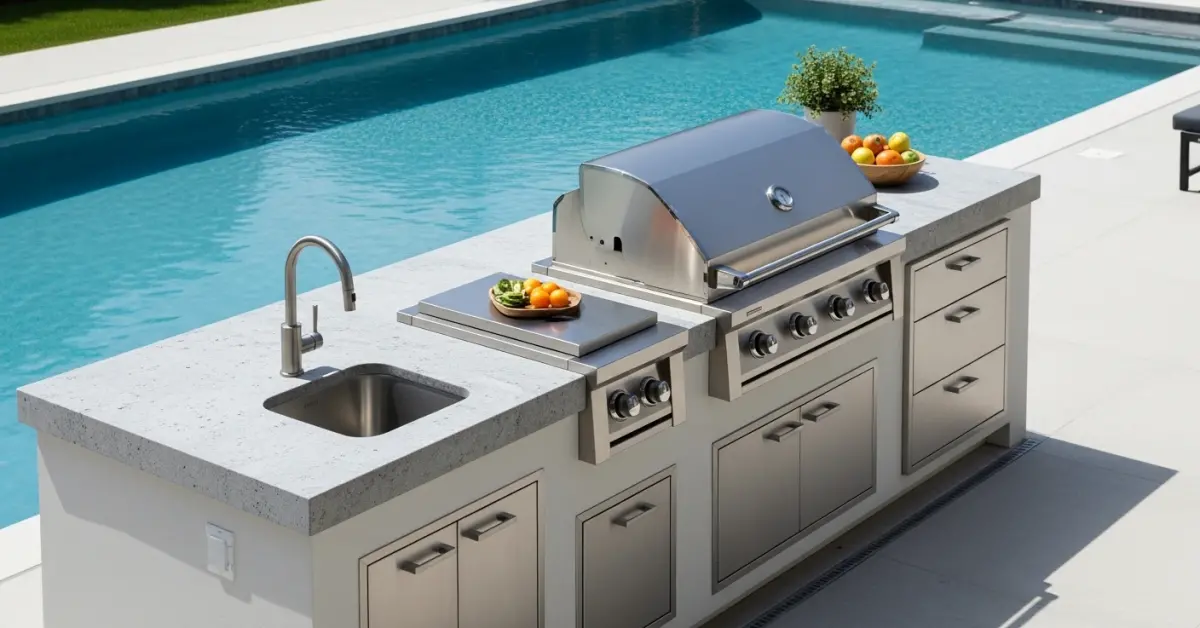
Modern Outdoor Kitchen in Polk County: My Framework for Humidity-Proofing and 25-Year Structural Integrity
I’ve seen more outdoor kitchen projects in Polk County fail within five years than anywhere else in Central Florida. The primary culprit isn’t poor craftsmanship; it's a fundamental misunderstanding of our unique sub-tropical climate. Homeowners in Lakeland and Winter Haven invest in high-end grills and beautiful stone, only to see cabinets warp from the humidity, grout develop mold, and stainless steel show rust spots. The common approach simply copies indoor kitchen design principles and moves them outside, which is a recipe for rapid degradation. My entire design philosophy is built around a single, non-negotiable principle: the structure must be engineered to defeat Polk County's specific combination of intense UV radiation, high humidity, and torrential rain. Before I even consider aesthetics or appliances, I focus on creating a skeleton that is virtually indestructible for this environment. This material-first, ventilation-focused methodology ensures the kitchen not only looks good on day one, but performs flawlessly for decades, even within the enclosed lanais common in Davenport communities.My Climate-Defense Diagnostic Protocol
Before a single drawing is made, I perform a three-part site analysis that I call the "Climate-Defense Protocol." This is a non-negotiable first step that has saved my clients thousands in future repairs. I developed this after seeing a high-end project near the Chain of Lakes suffer from catastrophic moisture failure because the builder used standard exterior-grade materials, which are simply not sufficient here. The protocol focuses on three core areas: Material Forensics, Structural Load Planning, and Airflow Dynamics. This isn't about picking colors; it's about engineering a permanent outdoor fixture.The Technical Deep Dive on Material and Airflow Failures
I've learned that standard "outdoor-rated" labels can be dangerously misleading in our environment. My Material Forensics phase involves scrutinizing the actual composition of every component. For instance, I specify 316L marine-grade stainless steel for all hardware, doors, and access panels. The common 304 stainless steel, while cheaper, will inevitably show surface corrosion from the constant moisture. For cabinetry, I avoid wood entirely. My preference is for closed-cell PVC or specific composite materials that have a zero percent water absorption rate. For countertops, I steer clients away from porous natural stones like granite, which can harbor mildew, and toward sintered stone or Dekton, which are non-porous and have a high UV resistance rating, preventing fading from the intense Florida sun. For airflow, especially inside a lanai, a standard grill vent hood is often useless. I calculate the required Cubic Feet per Minute (CFM) based on the enclosed volume and mandate a cross-ventilation path to prevent smoke and grease from coating the lanai ceiling and furniture.Phased Implementation: From Foundation to First Cookout
Once the materials and design are locked, execution is everything. A flawless plan with sloppy implementation is still a failure. I structure my projects using a rigid, phased approach with clear quality gates at each step. This eliminates guesswork and ensures every detail aligns with the Climate-Defense Protocol.- Phase 1: Foundation and Utility Mapping. We never build on an existing patio slab without first verifying its integrity. For most projects, this means pouring dedicated concrete footers that go below Polk County's sandy topsoil to ensure zero settling or cracking. All gas and electrical lines are run in waterproof conduits.
- Phase 2: Framing and Structural Assembly. The frame is built exclusively with welded aluminum or galvanized steel studs. No wood framing, ever. This creates a non-combustible, moisture-proof, and termite-proof skeleton that forms the true core of the kitchen's longevity.
- Phase 3: Cladding and Countertop Installation. We use a specialized polymer-modified mortar and waterproof backer board. Every seam is sealed with a marine-grade flexible sealant, not standard grout, to accommodate thermal expansion and prevent water ingress. Countertops are installed with a minimal overhang to reduce trapped moisture underneath.
- Phase 4: Appliance Integration and System Commissioning. This is the final and most critical phase. I personally test every appliance, check gas line pressure with a manometer for leak detection, and verify that all GFCI outlets are functioning perfectly. The ventilation system undergoes a smoke test to confirm its draw and efficiency.
Precision Adjustments and My 3-Point Quality Standard
After the build is complete, I don’t just walk away. I have a proprietary 3-Point Quality Standard check performed after the first major rainstorm. I’ve found this reveals the tiny issues that can become major problems. First, I conduct a Moisture Ingress Audit, using a moisture meter on all joints and interior cabinet surfaces. Second, I perform a Thermal Stress Check, inspecting for any material discoloration or warping after a full day of sun exposure. Finally, I re-calibrate all appliance settings, as the initial factory settings are rarely optimized for an outdoor, high-humidity environment. This obsessive final check is what separates a good-looking kitchen from one that will truly last a lifetime. Is your current outdoor kitchen plan based on materials rated for the national average, or has it been specifically engineered to withstand the relentless humidity and UV exposure of a Polk County summer?Written by

Tags
modern luxury outdoor kitchen
luxury modern outdoor kitchen
modern outdoor kitchen island
modern outdoor bbq
modern outdoor barbecue
Modern Outdoor Kitchen in Polk FL FAQ
How far should my new outdoor kitchen be from my pool to prevent problems?
Position your outdoor kitchen at least 3 meters (about 10 feet) away from the pool's edge to minimize contamination and safety risks. This distance helps prevent cooking grease, food particles, and cleaning agents from being blown or washed into the pool water, which can drastically alter your water chemistry and feed algae. More importantly, it provides a critical buffer zone, ensuring that any runoff from washing the patio or grill area, which may contain detergents or grease, does not drain directly into the pool. This placement also reduces the risk of splash-out from the pool damaging electrical components like your refrigerator or outlets, a common and costly failure point.
Can the runoff from cleaning my outdoor kitchen stain my pool's surface?
Yes, runoff containing grease, acidic food residues like citrus or wine, and harsh cleaning chemicals can cause significant staining on your pool's plaster or vinyl liner. These substances can etch concrete surfaces and create stubborn, dark stains that often resemble black algae but do not respond to normal chemical treatments. To prevent this, ensure the kitchen area has a dedicated, sloped drain that directs all runoff away from the pool deck and into your property's main drainage system. Never use a pressure washer to clean your kitchen patio in a way that allows the dirty water to flow toward the pool.
Do I need special drainage for my outdoor kitchen sink and grill area?
A dedicated drainage system separate from your pool's deck drains is absolutely critical for an outdoor kitchen. Tying kitchen drains into the pool's circulation system is a catastrophic mistake, as it introduces grease, food waste, and soap directly to your filter and plumbing, leading to severe clogs and equipment failure. Your outdoor sink and grill trap should be plumbed into your home's main sanitary sewer line, just like an indoor kitchen. This isolates contaminants and prevents them from ever reaching your pool water, protecting both your equipment and the health of swimmers.
Will the gas lines for my grill or fire pit interfere with my pool's underground plumbing?
Trenching for new gas lines poses a significant risk of damaging your pool's buried suction and return pipes, which are often just a few feet deep. Before any digging begins, you must have the exact location of your pool's plumbing professionally marked to avoid a costly and invasive repair that could require draining the pool and breaking up the deck. A cracked pipe from careless excavation can cause a hidden leak, wasting over 1,800 liters of water per day from a crack as small as 3 mm. Always consult your original pool builder's plans or a leak detection specialist first.
Can the weight of a heavy outdoor kitchen structure crack my pool deck?
A standard 4-inch concrete pool deck is not designed to support the concentrated weight of a heavy, permanent outdoor kitchen island built with masonry, stone countertops, and heavy appliances. This added load can cause the concrete slab to crack, settle, or even shift, which in turn can damage the pool's coping and bond beam—the critical structural edge of the pool shell. For any substantial kitchen structure, a separate, thicker concrete foundation with its own footings must be poured, completely independent of the existing pool deck, to properly distribute the weight and prevent structural damage.
Could the smoke and ash from my grill or smoker affect my pool's water chemistry?
Airborne soot, ash, and grease particles from a grill or smoker will settle on the pool's surface, directly impacting your water chemistry and filtration. These carbon-based particles consume chlorine at an accelerated rate, making it difficult to maintain proper sanitizer levels and often requiring more frequent shocking. They also act as a food source for algae and can clog your skimmer basket and filter much faster than usual. Orienting your grill so the prevailing winds blow smoke away from the pool is a simple but effective measure to minimize this ongoing maintenance headache.


