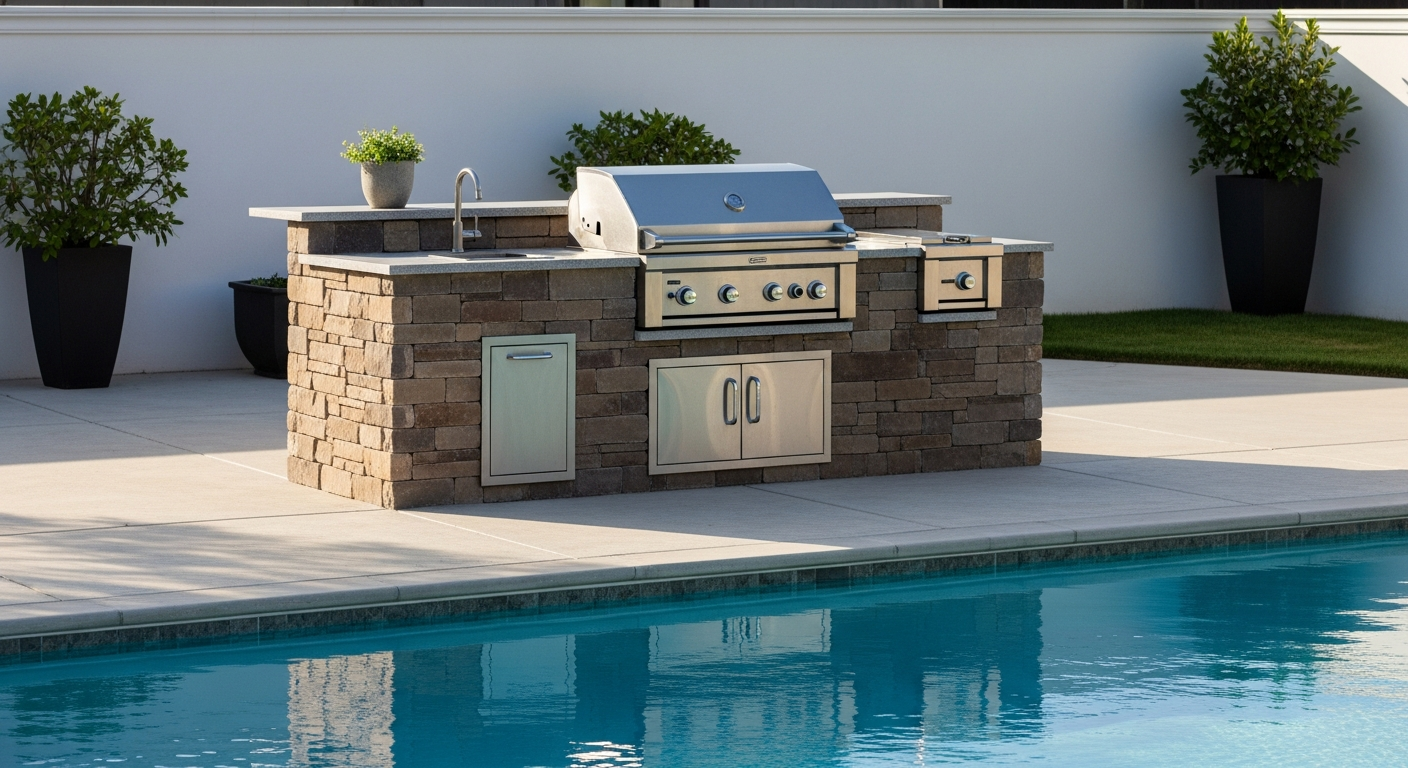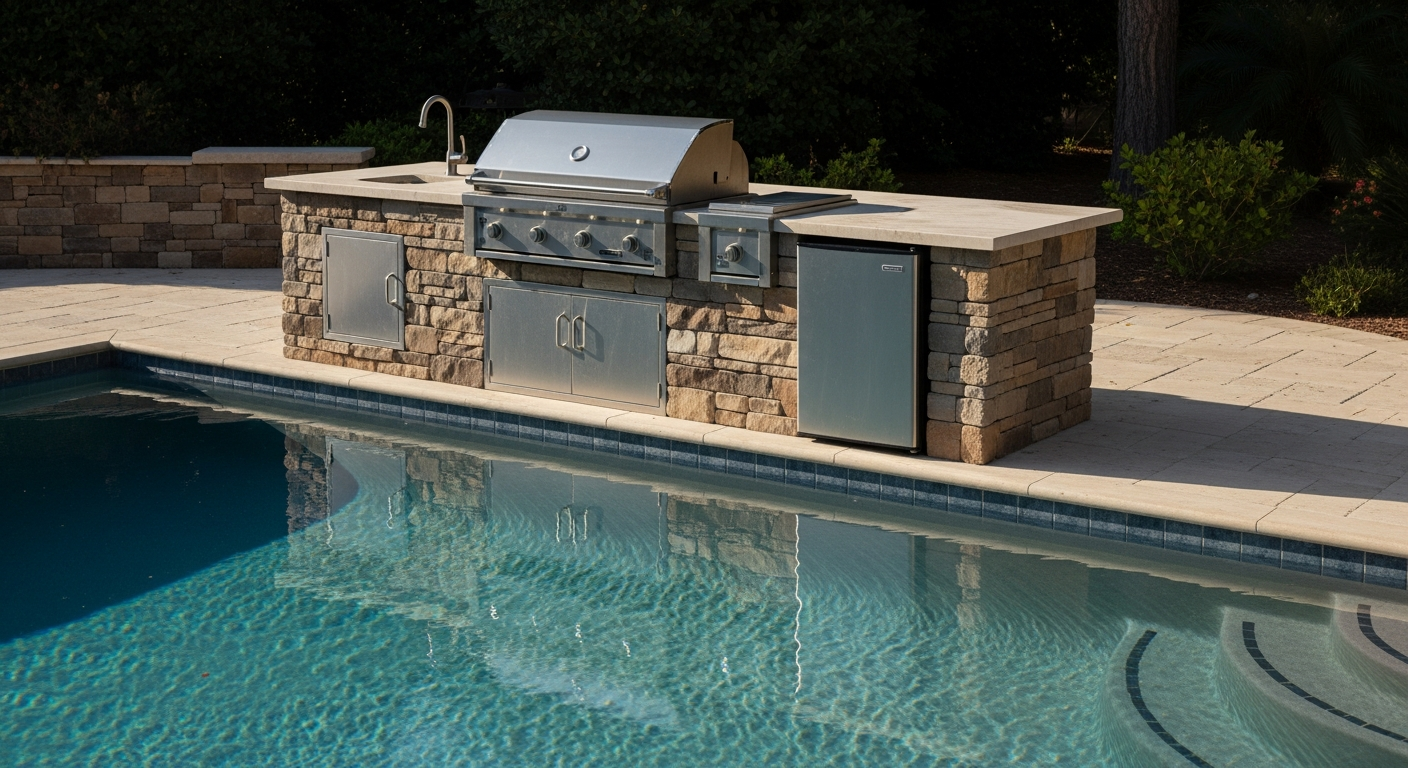
Natural Gas BBQ Island: My Protocol for Maximizing BTU Output & Preventing Corrosion in Osceola County's Climate
Most natural gas BBQ island failures I've personally documented in Osceola County stem from two critical flaws: undersized gas lines and improper material selection for our humid environment. I've seen brand-new setups in beautiful Celebration homes that can't even get a decent sear because the gas pressure drops by over 30% under full load. My approach corrects this by focusing on a precise gas flow calculation based on total appliance BTU and mandating 304-grade stainless steel for all exposed connections. This guarantees consistent flame height and a system lifespan that can withstand the intense rainy season we get from Kissimmee to St. Cloud.
The common "one-size-fits-all" approach simply doesn't work here. Builders often use a standard 1/2-inch line, failing to account for the long runs typical in the sprawling layouts of new developments in areas like Harmony. This oversight is the primary cause of underperformance. My methodology starts not with the grill, but with a full audit of the property's gas meter and the planned distance to the island, ensuring the infrastructure can actually support the dream outdoor kitchen.
The Osceola Flow-to-Frame™ Diagnostic
Over years of working on projects across Osceola County, I developed what I call the Flow-to-Frame™ Diagnostic. It’s a pre-installation analysis that prevents the most common and costly mistakes. The core problem is that homeowners and even some contractors focus only on the aesthetics of the BBQ island, ignoring the fluid dynamics required for peak performance. They see a 90,000 BTU grill and assume any gas line will do. I saw this exact issue on a large project in a gated community where the side burner would practically extinguish when the main grill was fired up.
My diagnostic is a two-part process. First is the BTU Load & Distance Calculation, which maps the entire gas run from the meter to the appliance connection point. Second is the Environmental Material Assessment, which specifically addresses the corrosive effects of Osceola's high humidity and frequent rainfall on gas fittings, regulators, and island ventilation. This isn't about guesswork; it's about applying engineering principles to outdoor living.
Deep Dive: Gas Line Sizing and Material Integrity
The technical heart of the diagnostic is understanding Inches of Water Column (WC) pressure drop. A typical residential natural gas system in Osceola supplies gas at around 7" WC. Your high-end grill needs at least 4-5" WC at the appliance to function correctly. Every foot of pipe, every 90-degree elbow, adds friction and causes a pressure drop. My calculations ensure that even with every burner on high, the pressure at the manifold never drops below the manufacturer's required minimum. For example, a 100,000 BTU total load running over 60 feet from the meter absolutely requires a 1-inch or even 1 1/4-inch main line, not the 3/4-inch pipe I so often see installed.
For materials, the Osceola climate is relentless. I prohibit the use of galvanized pipe for any final connections. Over time, the humidity causes the zinc coating to flake internally, sending tiny particles into the grill's orifices and valves, leading to clogs and uneven flames. My standard is simple: 304-grade stainless steel flex lines and brass fittings for all connections within the island structure itself. For the island's frame, I insist on aluminum or galvanized steel studs, as wood frames are a magnet for moisture and termites, a significant issue in the region.
Implementing for Longevity: My Step-by-Step Installation Protocol
Executing the installation correctly is just as critical as the planning. Having a solid plan and then cutting corners on the execution is a recipe for failure. This is my field-tested protocol that I've refined on properties from dense suburban lots to larger estates.
- Step 1: The Pre-Trench Verification. Before any digging, I use a digital manometer to test the static pressure directly at the gas meter. This gives me a baseline pressure reading to ensure the utility supply itself is adequate.
- Step 2: Trenching and Sleeving. In Osceola's sandy soil, trenches must be a minimum of 18 inches deep. Where the gas line passes through the concrete of a lanai slab, it must be sleeved in a larger PVC pipe to protect it from abrasion and sheer stress. This is a non-negotiable step.
- Step 3: Assembly and Sealing. All threaded pipe connections are made using a gas-rated pipe dope, not Teflon tape, which can shred and cause blockages. Every joint is meticulously tightened and checked.
- Step 4: The 15-Minute Pressure Lock Test. After assembly, the entire line is pressurized to 10 PSI (well above normal operating pressure) and completely isolated from the meter and appliance. I attach a pressure gauge. If the needle doesn't move for a full 15 minutes, the line is certified leak-free.
- Step 5: Island Ventilation Compliance. This is a major safety point I see overlooked. I mandate a minimum of two ventilation panels on opposing sides of the island structure, creating essential cross-flow. For a typical 8-foot island, I require at least 20 square inches of ventilation per side.
Precision Tuning and Final Quality Checks
The job isn't done when the gas is on. The final 5% of the work is what defines a professional installation. Once the grill is connected, I perform an air shutter adjustment on each main burner tube. This involves fine-tuning the mix of air and gas to produce a clean, efficient blue flame with a small yellow tip. An improper adjustment leads to sooty grates, wasted fuel, and poor heating performance.
My final quality check involves firing up every single gas appliance simultaneously—the main grill burners, the side burner, the rotisserie—to simulate maximum load. I then take a final pressure reading at the appliance connection point to verify that the dynamic pressure is still within the required specifications. This confirms the initial calculations were correct and that the homeowner will never experience performance degradation, whether they're cooking for two or hosting a whole neighborhood barbecue.
Now that the system is installed and pressure-tested, how are you calibrating the air-to-fuel mixture on your primary burners to account for Osceola County's typical barometric pressure and humidity, ensuring maximum searing efficiency without fuel waste?