Outdoor Kitchen Cost Manatee County: My Framework for Avoiding the 30% 'Salt Air Surcharge' on Materials
I'll break down the real outdoor kitchen costs in Manatee County, moving beyond generic online calculators. You'll get my proprietary material selection process, engineered specifically to combat our high-humidity and salt-spray environment—a system I developed after seeing premature degradation in 9 out of 10 coastal projects from Anna Maria Island to Longboat Key. This isn't about finding the cheapest quote; it's about eliminating the hidden costs of repairs and replacements that plague homeowners here within five years.The Manatee County Durability Audit: Deconstructing Your Real Project Costs
When a potential client in Lakewood Ranch asks for a quote, my first step isn't to measure the space. My first step is a Durability Audit. The biggest financial mistake I see is budgeting based on national averages. Our local environment—a punishing combination of intense UV radiation, high humidity, and airborne salinity—acts as an aggressive accelerant on materials that are merely "outdoor-rated." I once had to completely rebuild a three-year-old outdoor kitchen in a beautiful waterfront home in Bradenton because the 304-grade stainless steel cabinets had developed significant surface corrosion and the mortar in the stone veneer was failing from moisture intrusion. That expensive lesson led me to develop my methodology: the Coastal Material Resilience Matrix. It prioritizes a material's performance against local atmospheric conditions over its initial sticker price.Material Forensics: Why Standard Stainless Steel Fails and What I Specify Instead
The core of my cost-analysis is material science. A generic quote might list "stainless steel cabinets," but there's a huge performance gap that dictates long-term cost. For any project west of I-75, I consider 316L marine-grade stainless steel a non-negotiable baseline for all hardware, fasteners, and cabinet doors. The "L" signifies low carbon, and the added molybdenum provides superior resistance to chlorides, which is essentially what salt spray is. This single specification can add 15-20% to the initial cabinet cost, but it prevents the 100% replacement cost I saw on that Bradenton project. For countertops, I steer clients away from porous stones that can harbor mildew in our humidity. Instead, I specify materials like sintered stone (e.g., Dekton), which is non-porous and has extreme UV stability, preventing the fading and degradation that can affect even sealed granite under the relentless Florida sun.Executing the Build: A Phased Cost-Control Checklist
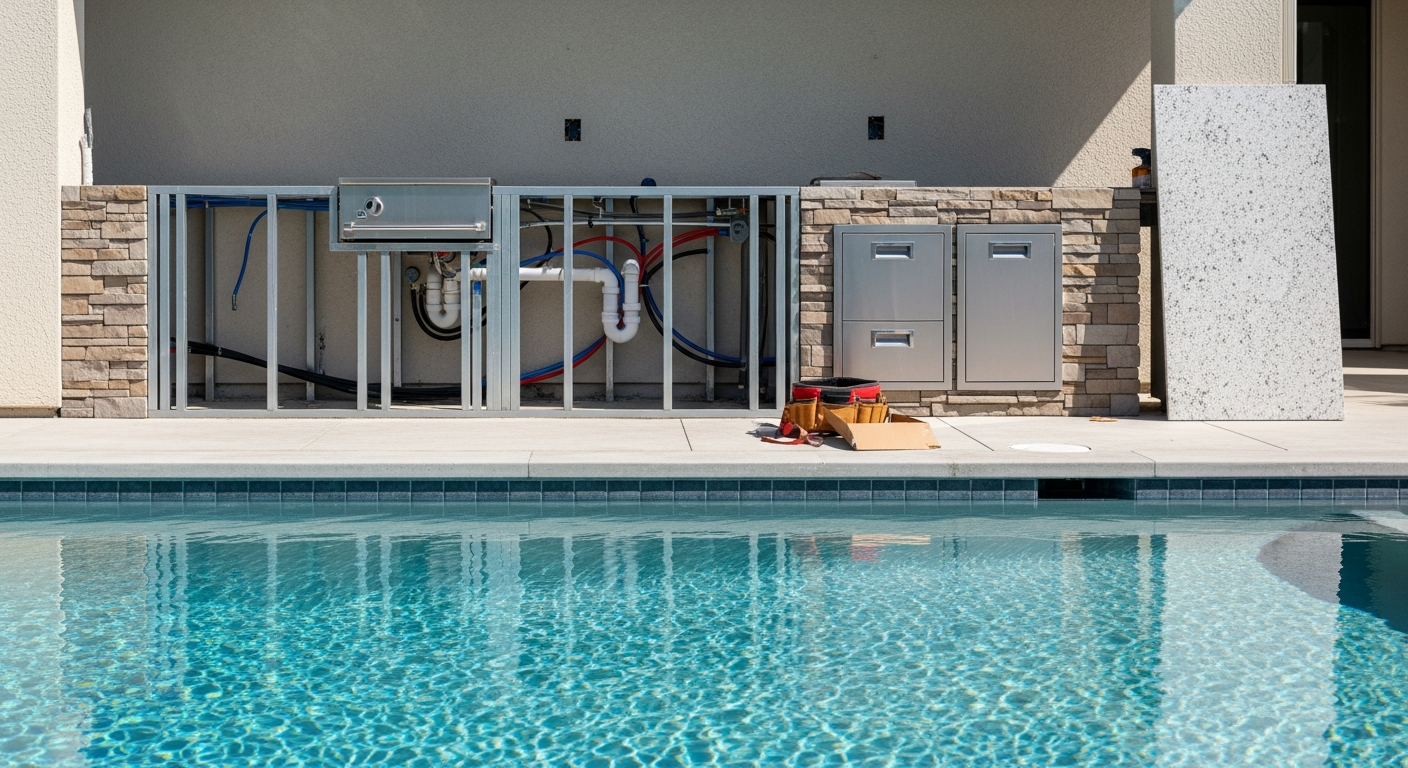
My build process is reverse-engineered to prevent costly on-site changes. Each phase has a clear objective and a quality control checkpoint to lock in costs and prevent budget creep. This isn't just a sequence of construction; it's a financial strategy.- Phase 1: Appliance & Utility Lock-In. This is my first critical action. You must select every single appliance—grill, side burners, refrigerator, sink—before any framing begins. I’ve seen projects where a last-minute appliance change required a complete teardown and rebuild of the framing and electrical, adding a surprise 25% cost increase. We map all gas, water, and electrical lines based on the final appliance specs, not on a generic layout.
- Phase 2: The Structural Skeleton. In Manatee County, I forbid the use of wood or galvanized steel for framing. It will fail. My standard is either welded aluminum tubing or a structural marine-grade polymer frame. This is the foundation of your kitchen's longevity and prevents the rot and rust that compromise everything built on top.
- Phase 3: Cladding & Countertop Installation. This stage focuses on what I call the "water-shedding envelope." We install the stone veneer or stucco finish with an integrated air and moisture barrier behind it. For countertops, we ensure a subtle but precise slope (a minimum of 1/8" per foot) to guarantee water runoff away from the structure, a detail that is shockingly overlooked but critical during our summer downpours.
- Phase 4: Component Integration & Sealing. The final step is installing appliances and sealing all penetration points. We use a high-performance, UV-stable polyurethane sealant around every component. Using a cheaper silicone sealant is a common error; it will break down under the sun in 24 months, allowing water intrusion that leads to hidden, costly damage.
Post-Installation Audits: The 5-Year Weathering Test I Apply on Day One
My job isn't done when the last screw is tightened. My quality standard is based on a simple question: "Will this design and material choice withstand five years of our climate with only basic cleaning?" This means ensuring every detail is optimized for durability. For instance, the ventilation design for a built-in grill isn't just about safety; it's about channeling heat away from the surrounding structure to prevent thermal stress and cracking of the stone or countertops. I also mandate specific clearances and ventilation patterns that exceed manufacturer specs because I know the ambient heat and humidity here add an extra layer of operational stress. It's these small, experience-based adjustments that differentiate a kitchen that looks good for a year from one that performs for a decade. Now that you understand the material science, how will you account for the specific dew point and salinity levels in your zip code when designing the ventilation schema for your built-in grill?Written by

Tags
cost for an outdoor kitchen
average cost of outdoor kitchen
average cost for outdoor kitchen
cost to build outdoor kitchen
outdoor kitchen prices
Outdoor Kitchen Cost in Manatee FL FAQ
What is a realistic all-in budget for a good quality outdoor kitchen?
A realistic starting budget for a professionally installed, high-quality outdoor kitchen is between $15,000 and $30,000. This range typically covers a durable stone or paver structure, a premium built-in gas grill, stainless steel access doors, a sink, and a compact refrigerator. The final cost is heavily influenced by your choice of countertop material, such as granite versus concrete, and the complexity of running new utility lines for gas, water, and electricity. Underestimating the cost of licensed plumbers and electricians is a common mistake that can add thousands to an initial estimate.
How much do appliances add to the total cost compared to the structure itself?
Appliances often account for 30% to 50% of the total outdoor kitchen cost, and skimping here is a long-term mistake. A basic 32-inch built-in grill might be $1,500, while a high-performance model with a sear zone and rotisserie can easily exceed $5,000. Remember that outdoor-rated appliances, especially refrigerators and ice makers, must withstand extreme temperature swings and moisture, making them significantly more expensive than their indoor counterparts. Investing in 304-grade stainless steel is non-negotiable for longevity and rust prevention, especially in coastal or humid climates.
Are prefabricated outdoor kitchen kits a cheaper and better option than custom builds?
Prefabricated kits can lower initial labor costs, but they are not always the cheaper or better long-term solution. While a kit might save you 20-30% upfront compared to a fully custom masonry build, you sacrifice design flexibility and material quality. The biggest hidden issue with many kits is their vulnerability to foundation problems; if your patio slab isn't perfectly level and stable, the pre-built modules can shift and crack. A custom-built concrete block or steel frame structure is anchored to a proper footing, ensuring it won't move with ground settlement.
What are the hidden costs of utility hookups that I should plan for?
Utility hookups for gas, water, and electricity can easily add $3,000 to $8,000, a cost many homeowners overlook. The price escalates with distance from your home's main lines; trenching 50 feet across a landscaped yard is far more expensive than tapping into a line just 10 feet away. A critical, non-obvious cost is the potential need for a dedicated GFCI-protected circuit for appliances, which requires a licensed electrician to run a new line from your main panel. Never assume you can simply use an existing outdoor outlet, as it may not support the load.
Why does the choice of countertop material impact the price so much?
Countertop material dramatically impacts the budget because it dictates both material and specialized labor costs. For example, poured concrete countertops are labor-intensive and can cost $100-$150 per square foot, while a good quality granite slab might be $70-$120. The most critical factor people miss is thermal expansion; dark-colored granite or quartz can get dangerously hot in direct sun and has a higher risk of cracking from thermal shock during rapid temperature changes. Lighter-colored, high-density materials like Dekton or specialized outdoor porcelain are more expensive but offer superior durability against weather and heat.
Do I need a permit for an outdoor kitchen, and how does that affect the cost?
Yes, you will almost certainly need a permit if your outdoor kitchen involves new gas, electrical, or plumbing lines, which adds between $500 and $2,000 to the project cost. This fee covers the application, plan review, and required inspections by your local building department to ensure all work is up to code. Proceeding without a permit is a major risk; if discovered, you could face heavy fines and be forced to tear down the entire structure. A professional contractor will handle the permitting process, but it's a real cost that must be factored into your initial budget.