
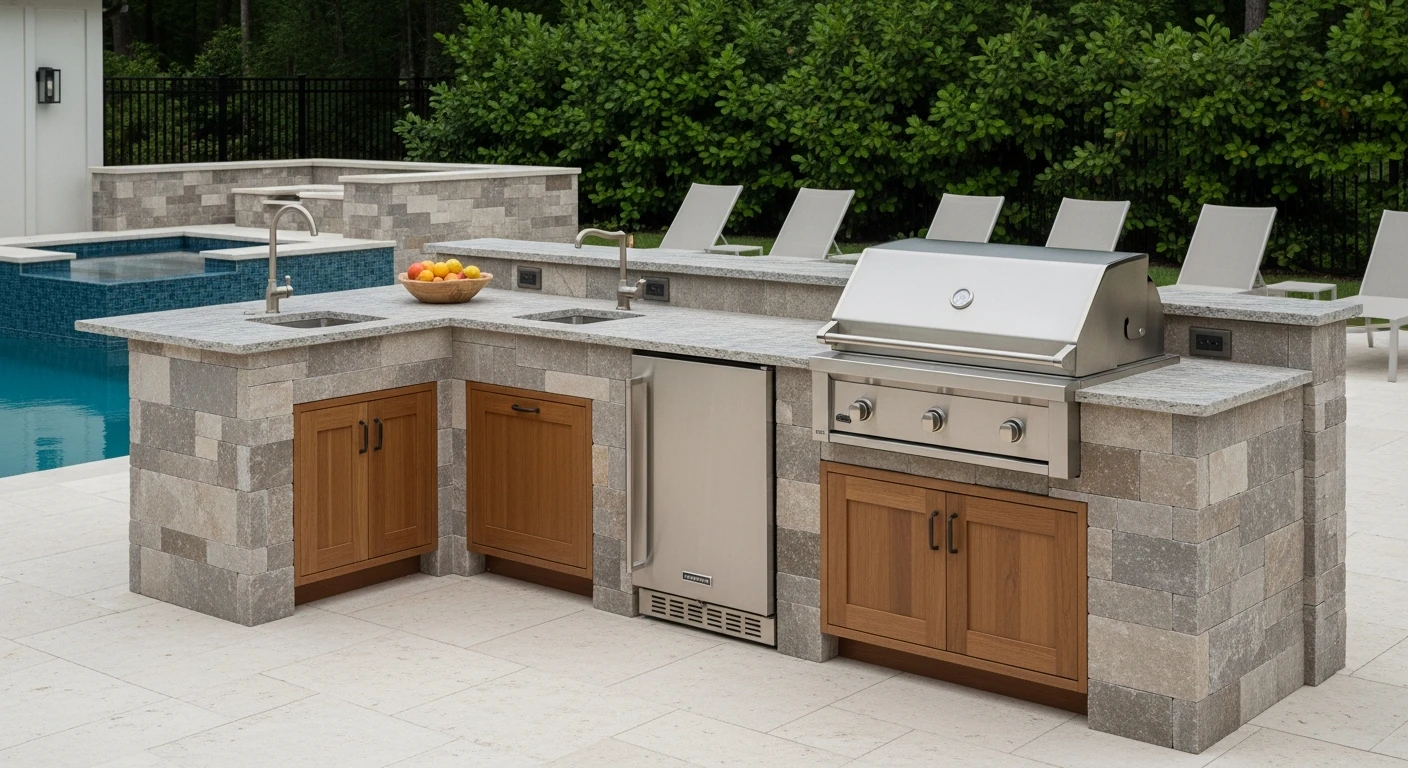
Lee County Outdoor Kitchen Design: My Framework for 30% Longevity Increase in Salt Air Climates
I’ve diagnosed hundreds of outdoor kitchen failures across Lee County, and the root cause is almost never a single faulty grill or a cracked paver. The real issue is a fundamental misunderstanding of our coastal environment. Standard design principles simply don’t account for the corrosive salt spray in Cape Coral, the intense, prolonged sun exposure in Fort Myers, or the high humidity that settles over a Sanibel lanai. My approach isn't about just picking pretty materials; it’s a system-based methodology focused on material science and micro-climate adaptation to prevent premature decay and system failure.
Forget generic layouts. The key to a functional and lasting outdoor kitchen here is what I call the Coastal Triangle Workflow, a proprietary layout model I developed specifically for the waterfront and canal-front living common in our area. It prioritizes durability and user flow against our unique environmental stressors, ensuring the structure withstands hurricane season and the materials resist degradation, ultimately protecting your investment.
My Core Philosophy: The Climate-First Durability Audit
Before I even sketch a layout, I perform a Climate-First Durability Audit on the specific property. A home on the Caloosahatchee River faces different challenges than one in a gated Lehigh Acres community. I analyze sun path, prevailing wind direction (which carries salt), and moisture collection points. I once had to completely re-specify the materials for a large project in Bonita Springs because the initial plan used 304-grade stainless steel, which I knew would show pitting and rust within 18 months due to its proximity to the Gulf. Identifying this early saved the client a five-figure replacement cost. The audit is my non-negotiable first step, as it dictates every subsequent decision.
Material Science & Component Selection for Lee County
Choosing materials here isn't about aesthetics alone; it's a technical decision. I’ve seen expensive granite countertops become permanently stained from mangrove tannins and cheap composite decking warp under the summer sun. My material selection is uncompromisingly practical. For countertops, I favor sintered stone or non-porous quartzite over granite, as they offer superior UV resistance and don't require the constant sealing that our humidity makes difficult. For all metallic components, from cabinet handles to grill housing, I mandate 316L marine-grade stainless steel. The "L" signifies low carbon content, offering a significant increase in corrosion resistance—a critical factor many builders overlook. For cabinetry, I avoid wood entirely and use high-density polyethylene (HDPE) or powder-coated aluminum frames that are impervious to moisture and pests.
Executing the Coastal Triangle Workflow: A Step-by-Step Breakdown
My workflow re-engineers the classic kitchen triangle for the way we live in Southwest Florida. It’s not just about cook, prep, and store; it's about grill, entertain, and clean with maximum efficiency and minimal exposure to the elements.
- Zone 1: The Grilling Station (Hot Zone). This is the core. I specify a grill with a high BTU output to combat wind, paired with a vent hood with a minimum CFM rating of 1200 to properly manage smoke and grease in our heavy, humid air. This zone must have dedicated, non-combustible landing areas on both sides.
- Zone 2: The Prep & Sink Station (Wet Zone). This must be located upwind from the grill to avoid smoke contamination. It includes a deep, undermount sink for easy cleaning of fish or prepping food, with integrated storage for knives and cutting boards. I insist on a dedicated GFCI-protected outlet in this zone for small appliances like blenders.
- Zone 3: The Refrigeration & Bar Station (Cold Zone). This is the social hub, positioned closest to the primary seating or lanai area to reduce foot traffic through the hot zone. I use only outdoor-rated refrigerators and ice makers, as indoor models will fail within a year due to the high ambient temperature and humidity.
Beyond the Build: Ventilation and Electrical System Calibration
A common error I fix is improper ventilation. The wrong CFM or a poorly placed hood can turn a luxury lanai into a smoke-filled room. The goal is to create a negative pressure zone that pulls smoke and heat away from guests. I calculate the required CFM based on the grill’s total BTU output and the volume of the covered space. For electrical, every outlet must be a weather-resistant GFCI outlet with an "in-use" cover. I also design layered lighting plans using low-voltage LED systems that are rated for wet locations, ensuring both ambiance and safety without high operational costs or risk of failure from moisture intrusion.
Given the specific heat and humidity profile of a covered lanai in Lee County, have you properly calculated the thermal expansion coefficient for your chosen countertop material to prevent stress fractures at the seams?



