
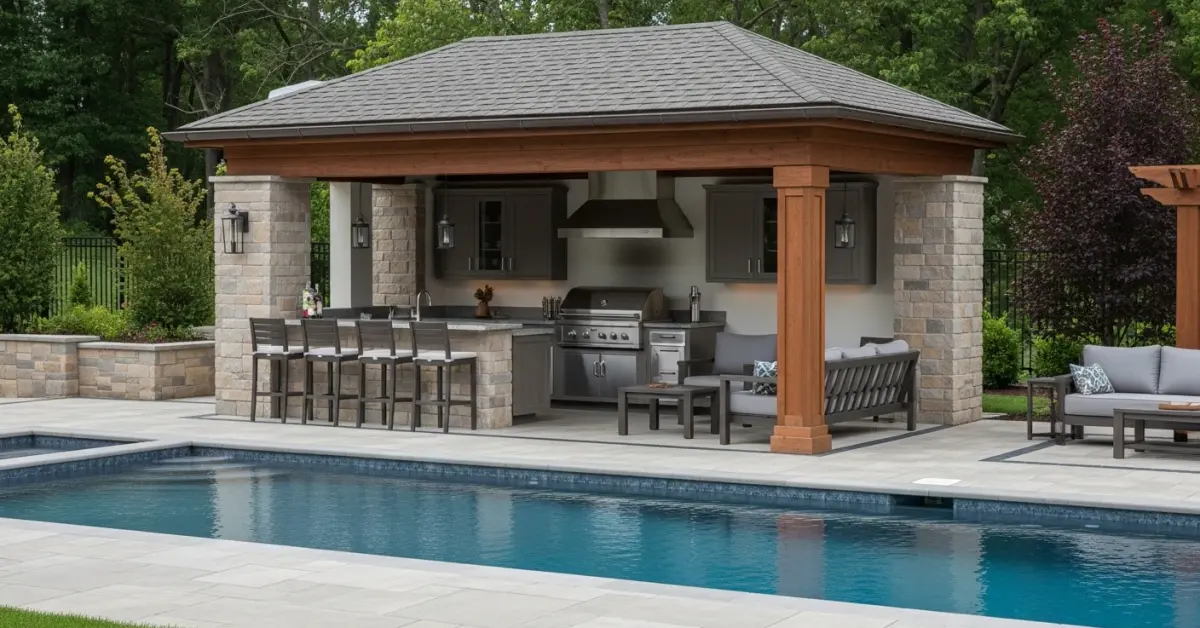
Outdoor Kitchen Pool House Manatee County: My Framework for a 30-Year Corrosion-Proof Build
Designing an outdoor kitchen pool house in Manatee County isn’t about aesthetics alone; it's a battle against atmospheric chemistry. The combination of intense humidity, high salinity in coastal areas like Anna Maria Island, and relentless UV exposure creates a uniquely corrosive environment. I developed my proprietary methodology after being called to salvage a $150,000 project in Bradenton Beach where standard 304-grade stainless steel appliances showed significant rust pitting in under 24 months—a completely avoidable failure. My approach focuses on a principle I call Material Immunity, which ensures every component specified is inert or highly resistant to the specific airborne chlorides and moisture levels found from Parrish to Longboat Key. This isn't just about choosing better materials; it’s about understanding how they interact to prevent galvanic corrosion and structural degradation, ultimately increasing the functional lifespan of the build by at least 25-30% compared to standard construction practices I regularly see.The Critical Failure Point Most Builders in Manatee Overlook
The most common and costly error I encounter is a fundamental misunderstanding of "outdoor-rated" materials in a coastal Florida context. A product rated for outdoor use in a dry climate will fail catastrophically here. The primary failure point is almost always the selection of fasteners, hardware, and framing materials that are incompatible with our environment. I once audited a project in a Lakewood Ranch golf community where the builder used galvanized screws on a marine-grade stainless steel grill housing. Within a year, galvanic corrosion had completely compromised the mounting points, creating a serious safety hazard. The builder focused on the big-ticket items but neglected the small components that hold everything together. This oversight turns a dream outdoor living space into a maintenance nightmare.My Climate-Adapted Structural Triad (C.A.S.T.) Protocol
To prevent these failures, I systematized my design and specification process into what I call the Climate-Adapted Structural Triad (C.A.S.T.) Protocol. It’s not just a checklist; it's a framework for material selection and assembly that addresses Manatee County’s unique challenges head-on.- Element 1: The Non-Ferrous Foundation. The structural framing cannot be standard pressure-treated wood or steel studs. I specify either powder-coated aluminum framing or, for maximum durability, a concrete block structure with a specialized moisture-blocking sealant. The critical detail is that all fasteners—every single screw and bolt—must be 316L stainless steel. The "L" denotes low carbon, which provides superior resistance to weld decay and sensitization. This is a non-negotiable specification.
- Element 2: Ventilated Cabinetry and Appliance Housing. Trapped moisture is the enemy. My designs mandate a minimum 1.5-inch air gap behind all appliance installations and passive ventilation ports in all enclosed cabinetry. For high-output grills, I calculate the required vent hood CFM (Cubic Feet per Minute) using a specific formula for our humid climate: (Grill BTU rating / 100) x 1.2. This 20% uplift factor accounts for the heavier, moisture-laden air, preventing grease buildup and mildew.
- Element 3: Surface & Sealant Synergy. For countertops, I've moved away from porous natural stone. My go-to is ultra-compact porcelain or a custom-mix Glass Fiber Reinforced Concrete (GFRC). The "pulo do gato" here is the sealant. I use a two-part, marine-grade aliphatic urethane sealant, which provides superior UV resistance and is impenetrable to salt and chlorine. This costs more upfront but eliminates the need for annual resealing.
Executing a Resilient Build: A Non-Negotiable Checklist
Translating the C.A.S.T. protocol into a physical build requires meticulous execution. After seeing subpar installations compromise excellent designs, I created this field-tested checklist for every project I oversee.- Foundation & Framing: Verify that all concrete block is treated with a penetrating silicate sealer before any framing is attached. If using aluminum framing, confirm all welds are TIG welds and the powder coating thickness is at least 3 mils.
- Appliance & Component Specification: Every single metal component, from the grill and refrigerator to the cabinet hinges and drawer pulls, must be explicitly specified as 316L Marine-Grade Stainless Steel. Do not accept 304-grade as a substitute. I make the contractor provide material data sheets for verification.
- Electrical Safety Protocol: All outlets must be GFCI protected and housed in "in-use" weatherproof covers. I mandate dedicated 20-amp circuits for refrigerators and grills to avoid voltage drop and ensure peak appliance performance.
- Plumbing and Drainage: All plumbing must have a clear drainage slope of at least 1/4 inch per foot. I specify solid polymer or 316L stainless steel for all sink and drain components to prevent corrosion from the inside out.
- Countertop Installation: Ensure the substrate for countertops is a cement board, not plywood, which will inevitably swell and delaminate in our humidity. The two-part urethane sealant must cure for a full 72 hours before the area is exposed to moisture.
Post-Installation Calibration for Peak Longevity
The job isn't done when the last screw is turned. My final quality assurance step involves a series of calibrations that many overlook. First, I perform a "burn-in" on the grill, running it at maximum temperature for 30 minutes to cure the factory coatings and identify any hot spots caused by improper installation. Second, I use a moisture meter to check the interior of the cabinets to ensure the ventilation is performing as designed, aiming for a reading no more than 5% above the ambient humidity. Finally, I double-check the drainage slope with a digital level after all appliances are installed and weight-bearing, ensuring no settling has created low spots where water can pool. These small adjustments are what separate a good build from a structure that will perform flawlessly for decades. Given that the coefficient of thermal expansion for aluminum framing differs significantly from that of a GFRC countertop, how have you accounted for material expansion and contraction to prevent stress fractures at the cantilevered joints during Manatee County's extreme temperature swings?Written by

Tags
pool pavilion with outdoor kitchen
pool house plans with outdoor kitchen
pool house with outdoor kitchen
outdoor kitchen and pool house
outdoor pool house kitchen
Outdoor Kitchen Pool House in Manatee FL FAQ
Does grease and smoke from my outdoor kitchen grill affect my pool's water chemistry?
Yes, airborne grease and soot from a grill will absolutely impact your pool's water chemistry and filtration system. These contaminants settle on the water's surface, increasing the demand for chlorine and leading to cloudy water and scum lines. Over time, this greasy film can clog your cartridge filter pleats or gum up the sand in a sand filter, reducing its effectiveness. A poorly placed grill can also cause staining on the pool's coping and the pool house structure, a problem that is difficult and costly to reverse once it sets in.
What are the special plumbing and drainage needs for a kitchen next to a pool?
Your outdoor kitchen must have a drainage system completely separate from the pool's circulation and deck drains. Kitchen sinks require a proper grease trap and connection to the sanitary sewer, not the storm drain system used for pool decks, to prevent food particles and oils from causing blockages or environmental issues. Never allow kitchen runoff to enter the pool, as this introduces phosphates and nitrates that fuel aggressive algae blooms, forcing you to constantly battle water quality and use excessive chemicals.
How should I plan electrical and gas lines for a pool house kitchen to ensure safety?
All electrical outlets within 6 meters (about 20 feet) of the pool must be protected by a Ground Fault Circuit Interrupter (GFCI). This is a non-negotiable safety requirement to prevent electrocution. Gas lines for grills or heaters must be professionally installed, pressure-tested, and routed away from pool plumbing and electrical conduits to prevent catastrophic failures. A critical but often overlooked detail is ensuring all metallic components, like a stainless steel grill cart, are bonded to the pool's electrical grid to prevent stray voltage.
What is the best flooring material for a combined pool house and kitchen area?
The ideal flooring must balance slip resistance for wet feet with non-porosity to resist grease stains from the kitchen. Unsealed natural stone like travertine is popular but can be stained by oils, while sealed concrete or high-quality porcelain tile with a high coefficient of friction rating offers a better compromise. Avoid smooth, glazed tiles which become extremely hazardous when wet. The key is choosing a material that can withstand both chlorine and common kitchen cleaners without degrading, ensuring a safe, durable surface for years.
Do I need special ventilation for my grill inside a covered pool house structure?
A powerful, properly rated outdoor vent hood is mandatory for any grill located under a solid roof, even in a three-sided structure. Without it, you risk dangerous carbon monoxide buildup and will coat the ceiling and furniture with a layer of greasy soot that is very difficult to clean. This residue can also be washed into the pool by rain. The ventilation system must be designed to withstand the elements and have its ducting routed to an exterior wall, well away from the pool itself to prevent exhaust from blowing over the water.
How can I prevent pests attracted by the kitchen from getting into my pool and equipment?
Food preparation will attract insects and rodents, which can then become a major nuisance for the pool. Ensure all kitchen trash is kept in sealed containers and located far from the pool pump and heater area, as pests can chew through wires and build nests inside the equipment, causing expensive damage. Integrating screened doors and windows into the pool house design is effective. Also, consider a professional pest control service to create a perimeter barrier around the entire outdoor living space, focusing on preventing entry into both the kitchen and the skimmer baskets.


