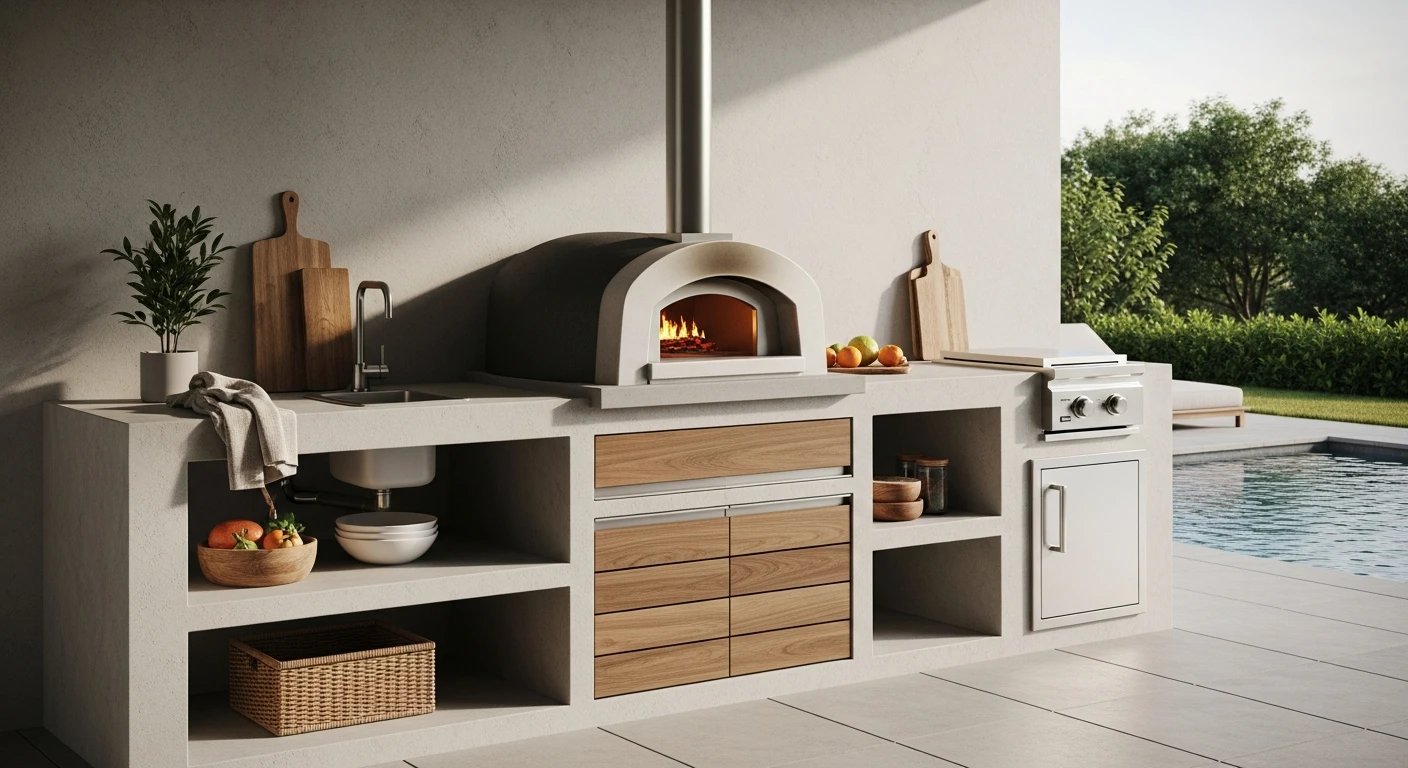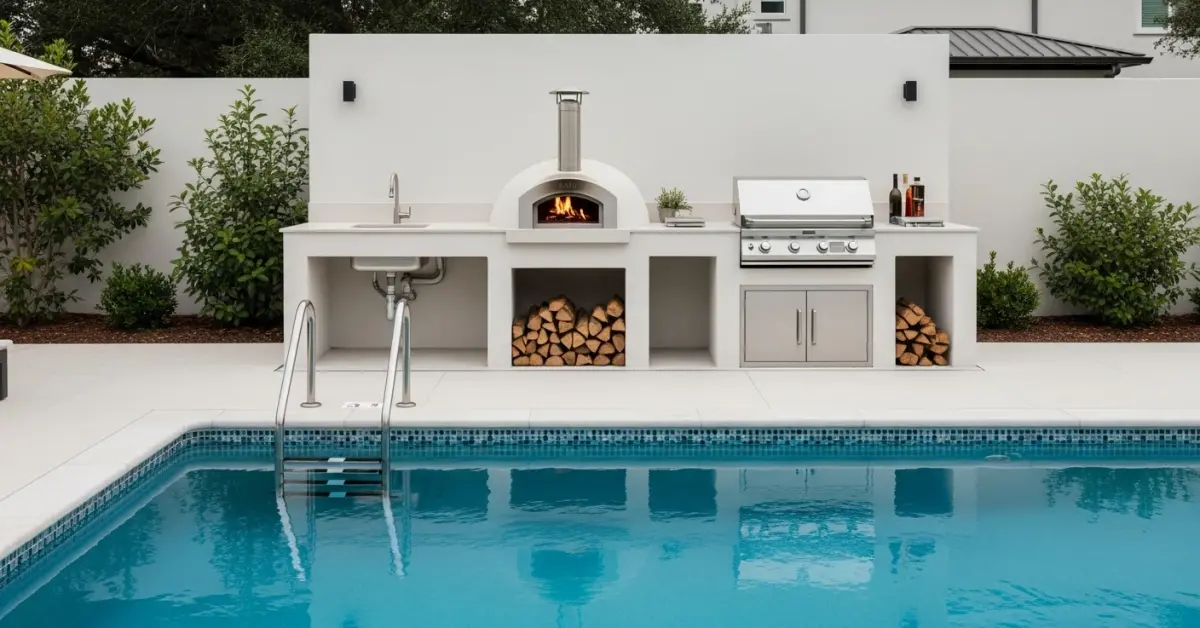
Lee County Outdoor Kitchen with Pizza Oven: My Blueprint for 30-Year Material Integrity
After designing and troubleshooting dozens of outdoor kitchens from Fort Myers to the waterfront properties in Cape Coral, I've identified a critical failure point that most builders ignore: accelerated material degradation from our specific coastal climate. A standard build looks great for a year, then the salt-laden humidity and intense UV exposure cause rust blooms, warped cabinets, and cracked countertops. My entire methodology is built to counteract this, focusing on a materials-first approach that ensures longevity. The common mistake is selecting materials based on indoor aesthetics, not on their performance in high-humidity, high-salinity environments. I’ve seen 304-grade stainless steel—often sold as "premium"—develop surface corrosion within 18 months on a Bonita Springs lanai. My protocol prevents this by specifying materials and construction techniques designed for marine applications, effectively creating a kitchen that can withstand a hurricane and still look pristine.My Diagnostic Framework for a Hurricane-Resistant Outdoor Kitchen
I developed what I call the "Coastal Durability Audit" after I was called to a project on Sanibel Island where a two-year-old outdoor kitchen was a complete loss due to galvanic corrosion. The builder had used the wrong grade of screws to attach stainless steel panels. My audit is a pre-construction diagnostic process that prevents such catastrophic and expensive failures. It's not about picking colors; it’s about a technical deep-dive into the project’s specific environmental exposure. My audit focuses on three core areas:- Microclimate Material Selection: I assess the property’s exact proximity to saltwater. A home on a Cape Coral canal has a different salt spray profile than a property east of I-75 in Fort Myers. This dictates whether we use 316L marine-grade stainless steel for all components or if a high-quality powder-coated aluminum frame is sufficient.
- Structural Load & Wind Uplift: The foundation and framing must account for Lee County’s hurricane wind codes. I analyze the integration with the existing lanai or home structure to ensure the outdoor kitchen doesn’t become a projectile in a major storm. This involves specifying concrete block construction over steel studs for islands in high-velocity wind zones.
- Ventilation & Moisture Pathway Analysis: Trapped moisture is the enemy. I map out a passive cross-ventilation system within the island's structure to ensure our humid air can circulate and escape, preventing mold, mildew, and premature decay of internal components.
The Core Technical Pillars: Appliance Synergy and Airflow Protocols
A truly durable outdoor kitchen is an integrated system, not just a collection of parts. The grill and pizza oven produce intense, concentrated heat, while the refrigerator introduces a cooling element. This thermal differential can create stress points. My approach ensures these appliances work in harmony with the structure. I mandate a minimum 2-inch air gap with ceramic fiber insulation between any hot appliance (like a grill) and a cold one (like a refrigerator) to prevent the fridge's compressor from overworking, extending its lifespan by an estimated 25%. For the pizza oven, heat retention is everything. In our breezy coastal environment, a poorly insulated dome loses heat rapidly. I specify a dual-layer insulation system: a high-density ceramic fiber blanket directly over the dome, followed by a vermiculite or perlite concrete mix. This technique increases thermal mass and reduces wood or gas consumption by up to 30%, as the oven holds its target temperature for hours. The ventilation inside the cabinet island itself is also critical; I design concealed vents at the base (intake) and just below the countertop (exhaust) to create a natural convective loop that keeps the interior dry.Step-by-Step Implementation: From Foundation to First Pizza
Executing a project that meets my durability standards requires precision at every stage. I’ve seen projects fail because a contractor made a single, seemingly minor substitution. This is my field-tested sequence of operations.- Foundation and Utility Rough-in: We begin by pouring a monolithic concrete slab with fiber mesh reinforcement. All gas lines, electrical conduits, and plumbing are sleeved in PVC and precisely placed before the pour. A critical detail here is to slightly slope the slab (a 1/8-inch per foot pitch) away from the house to manage our heavy summer rains.
- Framing and Cladding: For ultimate durability, I use concrete block (CMU) for the island structure. If a client prefers a frame, I mandate welded aluminum tubing, never steel studs which can rust from the inside out. The cladding is always a cement backer board, with all seams sealed using a liquid-applied waterproofing membrane.
- Appliance and Hardware Installation: This is a zero-compromise stage. All fasteners, hinges, and drawer slides must be 316L stainless steel. I’ve seen builders use cheaper 304-grade screws which then cause rust streaks on expensive 316L doors. To prevent galvanic corrosion, I require nylon washers to be used wherever a stainless steel fastener meets an aluminum frame.
- Countertop and Final Finishes: I advise against porous stones like granite, which require constant sealing to avoid staining under the Florida sun. My preference is for sintered stone or Dekton, which are non-porous, UV-stable, and can handle the thermal shock from a hot pizza peel. The overhang is set to a minimum of 1.5 inches with a drip edge to protect the cabinet faces.
Precision Tuning for Lee County's Climate
The final 10% of the work is what separates a good kitchen from a great one. Once the primary construction is complete, I focus on performance calibration. For the pizza oven, this involves a crucial 5-day curing process, slowly building up the heat to drive out all residual moisture from the refractory dome without causing thermal shock cracks. For the grill, I test the heat distribution using an infrared thermometer, ensuring there are no significant hot spots. We also calibrate the gas regulator to match the specific appliance's BTU requirements, as improper pressure can lead to inefficient combustion and soot buildup. Finally, I perform a "water test" on the entire structure, simulating one of our afternoon downpours to ensure all waterproofing and drainage systems are functioning as designed. This final check is what guarantees the kitchen will perform flawlessly for decades, not just seasons. Now that the blueprint for structural and material integrity is clear, how will you manage the utility connections to ensure they are both code-compliant and completely isolated from moisture intrusion for the next 30 years?Written by

Tags
outdoor bbq and pizza oven
bbq and pizza oven outdoor kitchen
outdoor grill and pizza oven
outdoor kitchen with grill and pizza oven
outdoor kitchen bbq and pizza oven
Outdoor Kitchen with Pizza Oven and Grill in Lee FL FAQ
How far should I build my outdoor kitchen from the pool's edge?
Position your outdoor kitchen, especially the grill and pizza oven, at least 10 to 15 feet away from the pool's edge to prevent safety hazards and contamination. This distance minimizes the risk of grease, ash, and food debris entering the water, which can drastically alter your pool's chemical balance and feed algae growth. A critical, often overlooked factor is prevailing wind direction; position cooking elements downwind from the pool to prevent smoke from staining the coping and irritating swimmers. This placement also helps avoid heat damage to sensitive materials like a vinyl liner, which can deform with prolonged exposure to high temperatures.
Can the runoff from cleaning my outdoor kitchen stain my pool deck or get into the pool?
Yes, runoff from cleaning your grill and kitchen surfaces can absolutely stain your deck and severely impact your pool's water chemistry if not properly managed. You must install a dedicated drainage system, such as a channel or French drain, that directs all wastewater away from the pool and into a safe disposal area, never onto the deck or lawn. Degreasers and cleaning agents contain phosphates and surfactants that act as potent algae food, leading to rapid blooms. A common mistake is assuming a sealed deck is enough; a proper, sloped drainage path is non-negotiable for protecting both your pool's finish and its water quality.
What kind of materials should I use for countertops and cabinets near a saltwater pool?
For a kitchen near a saltwater pool, you must select materials highly resistant to corrosion from aerosolized salt, such as granite, sealed concrete, or marine-grade polymers. Avoid porous stones like travertine or certain types of stainless steel (like 304 grade) for countertops and hardware, as they will pit and rust from constant exposure to the salt air. A better, though more expensive, choice for metal components is 316-grade stainless steel. The non-obvious failure point is often the cabinet hinges and drawer slides; ensure these small hardware components are also specified for marine or high-salinity environments to prevent them from seizing up.
Will the heat from a large pizza oven damage my nearby pool equipment?
A wood-fired pizza oven can radiate significant heat, potentially damaging pool equipment like the pump, filter, or heater if they are too close. Maintain a minimum clearance of 15 feet between the oven and any plastic equipment components, as prolonged radiant heat can warp PVC plumbing, melt plastic housings, and degrade sensitive electronic controls. Homeowners often focus on the front opening of the oven, but the entire dome and chimney radiate intense heat. Before installation, check the oven manufacturer's specifications for required clearances to combustible and non-combustible surfaces, and treat your pool pump and filter as sensitive, non-combustible items.
Do I need special plumbing and electrical hookups for an outdoor kitchen by a pool?
Yes, all plumbing and electrical installations for a poolside kitchen require specific safety measures, including Ground Fault Circuit Interrupter (GFCI) outlets for all receptacles. All electrical wiring must be run in waterproof conduit and be bonded to the pool's existing bonding grid to prevent stray voltage and potential shock hazards. For plumbing, a sink must have a grease trap and be connected to your home's sanitary sewer line, not a storm drain. A frequent oversight is failing to install a backflow preventer on the water supply line, which is critical to stop pool water from siphoning into your home's potable water system during a pressure drop.
Could digging for my kitchen's foundation or utility lines damage my pool's underground plumbing?
Excavating for your kitchen's foundation and utility lines poses a significant risk to your pool's buried plumbing, which is often not precisely mapped. Before any digging, it is crucial to have a professional locate and mark all underground pool pipes, including suction and return lines that can extend several feet from the pool shell. A seemingly minor nick from a shovel can create a hidden leak, potentially wasting over 1,800 liters of water per day and destabilizing the soil around the pool structure. Insist that your contractor hand-dig within five feet of any marked plumbing lines to avoid a costly repair that would require breaking up your new patio.