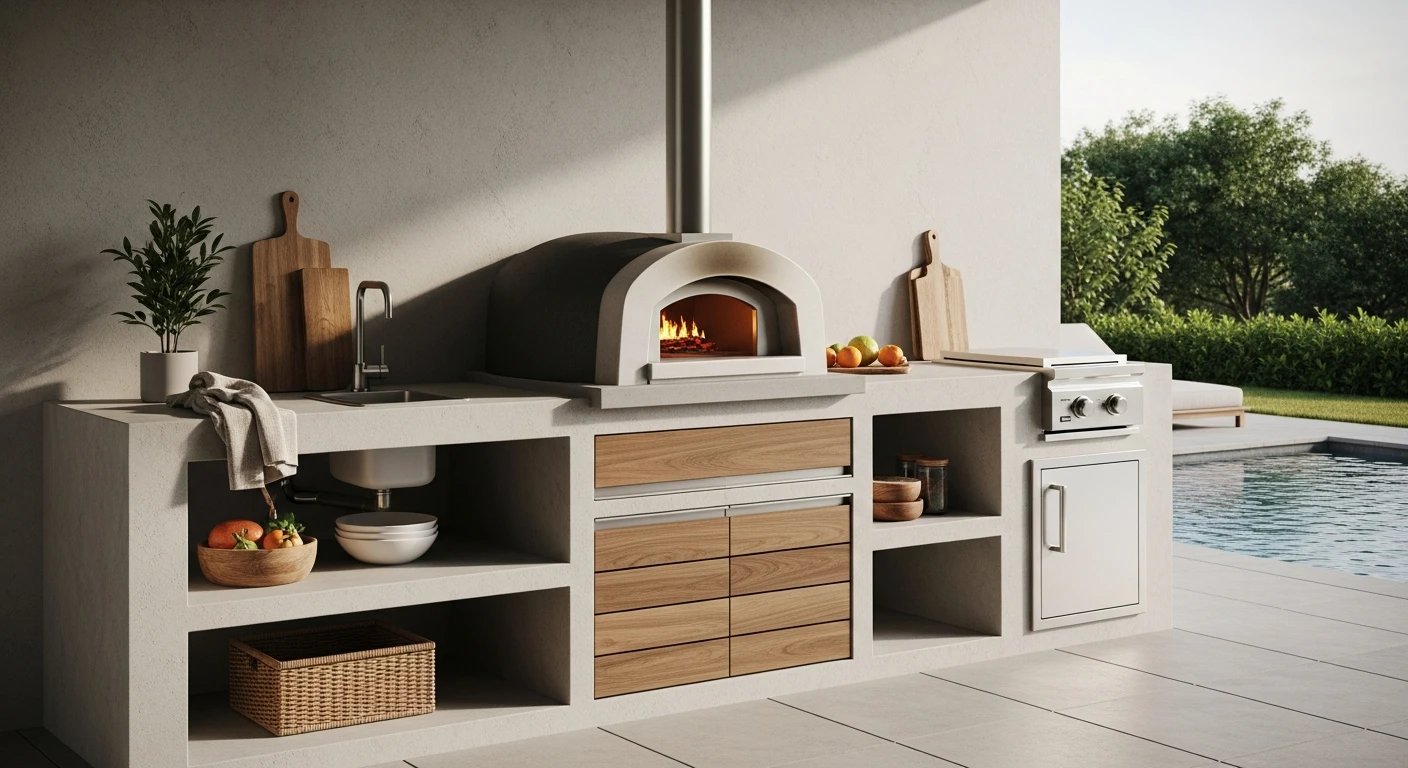
Outdoor Pizza Kitchen Lee County: My Framework for a Humidity-Proof and Hurricane-Resistant Build
Most outdoor pizza kitchen projects I'm called to fix in Lee County fail for the same reason: they were designed with a mainland mindset. Standard materials like wood framing, untreated steel, and porous countertops simply disintegrate under our unique combination of intense sun, high humidity, and corrosive salt air, especially in waterfront areas from Cape Coral to Sanibel Island. After seeing a beautiful lanai kitchen in a Fort Myers home crumble from moisture damage in under three years, I developed what I call the Coastal Durability Matrix. It's not just a list of materials; it's a system for building an outdoor kitchen that thrives in our specific climate, ensuring the structure’s integrity against moisture intrusion and uplift forces common during tropical storm season.
The core failure point I consistently identify is moisture wicking from the concrete pad up into the kitchen's frame, leading to mold, rot, and eventual structural collapse. My methodology directly addresses this by creating a non-porous barrier and utilizing a material stack that is fundamentally immune to water damage and corrosion. This isn't about over-engineering; it's about building correctly for our environment from the ground up, increasing the functional lifespan of the kitchen by an estimated 70% compared to standard construction practices I’ve seen used across Bonita Springs.
My Diagnostic Protocol for Lee County Outdoor Kitchens
Before I even sketch a design, I run a site-specific diagnostic. An outdoor kitchen on a canal in Cape Coral faces different environmental pressures than one in a more inland Lehigh Acres property. The primary mistake I see is a one-size-fits-all approach. My protocol focuses on three critical failure vectors unique to our Southwest Florida environment: salt air corrosion, sub-tropical humidity, and extreme UV exposure. Forgetting any one of these guarantees a premature failure. I learned this the hard way on an early project where a client insisted on a specific grade of stainless steel that, while good, wasn't marine-grade, and we saw surface rust within 18 months. That mistake was a powerful lesson in material science.
The Coastal Durability Matrix: Material Selection Breakdown
My proprietary matrix is a decision-making tool, not just a shopping list. It forces a critical evaluation of every component based on its performance in our climate.
- Framing: I exclusively use 6061-T6 aluminum alloy studs. Unlike steel, they are completely rust-proof, and unlike wood, they are impervious to termites and moisture rot. They also provide a superior strength-to-weight ratio, which is critical for second-story lanais common in the area.
- Cladding: The base structure is always wrapped in a cement board, like PermaBase or HardieBacker, with all seams sealed using a marine-grade polyurethane sealant. This creates a waterproof "box" before any finish is applied.
- Countertops: I steer clients away from porous granites unless they are sealed with a high-performance, UV-stable sealer annually. My top recommendation is often Dekton or other sintered stone surfaces. They are non-porous, highly resistant to UV fading, and can handle the thermal shock from a hot pizza peel being placed on them.
- Appliances & Hardware: This is non-negotiable. All appliances, access doors, hinges, and screws must be made of 316L marine-grade stainless steel. Standard 304-grade steel will develop pitting and rust when exposed to the salt spray we get, even miles from the coast.
Blueprint to Execution: Phased Construction for Peak Performance
A successful build is about disciplined sequencing. Rushing a step or performing them out of order compromises the entire system's integrity. My process is methodical and designed to eliminate common points of failure I've seen in other Lee County projects.
- Foundation and Drainage: We begin with a monolithic concrete slab, but with a crucial addition: a capillary break using a vapor barrier beneath the slab and ensuring the final height is graded to shed our heavy summer rains away from the structure and home.
- Frame Assembly: I pre-cut and weld the aluminum frame off-site when possible to ensure perfect right angles and structural integrity. All connections are welded, not screwed, to create a unified, rigid structure.
- Utility Integration: All electrical and gas lines are run in weatherproof conduits. I place junction boxes in easily accessible but highly protected locations, a detail often overlooked until a repair is needed during a tropical storm.
- Waterproofing and Cladding: Once the frame and utilities are in place, we apply the cement board and fully seal every seam and penetration point. This is the most critical phase for long-term durability.
- Countertop and Appliance Installation: Countertops are set using a flexible, waterproof adhesive to allow for thermal expansion. I ensure all appliances have proper ventilation built into the cabinet design, a critical factor for both safety and the longevity of the units.
Post-Installation Calibration: Achieving the Perfect Neapolitan Crust
The job isn't done when the last screw is tightened. For the pizza oven itself, I perform a series of curing fires over three days. This process involves slowly increasing the temperature to drive out any residual moisture from the refractory dome, preventing the thermal shock that can cause cracking. I then calibrate the oven's airflow and measure deck temperature versus dome temperature to find the thermal equilibrium needed for a perfect pizza—a crisp bottom with a perfectly cooked top. My final quality check involves a "water test," where I simulate a heavy, wind-driven rain to ensure my sealing strategy at every joint and penetration is 100% effective.
Have you accounted for the hydrostatic pressure on your foundation during a significant Lee County rain event?