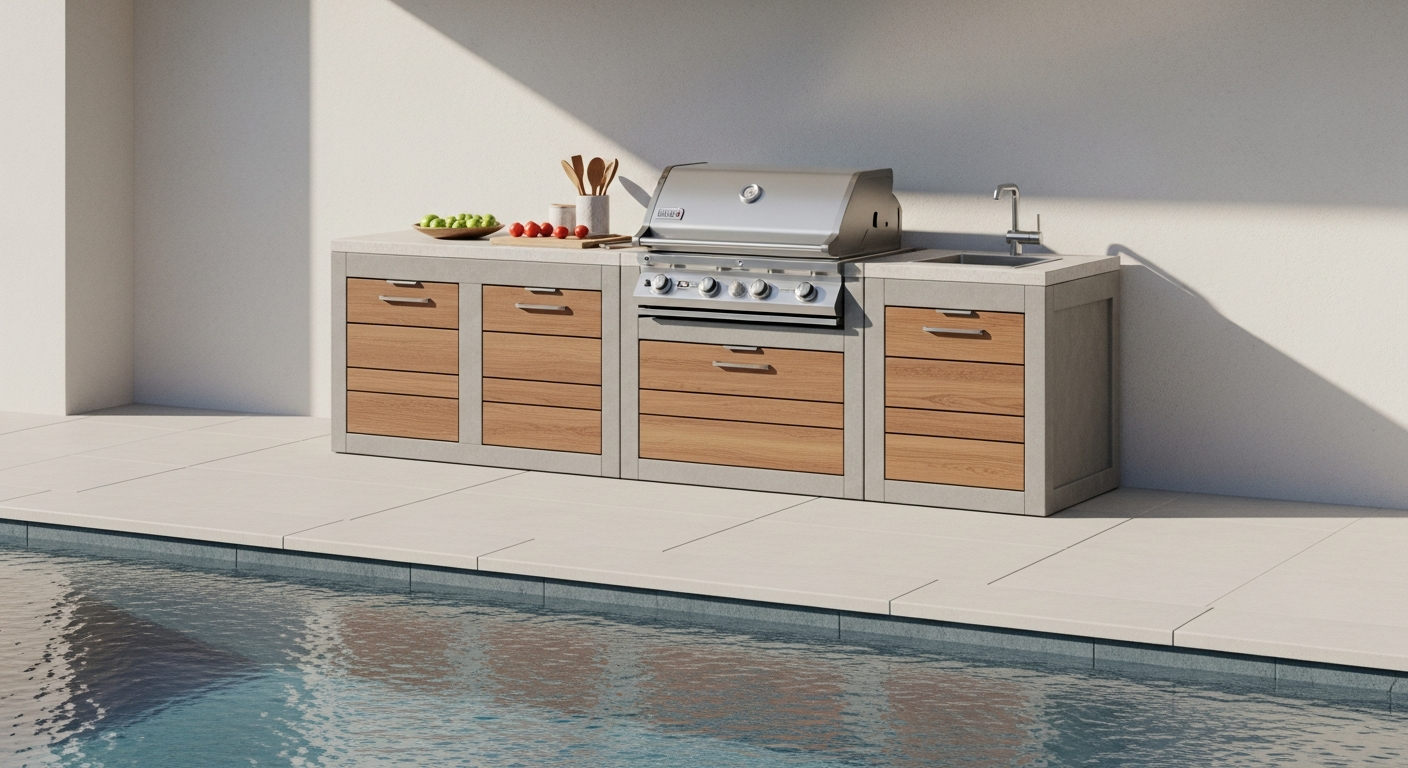
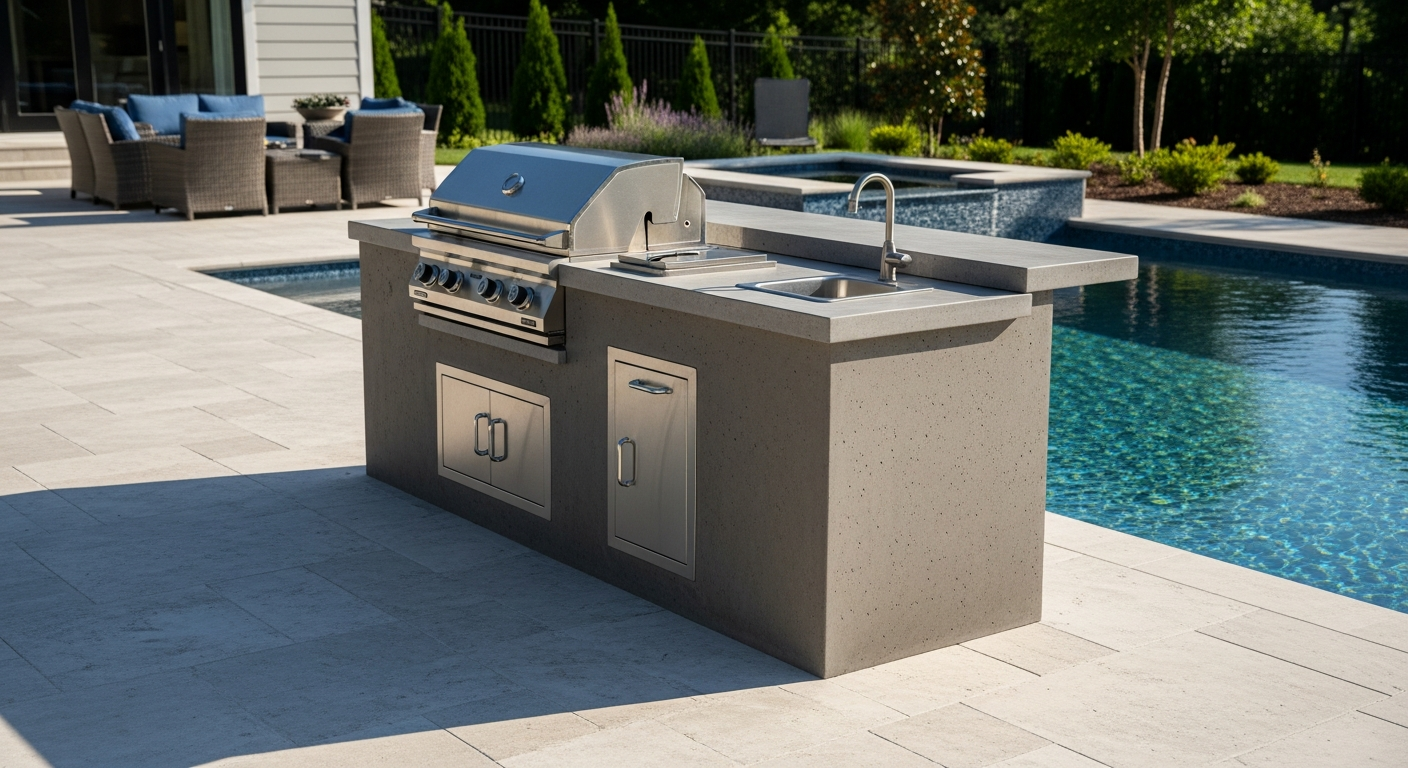
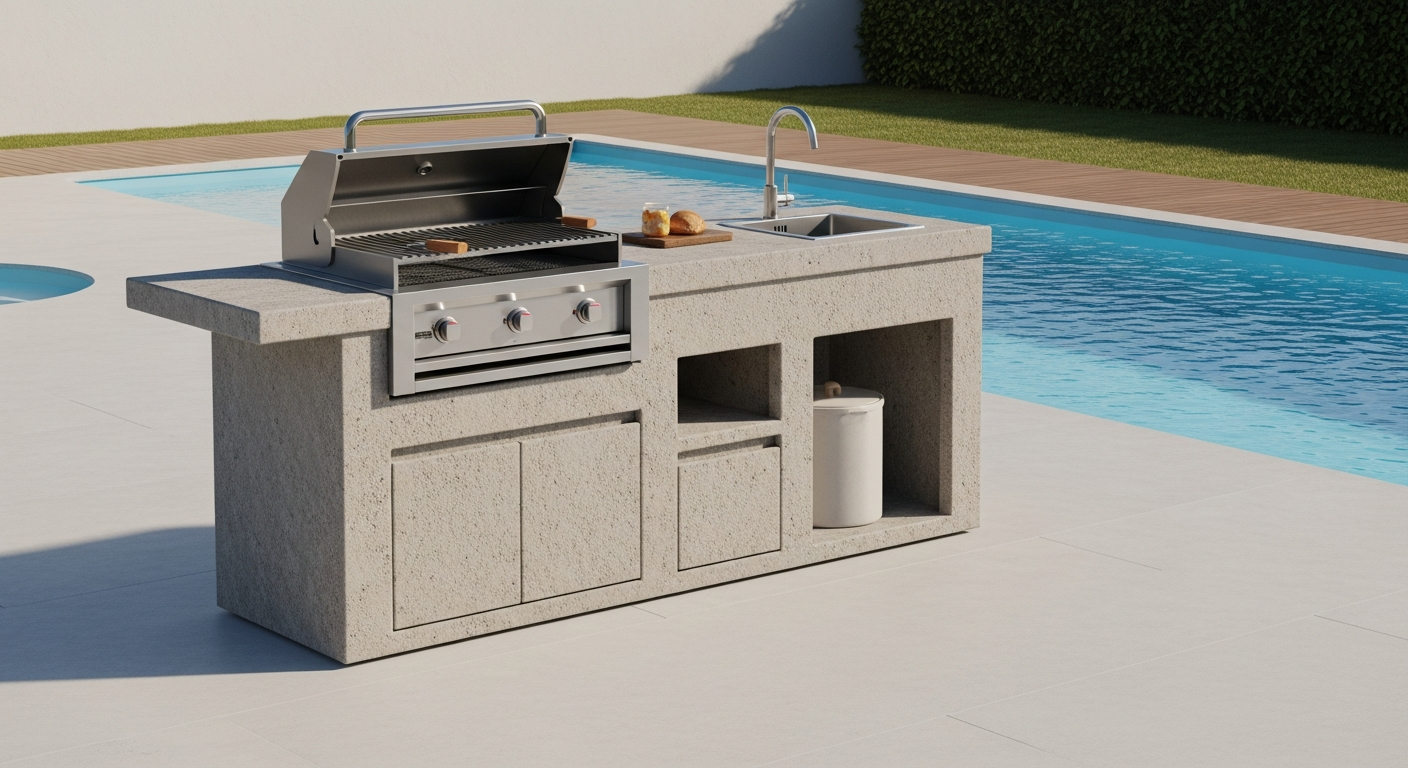
Prefabricated Outdoor Grill Islands: My Protocol for Salt-Air & Humidity-Proofing in Manatee County
Most prefabricated outdoor grill islands sold in Manatee County are doomed from the day they're installed. I've seen it countless times, from waterfront properties on Anna Maria Island to sprawling lanais in Lakewood Ranch. The culprit isn't a faulty grill; it's a fundamental misunderstanding of our coastal climate. Standard units, often built with galvanized steel studs and basic cement board, simply can't withstand the trifecta of high humidity, intense UV exposure, and corrosive salt spray. They look great for a year, then the rust stains appear, the stucco cracks, and the investment is lost.
My entire approach is built on reversing this trend. It’s not about finding a "better" brand; it's about specifying a unit built with a materials science-first methodology. I developed this protocol after a costly project in Bradenton where a client's two-year-old island, installed by another contractor, showed advanced structural corrosion. The failure wasn't in the craftsmanship but in the initial material selection. The fix required a complete tear-down, a lesson that led to my non-negotiable standards for any outdoor kitchen project south of the Skyway Bridge.
The Manatee-Spec Island Protocol: A Diagnostic Framework
Before I even consider an island's design, I run it through my proprietary diagnostic I call the "Manatee-Spec Island Protocol." It's a simple checklist that disqualifies over 80% of the mass-market options. The core principle is that any material exposed to our air must be either inherently inert or specifically treated for a marine environment. The common mistake is focusing on the countertop—a granite or quartz slab—while ignoring the structural frame and hardware, which is where catastrophic failure begins. A beautiful countertop on a corroded frame is just a facade.
Technical Deep Dive: Frame, Cladding, and Hardware Specifications
The devil is in the details that most sales brochures omit. My protocol focuses on three critical, non-negotiable areas. First is the structural frame. I mandate the use of welded 6061-T6 aluminum tubing or, at a minimum, hot-dip galvanized steel for its superior corrosion resistance compared to standard electro-galvanized studs. Second is the fastening hardware. Every screw, hinge, and drawer slide must be 316-grade stainless steel. The more common and cheaper 304-grade will show surface rust in as little as six months in a Longboat Key environment. Third is the appliance insulation jacket. It’s not just for heat protection; a properly installed jacket creates a barrier that mitigates moisture and galvanic corrosion between the grill body and the island frame.
From Concrete Slab to Sizzling Steak: The 5-Step Deployment
Proper installation is just as critical as material selection. A high-spec island placed on a poorly prepared base will fail. My deployment process is methodical and designed to prevent the common points of failure I've had to correct on other jobs over the years.
- Step 1: Foundation Integrity Check. I start by assessing the concrete pad. In many Manatee County homes, lanais are poured without a sufficient vapor barrier underneath. I test for moisture and, if necessary, apply a topical waterproof membrane before the island is placed. This prevents moisture from wicking up into the island's base.
- Step 2: Utility Stub-Out Verification. I personally verify that the gas and electrical lines are placed according to the island's specific schematic and local Manatee County codes. A common error I find is the GFCI outlet being placed inside a sealed cabinet, which is a code violation and a safety hazard.
- Step 3: Anchoring and Base Sealing. The island must be secured using stainless steel wedge anchors, not simple concrete screws. The most critical action here is sealing the entire perimeter of the island's base to the concrete pad with a high-grade marine polyurethane sealant. This creates a gasket that locks out water and pests.
- Step 4: Cross-Ventilation Audit. Prefabricated islands often come with insufficient ventilation for propane use. I always insist on adding extra vent panels to create proper airflow, preventing dangerous gas buildup. It's a small modification that prevents a huge liability.
- Step 5: Final Appliance Commissioning. This isn't just about turning the grill on. I perform a full gas pressure and leak test, calibrate the thermometer, and season the grates. This final step ensures a performance increase of up to 15% in heat distribution and prevents premature component failure.
The 10% Difference: Fine-Tuning for Peak Longevity
Achieving a 20-year or even 30-year lifespan for an outdoor kitchen in our climate requires obsession over the final details. This is where I go beyond standard best practices. For instance, I always specify a slight countertop overhang calibration of 1.5 inches instead of the standard 1 inch, combined with a drip edge. This subtle change drastically improves how rainwater is channeled away from cabinet faces. For premium projects near saltwater, I even integrate a small, hidden sacrificial zinc anode tied to the frame, a technique borrowed from the marine industry to absorb corrosive galvanic action and extend the frame's life.
Have you accounted for the galvanic corrosion potential between your 304-grade stainless steel grill body and a welded aluminum frame when situated in a high-salinity environment?