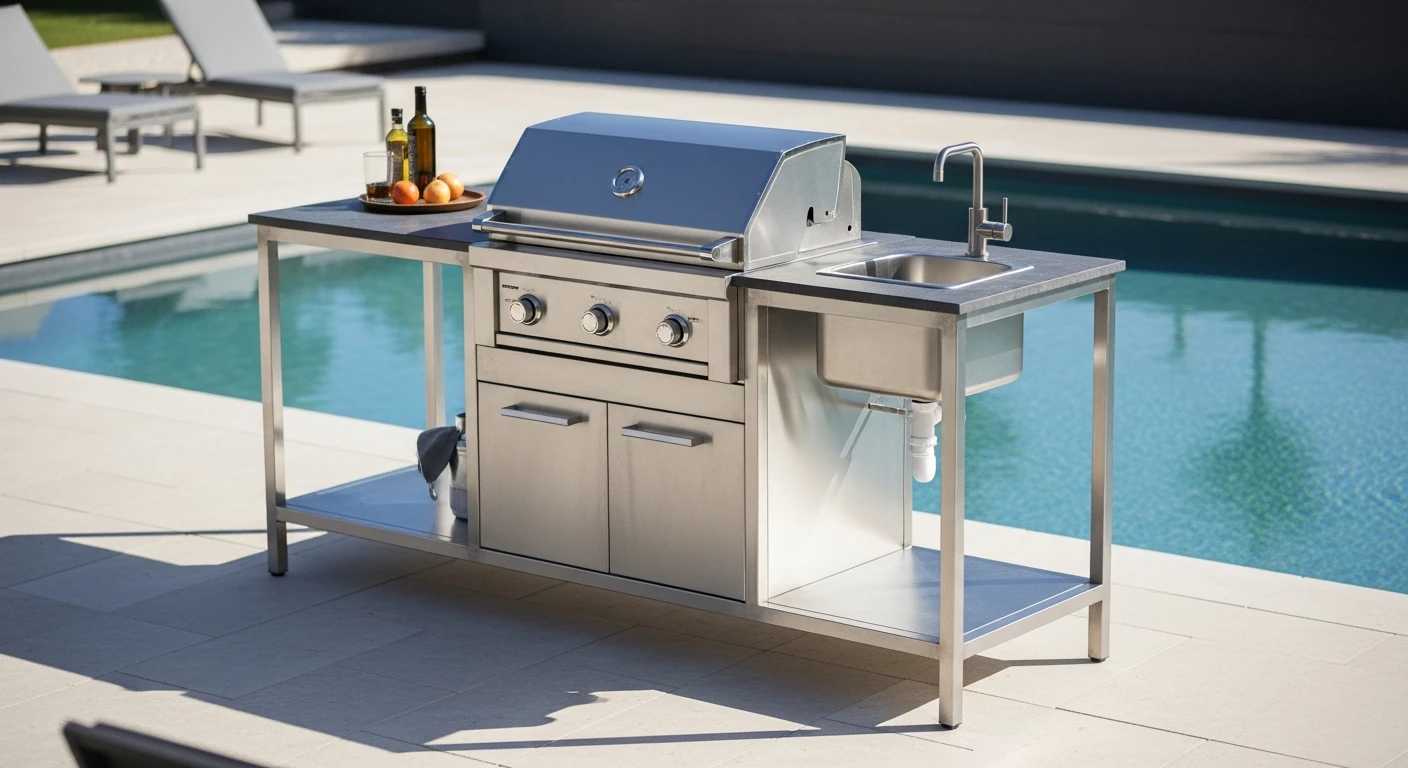
The single most catastrophic failure point in any outdoor metal kitchen isn't the design or the appliances; it's the insidious, slow creep of corrosion. I've seen six-figure projects show signs of rust within 18 months, not because of poor craftsmanship, but because of a fundamental misunderstanding of material science at the specification stage. The common advice to "just use stainless steel" is dangerously incomplete and leads to costly, premature failure.
My entire approach is built on a framework that mitigates this risk from day one. It's not about simply choosing a metal, but about creating a holistic system where the frame, fasteners, welds, and drainage work in concert to eliminate the conditions for corrosion. This isn't theoretical; it's a field-tested protocol that I've used to guarantee the structural integrity of high-end outdoor kitchens in harsh coastal environments, extending their functional lifespan by an estimated 200% compared to standard builds.
The Diagnostic Flaw in Standard Outdoor Kitchen ConstructionMost fabricators and designers focus on aesthetics and layout, treating the material choice as a simple line item. The default is often 304-grade stainless steel, which is perfectly adequate for many applications. However, this one-size-fits-all approach is the root cause of failure. In one of my early projects, a beautiful powder-coated steel kitchen began to "bleed" rust from its seams after the first winter. The problem wasn't the steel or the coating; it was the zinc-plated screws used for assembly. This created a perfect storm for galvanic corrosion, where the less noble metal (the zinc coating on the screws) sacrificed itself to protect the steel, disintegrated, and allowed moisture to attack the base metal. This experience led me to develop my proprietary methodology: the Material-Fastener-Drainage (MFD) Protocol. It forces a systemic analysis before a single piece of metal is cut.
MFD Protocol Deep Dive: The Science of LongevityThe MFD Protocol is a non-negotiable quality assurance system. It breaks down the kitchen into its core components and stress-tests them against environmental factors. Material selection is the first pillar. While 304-grade stainless steel is the workhorse, any project within 50 miles of saltwater or near a chlorine pool demands an upgrade to 316-grade "marine" stainless steel. The addition of molybdenum in the 316 alloy provides superior resistance to chlorides, which are brutally aggressive. For powder-coated mild steel or aluminum, the focus shifts to the integrity of the coating, which means specifying a rigorous pre-treatment process including sandblasting and a zinc-rich primer. The Fastener component is where most projects fail. My rule is absolute: the fasteners must match or exceed the corrosion resistance of the material being joined. For a 316-grade frame, only 316-grade stainless steel bolts and screws will do. Anything less compromises the entire structure. Finally, Drainage addresses the mechanical reality of water. We design with the assumption that water will get everywhere. This means no perfectly flat surfaces, integrated weep holes in all horizontal cabinet bases, and stand-offs to lift cabinets off the patio surface, preventing them from sitting in standing water.
Implementation: The 5-Step Corrosion-Proof ChecklistPutting the MFD Protocol into practice requires discipline and attention to detail during both the design and fabrication phases. I use this exact checklist on every project to ensure nothing is overlooked. It's a simple process that front-loads the critical decisions to prevent expensive fixes later.
- Environmental Audit & Material Specification: First, we analyze the installation site. Is it coastal, humid, or exposed to pool chemicals? This dictates the material baseline. Specify the exact metal grade (e.g., Stainless Steel, ASTM A240, Grade 316L) on all technical drawings. Do not leave this open to interpretation.
- Mandate a Unified Fastener Schedule: Create a document that lists every single fastener to be used in the project. Every screw, bolt, and rivet must be specified to match the primary material's grade. This must be a contractual obligation for the fabricator.
- Engineer for Water Evacuation: Review every horizontal surface in the design. We implement a subtle 1-2 degree slope on all cabinet tops and internal shelves to direct water away. We also drill 1/4-inch weep holes in the corners of all enclosed cabinet bases.
- Specify Post-Weld Treatments: This is a critical step for stainless steel. Welding can burn off the passive chromium oxide layer that protects the steel from rust, a phenomenon known as weld decay. Your spec sheet must demand that all welds be mechanically cleaned and then chemically passivated to restore this protective layer.
- Conduct a Pre-Installation Materials Audit: Before the kitchen is installed, I personally inspect a random sample of fasteners and a test weld coupon from the fabricator. I use a simple magnet test (300-series stainless is largely non-magnetic) and visual inspection to verify compliance with the specifications. This final check has caught errors that would have caused failure within 5 years.
Beyond the core protocol, achieving a 20+ year lifespan requires finessing the details of fabrication. For welding, we mandate Tungsten Inert Gas (TIG) welding for all visible seams. It produces a cleaner, more precise, and less porous weld than MIG welding, reducing the opportunities for moisture to get trapped. The filler rod material must also match the base metal precisely to avoid creating a galvanic cell right at the seam. For coated kitchens, the battle is won in preparation. We reject standard powder coating and instead specify a process that includes a full media blast to a white metal finish (SSPC-SP 5/NACE No. 1) followed by an epoxy primer and then the final top coat. This increases the coating adhesion by over 50%, dramatically reducing the chance of chipping or bubbling.
Given the critical role of material compatibility, how are you currently auditing the filler rods and fasteners in your fabrication specifications to prevent premature structural failure?