Patio Pavers: My Interlock Matrix Protocol for a 30-Year Lifespan
After 15 years in the field, I’ve seen countless patio paver projects fail within 5 years. The culprit is almost never the paver itself, but a catastrophic failure in the unseen foundation. The standard advice you find online is dangerously incomplete. It leads to sinking, shifting, and weed-infested patios that cost thousands to repair.
My entire approach is built on preventing this. I developed what I call the Interlock Matrix Protocol, a system focused on sub-base geo-stabilization and dynamic load distribution. This isn't just about laying stones; it's about engineering a floating, flexible surface that resists frost heave and hydrostatic pressure, effectively guaranteeing a minimum 30-year functional lifespan with near-zero maintenance.
Diagnosing Premature Paver Failure: My Core Methodology
The most common failure I'm called in to fix is what I term "pattern sag," where the center of a patio sinks, or "edge creep," where the outer pavers spread apart, creating dangerous gaps. Both are symptoms of the same disease: a weak and improperly engineered base. Many contractors cut corners here because the client never sees it. They'll use cheap, rounded pea gravel or fail to compact the base in lifts, creating a foundation that's essentially quicksand over time.
My Interlock Matrix Protocol directly addresses these failure points. It’s not a single trick but a synergistic system of material selection, compaction standards, and restraint techniques. I learned this the hard way after a large commercial project I consulted on experienced a 5% failure rate in its first winter. The root cause was inconsistent base compaction. That mistake cost the original installer six figures to fix and led me to formalize this protocol to ensure it never happens on my projects.
The Three Pillars of the Interlock Matrix
The protocol's success relies on three non-negotiable technical elements that work in concert. Skipping or compromising on even one of them invalidates the entire system.
- Sub-Base Geo-Stabilization: This is the most critical pillar. We don't just use "gravel." We exclusively use a 3/4-inch angular crushed stone, often referred to as #57 stone. Its sharp, interlocking edges are key. We lay this base on top of a commercial-grade, non-woven geotextile fabric which prevents the stone from sinking into the subsoil. The base is then built up and compacted in 2-inch lifts using a plate compactor until we achieve 98% Proctor density. This creates a monolithic, yet permeable, foundation.
- Screeding Precision with ASTM C33 Sand: The 1-inch bedding layer of sand is not just for leveling; it's a crucial decoupling layer. I only use ASTM C33 concrete sand. Its coarse, angular grains provide superior interlocking properties compared to fine masonry sand, which can wash out. The depth must be a uniform 1 inch—no more, no less. Any deviation creates subsurface voids that lead to paver rocking and eventual sinking.
- Dynamic Joint Lock-In: Once the pavers are laid, the final step is to lock them together. Regular sand is a recipe for failure. We use high-grade polymeric sand. When activated with a precise amount of water, it creates a flexible, mortar-like bond in the joints. This bond achieves two things: it locks the pavers together to distribute loads across the entire surface (the "matrix" effect) and it forms an impenetrable barrier against weeds and ants.
- Excavation and Slope Calculation: We excavate 7 to 9 inches deep, depending on soil type and expected load. A critical, non-negotiable step is engineering a minimum 1/4-inch per foot slope away from any structures to manage water runoff.
- Geotextile Fabric Installation: The non-woven fabric is laid down, overlapping seams by at least 12 inches. This stabilizes the subsoil and prevents contamination of our base layer.
- Base Material Compaction: We add the #57 angular stone in 2-inch lifts. Each lift is wetted and compacted with a minimum of three passes from a plate compactor. This methodical process is the only way to ensure uniform density and eliminate future settling.
- Edge Restraint Installation: Before the sand layer, we install commercial-grade paver edging, securing it with 10-inch steel spikes every 12 inches. This is not optional. Without it, the patio will fail from lateral creep.
- Screeding the Bedding Sand: We lay down 1-inch screed pipes and pull the ASTM C33 sand across to create a perfectly flat and uniform bedding course. Once screeded, this area becomes a no-walk zone.
- Paver Placement: Pavers are laid in the desired pattern, working from a corner outwards. We use a "click-and-drop" method, ensuring hand-tight placement with consistent joint lines.
- Final Compaction and Joint Sand Application: A plate compactor with a protective pad is run over the entire surface to set the pavers into the sand. Then, we sweep the polymeric sand into the joints, remove all excess from the paver surfaces with a leaf blower, and activate it with a fine mist of water according to manufacturer specifications.
Tags
large pavers for patio
patio sealing near me
paver patio cost
patio pavers for sale
patio pavers near me
Patio Pavers FAQ
My pavers around the pool are sinking and uneven. What's causing this?
Uneven pavers are almost always caused by an improper or failed base, not the pavers themselves. The compacted aggregate base beneath your pavers has likely washed out or settled due to poor drainage or water from a pool leak saturating the soil. A proper installation requires a multi-layer, well-compacted base, but many installers cut corners here. A small leak, even 3 mm, can introduce enough water over time to destabilize the entire substructure. Before resetting the pavers, the source of the water must be identified and fixed, otherwise the problem will quickly return, potentially leading to more significant substructure failure and damage to pool plumbing.
Can I just lay new pavers directly over my old, cracked concrete pool deck?
Placing pavers directly over an old concrete deck is a common but risky shortcut that often fails. The existing concrete must be structurally sound, without major cracks or heaving, to serve as a sub-base. Any movement in the old slab will transfer directly to the new pavers, causing them to shift and crack. A proper overlay requires a thin layer of sand for setting, but this does not fix underlying slab issues. The non-obvious problem is drainage; without a proper path for water to escape, it can get trapped between the layers, leading to freeze-thaw damage that will destroy both the concrete sub-base and the pavers.
What type of paver is best for a saltwater pool area?
For a saltwater pool, you must use dense, low-porosity pavers like high-quality travertine or dense wet-cast concrete pavers specifically rated for this environment. Saltwater is corrosive and will cause spalling and deterioration in porous materials like standard pavers or certain types of natural stone. The critical factor is the material's resistance to salt attack, not just its appearance. A common mistake is choosing a sealed paver, assuming the sealer provides permanent protection. Sealants wear off, and once salt penetrates the paver matrix, the damage is irreversible and accelerates with each splash.
Why is there a white, chalky substance growing on my patio pavers?
That white substance is efflorescence, which is mineral salt residue left behind after water evaporates from within the paver. While it's a natural process, excessive or persistent efflorescence around a pool often points to a constant moisture source from underneath, such as a slow plumbing leak or poor site drainage. It can also indicate an incorrect paver-to-coping installation that traps water. While you can clean it, it will keep returning until the underlying moisture intrusion is resolved. Ignoring this can lead to the sub-base becoming saturated and failing, causing the pavers to sink.
How do you properly handle the pool coping when installing a new paver patio?
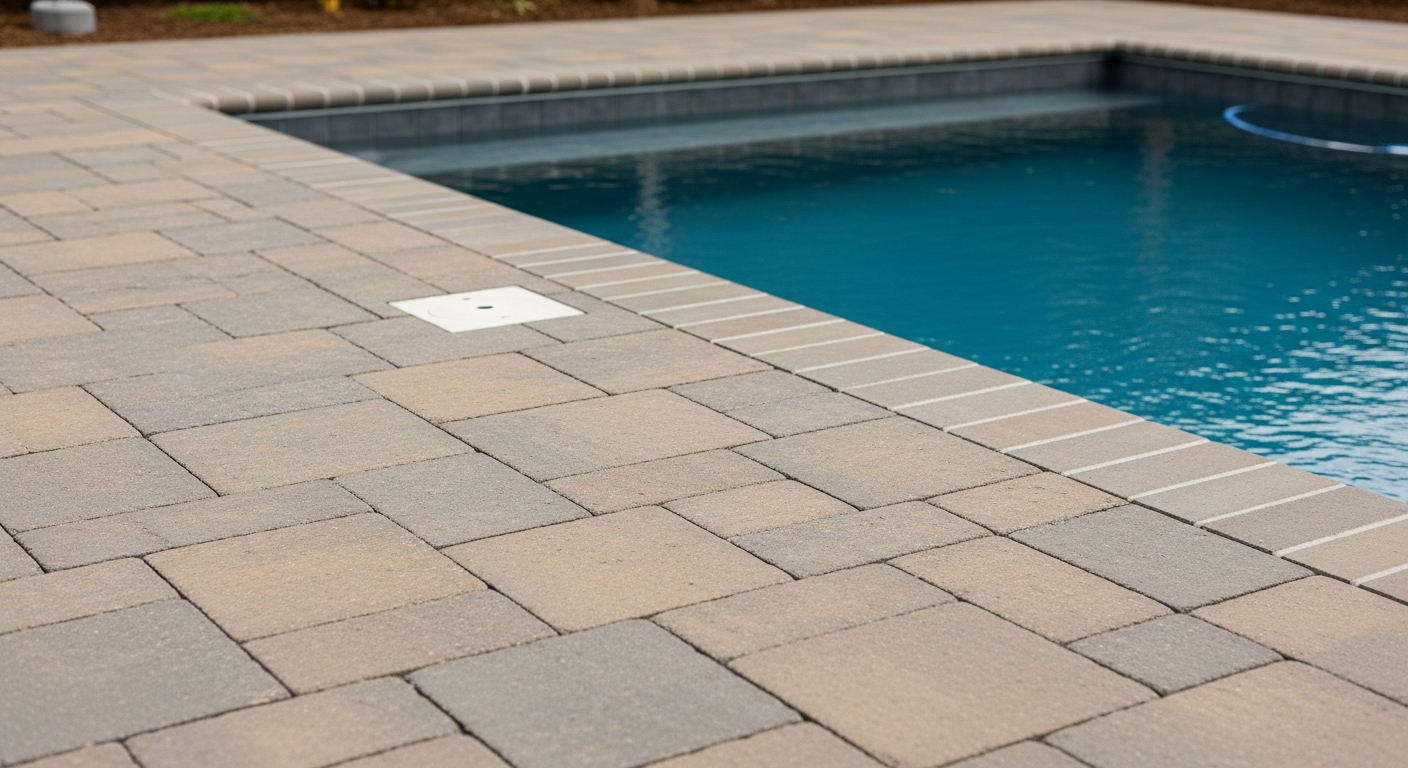
The joint between the pavers and the pool coping is a critical failure point that requires precise installation. The new paver field must be set slightly below the coping to create positive drainage away from the pool, and the gap must be filled with a flexible, high-grade polymeric sand, not rigid mortar. Mortaring this joint is a major error; as the patio and pool shell expand and contract at different rates, a rigid joint will crack, allowing water to penetrate and erode the base directly behind the pool wall. This can compromise the bond beam's integrity over time.
My paver patio gets extremely hot in the sun. Are there better options?
Yes, paver color and material density directly determine how hot they get. Dark-colored, dense concrete pavers absorb and retain significant heat, becoming dangerously hot. For a cooler surface, choose light-colored options like silver travertine or pavers with a high Solar Reflectance Index (SRI) rating. The overlooked factor is the sand in the joints; dark polymeric sand can become a heat sink, radiating heat upwards. Using a lighter-colored sand can make a noticeable difference. While no paver is truly cool in direct sun, selecting a high-SRI material can reduce surface temperatures by a significant margin, making the deck usable on hot days.