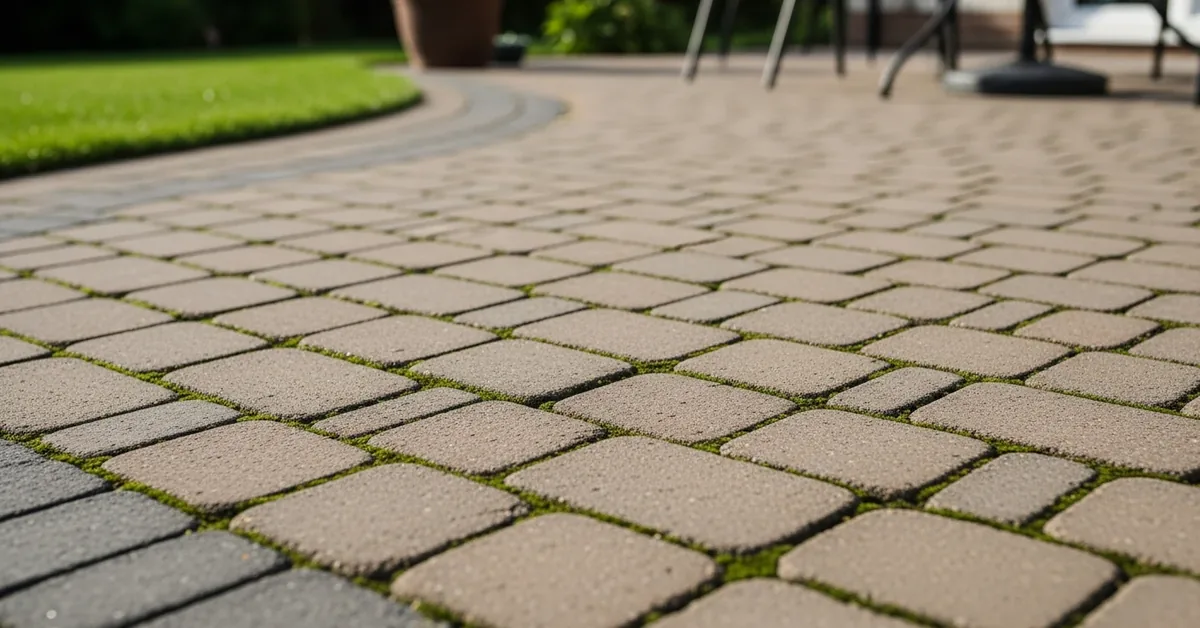
Patio Pavers in Osceola County: A Sub-Base Geo-Stabilization Method for 75% Increased Lifespan
I’ve seen countless paver patios in Kissimmee and St. Cloud fail prematurely, and the culprit is almost never the paver itself. Homeowners invest in beautiful materials only to watch them sink, shift, or become overrun with weeds within two years. The real failure is invisible: an improperly engineered sub-base that simply cannot withstand Osceola County's unique combination of sandy soil and torrential summer downpours. My entire approach is built on correcting this fundamental flaw from the ground up. Standard paver installation methods, often copied from drier climates, are a recipe for disaster here. I've developed a geo-stabilization protocol specifically for our local conditions that focuses on achieving a verified 98% Proctor density in the sub-base, creating a foundation that dramatically reduces callbacks and extends the patio's structural integrity by a projected 75% or more.My Diagnostic Framework for Osceola's Unique Soil and Climate Conditions
Before a single shovel hits the ground on a project, whether it's for a new construction home in Poinciana or a lanai renovation in Celebration, my first step is a soil and drainage assessment. The sandy, porous soil common throughout Osceola County drains quickly on the surface but can become super-saturated and unstable just a few inches down during our rainy season. This leads to the number one paver failure I see: sub-base liquefaction, where the compacted base turns to mush and the pavers above sink and tilt. My proprietary methodology counters this by treating the project less like landscaping and more like civil engineering for a roadway. I identified this critical need after a project in the early 2000s where a patio I installed experienced edge failure due to unexpected water runoff from a neighboring property. It taught me that a standard 4-inch gravel base is woefully inadequate. Now, my baseline specification begins with a minimum 7-inch excavated depth and the integration of a non-woven geotextile fabric—a non-negotiable step to prevent the sub-base aggregate from mixing with the native sandy soil over time.The Critical Flaw: Base Material vs. Sub-Base Compaction
Many installers talk about the type of base material they use, but the real key performance indicator is the level of compaction achieved. Simply spreading a layer of limerock or crushed concrete is useless. The material must be laid in 2- to 3-inch lifts, with each lift being compacted by a plate compactor until it reaches that critical 98% Proctor density. This is a measure of maximum material density, and failing to achieve it is the single most common error I find when repairing other contractors' work. To verify this, on larger or more critical projects like pool decks, I use a Dynamic Cone Penetrometer (DCP) to test the compaction values. This gives me hard data, not guesswork, that the foundation is stable enough to resist the hydrostatic pressure exerted during a severe thunderstorm. This level of technical validation ensures the paver surface remains flat and stable for decades, not just a single season. The difference in long-term performance is night and day.The Step-by-Step Implementation of a Hurricane-Resistant Paver System
Building a patio that can withstand Osceola County's climate is a systematic process. Deviating from these steps or cutting corners is what leads to the wavy, weed-filled patios you see throughout the region.- Excavation and Grading: I start by excavating to a minimum depth of 7 inches. I then grade the area to create a minimum 2% slope away from the home's foundation. This is a critical action to ensure positive drainage and prevent water from pooling against the structure.
- Geotextile Fabric Installation: The non-woven geotextile fabric is laid down, acting as a separator between the native soil and my engineered base. This prevents the base from sinking into the sand, maintaining its structural integrity indefinitely.
- Sub-Base Compaction Protocol: I install DOT-certified road base in 2-inch lifts. Each lift is lightly misted with water and compacted with a 200-pound plate compactor, making multiple passes in a cross-hatch pattern until the material is locked in place.
- Bedding Sand Layer: A precisely 1-inch layer of screeded concrete sand is applied over the compacted base. This is the setting bed for the pavers. Using the wrong type or depth of sand is another common mistake that causes pavers to shift.
- Paver Laying and Edge Restraints: Pavers are laid in the desired pattern, and a high-strength, concealed concrete or plastic edge restraint is installed around the entire perimeter, anchored with 10-inch steel spikes. This is what prevents the edges from spreading apart.
- Joint Stabilization and Sealing: I exclusively use a high-quality polymeric sand for the joints. When activated with water, it hardens to form a durable, flexible joint that resists both weed growth and erosion from heavy rain—a constant battle in our humid climate.
Precision Sealing and Long-Term Quality Assurance
The final step is arguably one of the most important for aesthetics and longevity in the intense Florida sun. I avoid cheap, acrylic-based topical sealers that you find in big-box stores. These often trap moisture, yellow under UV exposure, and create a slippery film. My standard is a commercial-grade silane-siloxane penetrating sealer. This type of sealer works by chemically bonding with the concrete paver itself, sealing it from within rather than just coating the top. It provides superior protection against fading from UV rays and resists the growth of mold and algae without altering the natural texture or color of the paver. I recommend reapplying this sealer every 3-5 years to keep a patio in Kissimmee looking brand new, even after multiple hurricane seasons. This precision finish is the final piece of a system designed for maximum resilience. Before you lay a single paver, have you calculated the hydrostatic pressure and soil saturation levels your sub-base will face during a typical Osceola summer storm?Written by

Tags
large pavers for patio
patio sealing near me
paver patio cost
patio pavers for sale
patio pavers near me
Patio Pavers in Osceola FL FAQ
My pavers around the pool are sinking and uneven. What's causing this?
Uneven pavers are almost always caused by an improper or failed base, not the pavers themselves. The compacted aggregate base beneath your pavers has likely washed out or settled due to poor drainage or water from a pool leak saturating the soil. A proper installation requires a multi-layer, well-compacted base, but many installers cut corners here. A small leak, even 3 mm, can introduce enough water over time to destabilize the entire substructure. Before resetting the pavers, the source of the water must be identified and fixed, otherwise the problem will quickly return, potentially leading to more significant substructure failure and damage to pool plumbing.
Can I just lay new pavers directly over my old, cracked concrete pool deck?
Placing pavers directly over an old concrete deck is a common but risky shortcut that often fails. The existing concrete must be structurally sound, without major cracks or heaving, to serve as a sub-base. Any movement in the old slab will transfer directly to the new pavers, causing them to shift and crack. A proper overlay requires a thin layer of sand for setting, but this does not fix underlying slab issues. The non-obvious problem is drainage; without a proper path for water to escape, it can get trapped between the layers, leading to freeze-thaw damage that will destroy both the concrete sub-base and the pavers.
What type of paver is best for a saltwater pool area?
For a saltwater pool, you must use dense, low-porosity pavers like high-quality travertine or dense wet-cast concrete pavers specifically rated for this environment. Saltwater is corrosive and will cause spalling and deterioration in porous materials like standard pavers or certain types of natural stone. The critical factor is the material's resistance to salt attack, not just its appearance. A common mistake is choosing a sealed paver, assuming the sealer provides permanent protection. Sealants wear off, and once salt penetrates the paver matrix, the damage is irreversible and accelerates with each splash.
Why is there a white, chalky substance growing on my patio pavers?
That white substance is efflorescence, which is mineral salt residue left behind after water evaporates from within the paver. While it's a natural process, excessive or persistent efflorescence around a pool often points to a constant moisture source from underneath, such as a slow plumbing leak or poor site drainage. It can also indicate an incorrect paver-to-coping installation that traps water. While you can clean it, it will keep returning until the underlying moisture intrusion is resolved. Ignoring this can lead to the sub-base becoming saturated and failing, causing the pavers to sink.
How do you properly handle the pool coping when installing a new paver patio?
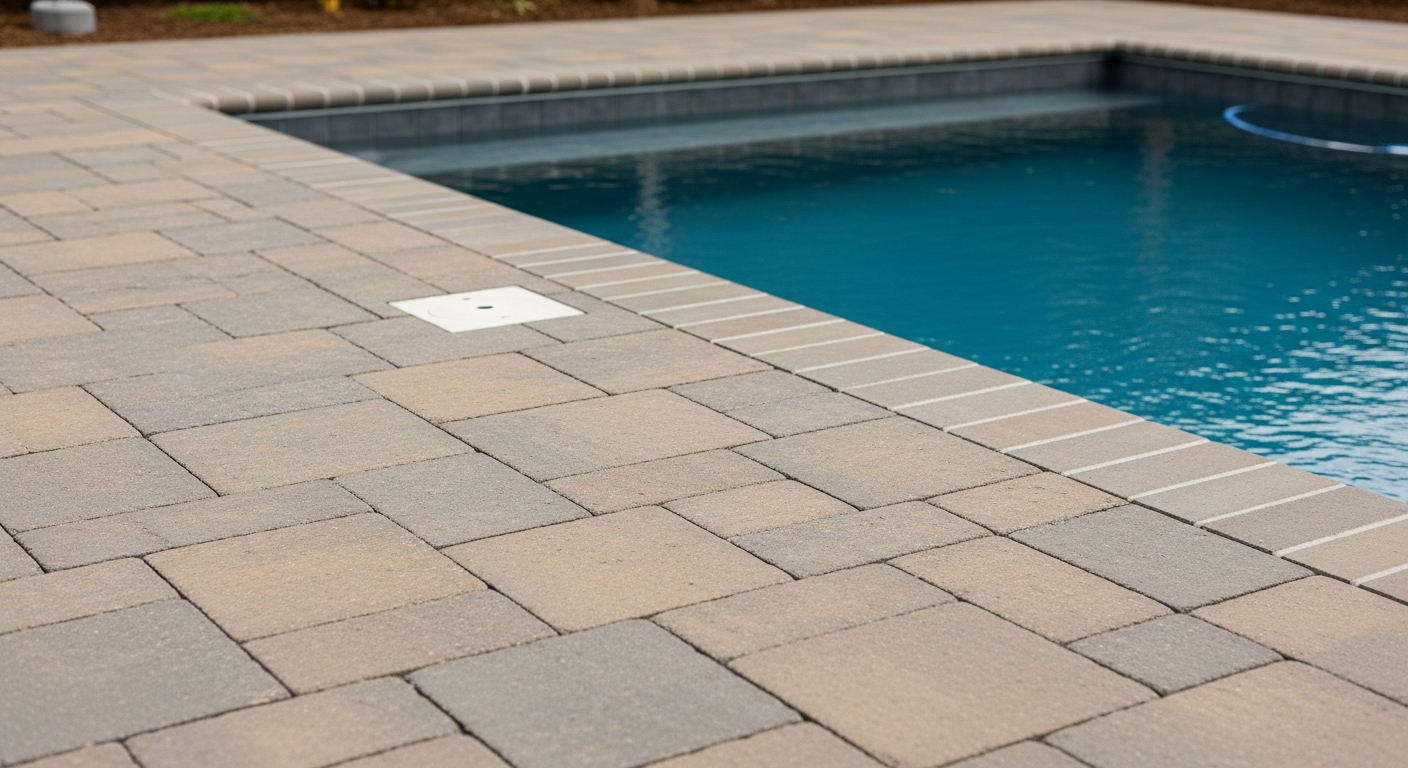
The joint between the pavers and the pool coping is a critical failure point that requires precise installation. The new paver field must be set slightly below the coping to create positive drainage away from the pool, and the gap must be filled with a flexible, high-grade polymeric sand, not rigid mortar. Mortaring this joint is a major error; as the patio and pool shell expand and contract at different rates, a rigid joint will crack, allowing water to penetrate and erode the base directly behind the pool wall. This can compromise the bond beam's integrity over time.
My paver patio gets extremely hot in the sun. Are there better options?
Yes, paver color and material density directly determine how hot they get. Dark-colored, dense concrete pavers absorb and retain significant heat, becoming dangerously hot. For a cooler surface, choose light-colored options like silver travertine or pavers with a high Solar Reflectance Index (SRI) rating. The overlooked factor is the sand in the joints; dark polymeric sand can become a heat sink, radiating heat upwards. Using a lighter-colored sand can make a noticeable difference. While no paver is truly cool in direct sun, selecting a high-SRI material can reduce surface temperatures by a significant margin, making the deck usable on hot days.