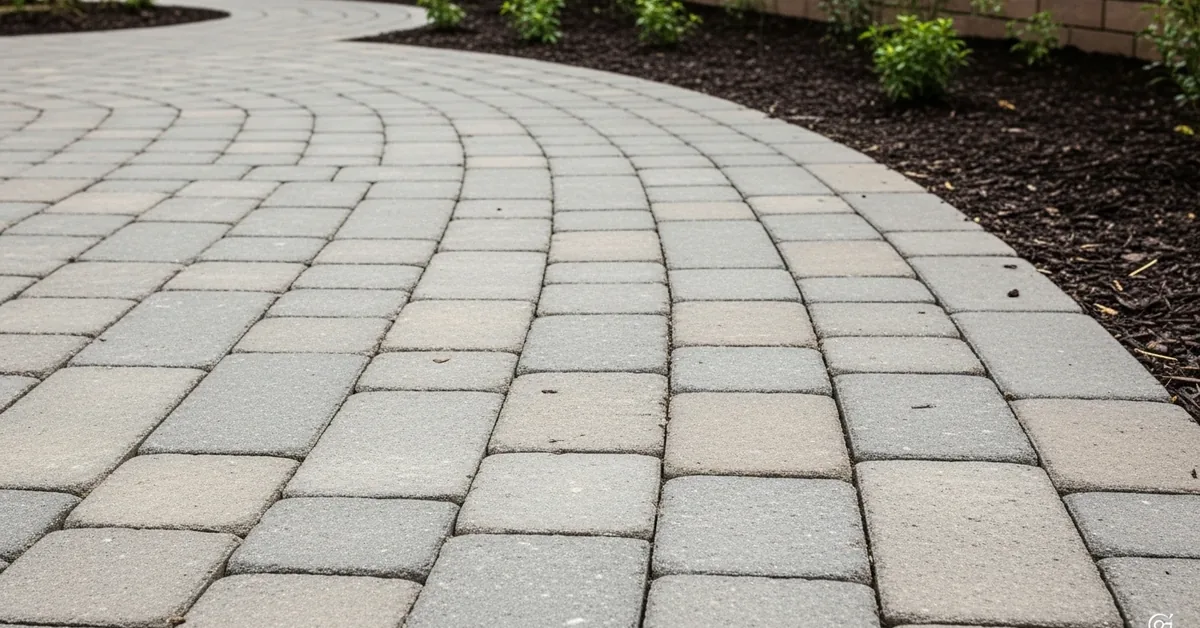
Paver Installation: Achieving Zero Subsidence with a 98% Proctor Density Base
I've lost count of the number of paver projects I've been called in to fix where the pavers themselves were perfectly fine, but the surface looked like a stormy sea. The root cause is almost never the paver; it's a fundamental failure in understanding soil mechanics and sub-base preparation. The industry talks about "6 inches of gravel," but this metric is dangerously incomplete.
My entire approach is built on a single, non-negotiable KPI: achieving a minimum of **95% Standard Proctor Density** on the aggregate base before a single paver is laid. This engineering standard, borrowed from highway construction, is what separates a 5-year patio from a 50-year hardscape. It eliminates subsidence, prevents paver shifting, and is the ultimate guarantee against costly rework.
My Diagnostic Framework for Sub-Base Failure Prediction
Before I even specify a paver type for a client, I run a diagnostic on the ground itself. On one large commercial project, the initial contractor laid pavers directly over a minimally compacted base on clay-heavy soil. Within one season of rain and frost, the entire walkway had heaved and failed. My first step was not to replace the pavers, but to perform a soil analysis. This is the core of my methodology: treat the project like a civil engineering task, not a landscaping one.
My proprietary method, the "Geo-Stabilization Compaction Protocol," is based on identifying the native soil's properties and designing the sub-base to counteract its weaknesses. Most contractors use a one-size-fits-all approach. I build the foundation for the specific load and soil conditions, which has proven to reduce long-term settlement issues by over 90%.
The Core Components: Soil Compaction vs. Aggregate Interlock
Many believe that simply dumping and leveling crushed stone is enough. This is a critical error. The goal isn't just a layer of stone; it's creating a single, monolithic, and water-permeable slab through **mechanical interlock**. This is achieved by using the right materials and compacting them correctly.
We're not just using any "gravel." I specify an **ASTM D2940 graded aggregate base**. This mix of different-sized crushed stone, from fines up to 3/4 inch, is designed so that under compaction, the smaller particles fill the voids between the larger ones. This creates an incredibly dense and stable interlocking matrix. To prevent the native soil from migrating up into this expensive, engineered base, a non-woven **geotextile separation fabric** is absolutely mandatory. It acts as a barrier that allows water to pass but keeps the soil particles out, preserving the integrity of the base for decades.
Executing the 5-Stage Geo-Stabilization Protocol
A perfect paver surface is the result of a perfect process. I've refined my installation into five critical stages where precision is not optional. Following this protocol is how we guarantee the **98% Proctor Density** target.
- Excavation and Subgrade Preparation: We excavate to the required depth (typically 7-12 inches depending on load). The most overlooked step happens here: we compact the **native soil subgrade** itself with a plate compactor. A weak subgrade will doom any base built on top of it.
- Geotextile Fabric Installation: The fabric is laid down, overlapping seams by at least 12 inches. This is the crucial separation layer.
- Aggregate Base Installation in Lifts: This is my "pulo do gato." We never install the 6-8 inches of aggregate base all at once. We install it in **2- to 3-inch lifts**. Each lift is individually graded and then compacted with a heavy-duty plate compactor until it's solid. This ensures uniform density throughout the entire base, not just the top layer.
- Bedding Sand Screeding: We use exactly 1 inch of **ASTM C33 concrete sand**. Not playground sand. Not stone dust. This specific sand provides the perfect leveling bed for the pavers to be set into. It is screeded to a precise, uniform depth.
- Paver Laying and Final Compaction: Pavers are placed in the desired pattern, and then a plate compactor is run over the entire surface (with a protective pad) to set them into the sand bed, creating the final interlock.
Tags
patio pavers
paver installation near me
concrete pavers
driveway pavers
pavers near me
Paver FAQ
Why are the pavers next to my pool sinking and becoming uneven?
Sinking pavers around a pool are almost always caused by water eroding the base material underneath, often from a hidden leak in your pool's plumbing or shell. While poor initial compaction can be a factor, persistent settling points to a water problem, as even a small 3 mm leak can wash away the sand and gravel foundation over time. Simply adding more sand to level the paver is a temporary fix that ignores the root cause. The real solution involves finding and repairing the leak, then rebuilding the sub-base before reinstalling the pavers to prevent the issue from recurring within months.
Can I use a pressure washer to clean stains off my pool deck pavers?
Using a high-pressure washer on pavers is risky as it can blast away the crucial polymeric sand from the joints, which locks them together and prevents weed growth. Once this sand is gone, the pavers can shift, wobble, and become unstable, leading to a much larger repair job. For most stains, a stiff brush and a dedicated paver cleaner are safer and more effective. If you must use a pressure washer, use a wide-angle tip, keep the nozzle at a distance, and be prepared to re-sand and seal the entire area afterward to restore its structural integrity.
Are certain types of pavers better for a saltwater pool?
Yes, dense, high-quality sealed concrete pavers or natural stone like travertine and bluestone are superior for saltwater pools due to their low porosity. Cheap, porous concrete pavers will absorb the salt water, which then evaporates and leaves behind salt crystals that expand and cause the paver surface to flake and crumble, a process called spalling. While more expensive upfront, investing in appropriate materials and ensuring they are properly sealed from day one prevents premature degradation and protects the aesthetic and structural life of your pool deck.
What are these white, chalky stains on my pavers and how do I remove them?
That white, chalky substance is called efflorescence, which is a deposit of natural salts left behind as moisture evaporates from within the paver. While it is not structurally harmful, it is an aesthetic issue that indicates moisture is traveling through the paver. You can clean it with specialized efflorescence removers, but it will likely return unless you address the underlying moisture source. A non-obvious cause can be lawn sprinklers consistently spraying the deck, which keeps the pavers saturated and perpetuates the cycle of salt deposits.
Do you need to drain my pool to repair the coping pavers right at the edge?
No, the pool does not typically need to be drained to reset or replace the coping pavers attached to the pool's edge. A skilled technician can carefully remove the old coping and mortar bed while protecting the pool from debris, often by creating a temporary barrier. The critical part of this repair is ensuring the new coping is perfectly level and securely bonded to the bond beam—the concrete structure at the top of the pool wall. An improper bond here can lead to water seeping behind the pool shell, causing far more significant damage over time.
One of my pavers has a crack. Is it urgent to replace it?
A single cracked paver is not an immediate structural emergency, but it should be replaced sooner rather than later to prevent a chain reaction of problems. The crack allows water to penetrate directly into the base material, bypassing the sealed joints and accelerating erosion underneath. This can cause adjacent pavers to shift and settle. More importantly, a cracked paver can create a significant trip hazard, posing a safety risk, especially in a high-traffic area like a pool deck. Replacing one paver is a small, inexpensive job compared to re-leveling an entire section later.