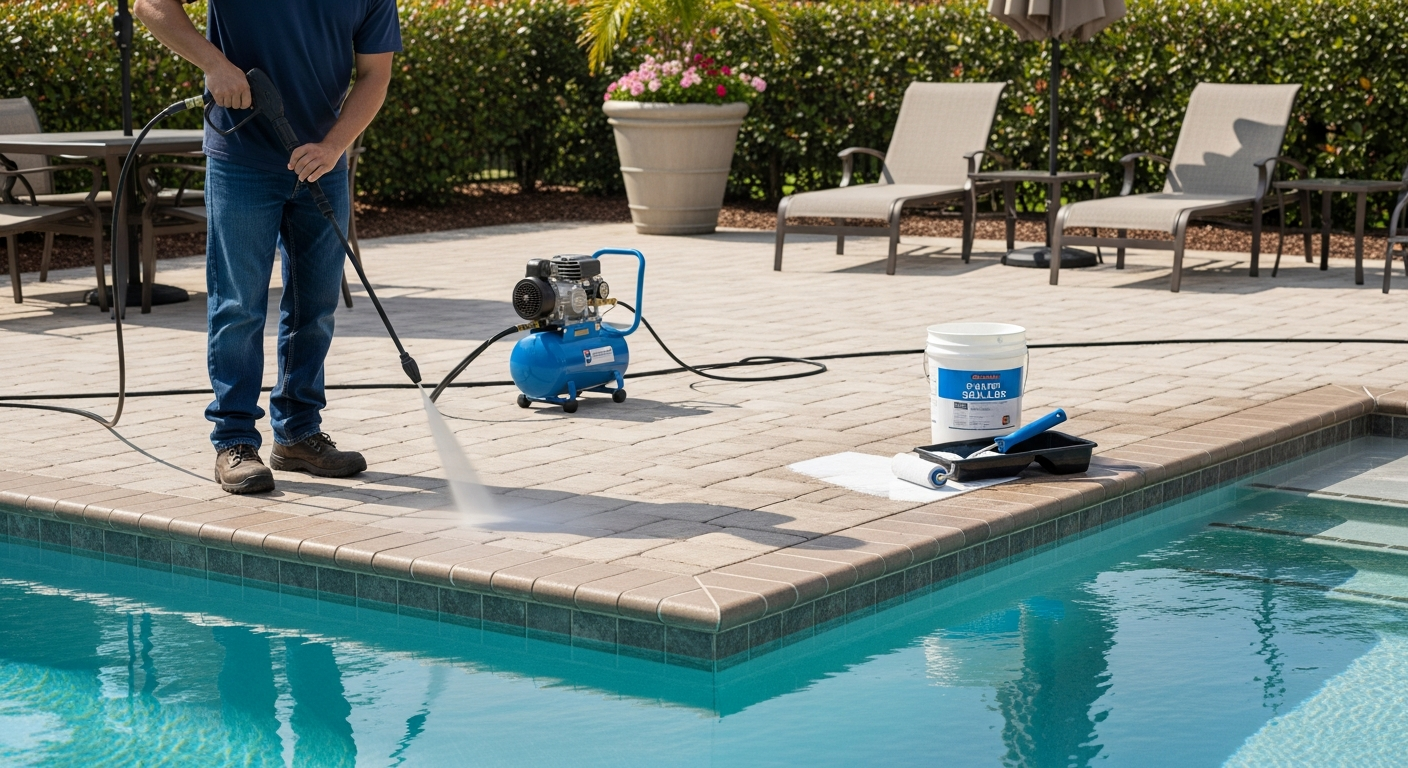
Paver Pressure Washing And Sealing in Pasco County: My Protocol for a 300% Longer Sealer Lifespan
After years of restoring paver driveways and pool decks across Pasco County, from the expansive lanais in Trinity to the newer developments in Wesley Chapel, I’ve pinpointed the single biggest point of failure: it’s almost never the sealer itself. The real problem is a fundamental misunderstanding of substrate preparation, especially given our relentless Florida humidity and intense UV exposure. A botched job doesn't just look bad; it traps moisture, accelerates paver degradation, and often requires a costly chemical stripping process down the line. My entire approach is built on a principle I call Substrate Integrity First. This means I spend about 70% of my project time on preparation and only 30% on the actual sealing. I've seen countless projects in Land O' Lakes where a thick, milky-white film appears on pavers weeks after sealing. This isn't a bad sealer; it's a classic case of sealer blushing, caused by applying it over a damp or contaminated surface. My methodology prevents this by ensuring the pavers are not just clean, but chemically balanced and verifiably dry before a single drop of sealer is applied.The Substrate Saturation & Contaminant Analysis
Before any equipment is turned on, my first step is a diagnostic walk-through. On a typical paver driveway in New Port Richey, I’m not just looking for dirt. I'm hunting for the specific culprits that cause sealer failure in our climate. I’m looking for the tell-tale signs of efflorescence—a white, chalky powder pushed out of the paver by moisture—which acts as a bond-breaker. I’m also identifying organic growth, like the stubborn black mold that thrives in the shaded areas and porous paver joints, and tannin stains from fallen oak leaves. Ignoring these is the most common mistake I see. Applying sealer over them is like painting over rust. My analysis also involves assessing any old, failing sealer. Is it delaminating in sheets? Is it yellowed and brittle from sun exposure? This dictates the level of chemical intervention required. I once took on a project where the previous contractor had used a cheap, non-breathable sealer that completely clouded over. The only fix was a full stripping with specialized solvents, a cost the homeowner could have avoided entirely with proper initial application.Beyond PSI: My 3-Phase Paver Surface Preparation
Pressure washing is a blunt instrument. My method is more surgical. It’s a multi-step process designed to purify the paver surface at a microscopic level.- Phase 1: Targeted Chemical Treatment. I don't just blast away at stains. I apply a proprietary blend of buffered acids to dissolve efflorescence and mineral deposits. For organic growth, a carefully measured application of sodium hypochlorite is necessary to kill the mold spores at their root, not just wash them off the surface. A simple pressure wash only spreads these spores around.
- Phase 2: Calibrated Pressure & Rinsing. I rarely exceed 2500 PSI and use a fan-tip nozzle, never a zero-degree tip that can etch and permanently damage the paver surface. The goal is to flush out the contaminants that the chemicals have broken down. This is followed by an extensive, low-pressure rinse to neutralize the surface pH.
- Phase 3: The Critical Moisture Meter Reading. This is my non-negotiable final gate before sealing. I will not seal a paver surface until my digital moisture meter gives me a reading of less than 5% moisture content deep within the paver. In Pasco County's humid summers, this can sometimes mean waiting an extra 24-48 hours after cleaning, but it is the single most effective way to prevent sealer failure.
The Polymeric Sand & Sealer Application Sequence
With a truly prepared surface, the application stage is about precision and material science. It's not just about rolling on a coat of sealer; it's about rebuilding the paver system's integrity from the joints up.My Lock-In Application Process
- Polymeric Sand Installation: The joints are the weakest point. I use a high-grade polymeric sand and sweep it into the cleaned-out joints. The key I've learned is to use a plate compactor to vibrate the sand deep into the joints, ensuring a dense, stable lock. Any residual sand dust on the paver surface must be meticulously blown off with a leaf blower; this "poly-haze" is a common amateur mistake.
- Sealer Selection: For Pasco County, a solvent-based, UV-resistant acrylic sealer is often my recommendation for its durability and color enhancement. However, for areas near saltwater pools or with high moisture, a breathable water-based silane/siloxane sealer might be the correct technical choice to avoid trapping efflorescence. The material must match the environment.
- The Saturation Flood Coat: My first coat of sealer is a heavy "flood coat" applied with a specialized sprayer. The objective here is not surface shine but deep penetration. This coat soaks into the porous paver and, more importantly, into the top layer of the polymeric sand, hardening it into a durable, weed- and insect-resistant mortar.
- The Final Top Coat: After the flood coat has penetrated, a second, lighter top coat is applied. This coat is for aesthetics and surface protection, providing the desired sheen (from natural to wet-look) and creating the hydrophobic barrier that repels water and oil.
Curing Protocols and Quality Control in Florida's Humidity
The job isn't done when the last coat is applied. The curing process is especially challenging here. An unexpected afternoon thunderstorm, a Pasco County staple, can ruin a freshly sealed surface. I insist on a 48-hour vehicle traffic cure time and a 24-hour foot traffic cure time, no exceptions. My final quality check involves a "water bead test" 72 hours post-application. I spray a small amount of water on the surface; if it beads up instantly like on a freshly waxed car, I know I've achieved a perfect, non-porous seal. If it soaks in, something is wrong. Given the unique environmental stresses on pavers here, are you simply cleaning your surfaces, or are you implementing a system designed to structurally enhance and protect them for years to come?Written by

Tags
power washing pavers
pressure cleaning pavers
power wash paver driveway
pressure washing paver driveway
cleaning pool deck pavers