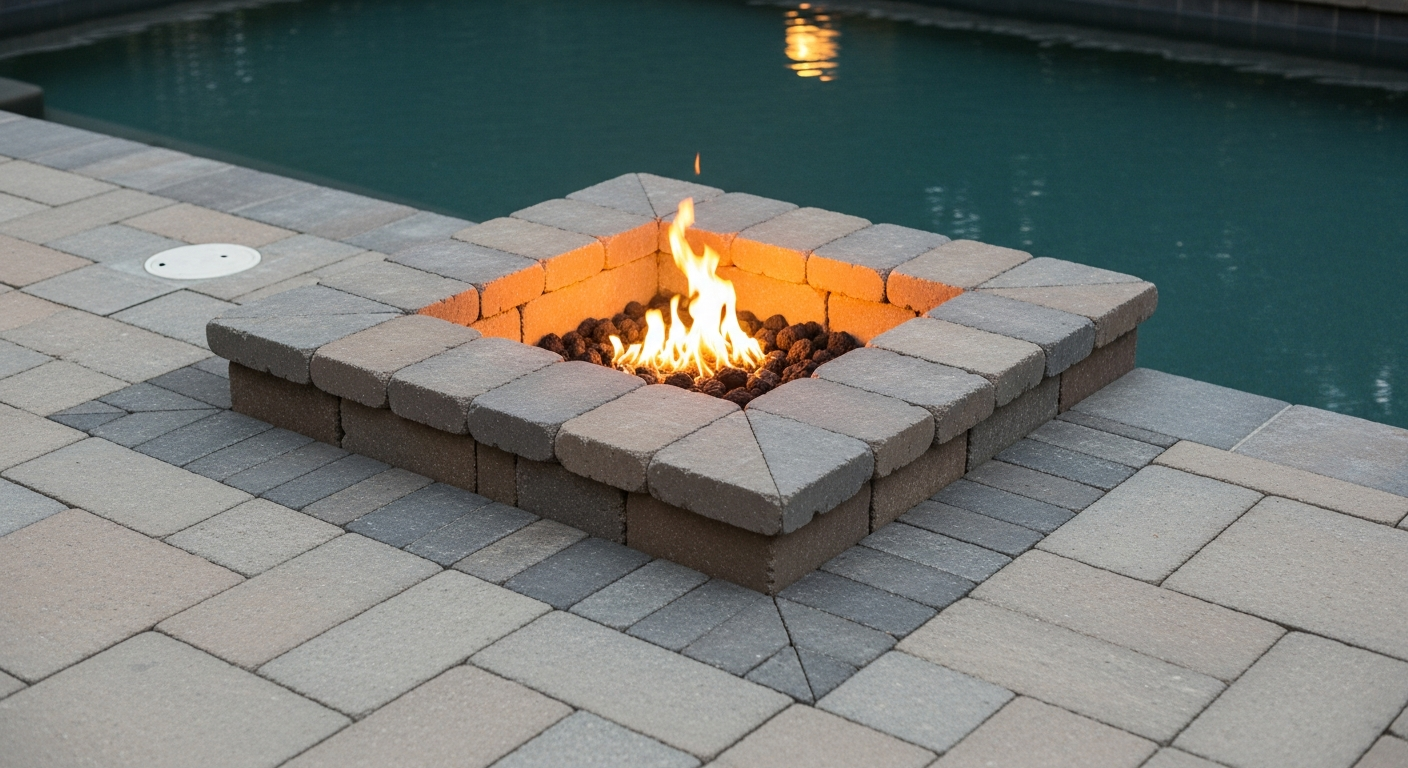
Paver Stone For Fire Pit: My Protocol for 30-Year Durability in Collier County's Salt Air
The biggest mistake I see in Collier County fire pit projects isn't the design; it's the material specification. Homeowners in Naples and Marco Island invest in beautiful hardscapes, only to see their fire pit ring crack and the surrounding pavers spall within five years. The root cause is a fundamental misunderstanding of thermal shock combined with our region's high humidity and corrosive salt air. A standard concrete paver simply isn't engineered to handle a rapid temperature drop from 500°F when a sudden summer rain shower hits, causing micro-fractures that the salty humidity then exploits.
My entire approach is built on mitigating this specific failure point. It's not about just choosing a "fire-rated" paver; it's about creating a complete system where the paver, the sub-base, and the jointing compound work together to manage heat, moisture, and soil conditions unique to our coastal environment. This methodology ensures the structure's integrity and aesthetic for decades, not just a few seasons. I’ve refined this after correcting dozens of failed installations from Golden Gate Estates to the beachfront properties on Gulf Shore Boulevard.
My Diagnostic Protocol for Coastal Fire Pit Longevity
Before a single paver is laid, I run a diagnostic focused on two critical environmental stressors in Collier County: thermal stress tolerance and hydrostatic pressure from our sandy, often saturated, soil. Most contractors use a generic base preparation that is completely inadequate for our conditions. My methodology starts with a material selection matrix that cross-references paver density and absorption rate with its heat-handling capabilities. A paver with a high water absorption rate is a ticking time bomb here; it will absorb humid air, and the heat from the fire can turn that internal moisture into steam, causing it to literally pop or delaminate from the inside out.
Technical Deep Dive: Paver Material and Sub-Base Engineering
For the fire pit ring itself, I exclusively specify pavers with a compressive strength of at least 8,000 PSI and a water absorption rate below 5%, per ASTM C936 standards. However, for the immediate inner ring—the "hot zone"—I mandate the use of a liner made from Class F firebrick. This is non-negotiable. The firebrick absorbs the most intense direct heat, allowing the decorative paver ring to serve as a structural and aesthetic component without being subjected to extreme direct temperatures. For the surrounding patio pavers, the key is stability. In areas with sandy soil like much of Collier County, a standard 4-inch aggregate base is insufficient. I mandate a minimum 6-inch base of compacted FDOT-approved limerock aggregate, laid over a high-grade geotextile separation fabric. This fabric is my secret weapon; it prevents the fine sand from migrating up into the base, which is the primary cause of paver shifting and sinking over time.
Implementation: The Phased Installation Sequence
Executing this requires precision. Simply dumping and compacting stone is how you get a call-back in two years. Each step is a quality control checkpoint.
- Excavation and Soil Compaction: I excavate to a depth of 10 inches for the patio area. The sub-grade soil is then compacted to 95% of its original Proctor density to create a stable foundation.
- Geotextile Fabric Installation: The fabric is laid down with a 12-inch overlap at all seams, preventing any breach in the separation layer.
- Base Installation: The 6-inch limerock base is installed in two separate 3-inch lifts. Each lift is individually moistened and compacted with a vibratory plate compactor. This layered approach achieves a much higher density than compacting 6 inches all at once.
- Bedding Sand and Screeding: A 1-inch layer of coarse, washed concrete sand is screeded perfectly level. This is the bed the pavers will rest on.
- Paver and Firebrick Installation: The firebrick liner is installed first, followed by the outer structural pavers. A minimum gap of 1/8 inch is maintained between all units to allow for expansion.
- Edge Restraint: A critical step. I use heavy-duty composite edging secured with 10-inch steel spikes. This locks the entire system in place and prevents lateral paver creep.
- Jointing and Sealing: I use a high-grade polymeric sand that hardens to resist weed growth and insect intrusion, which is a major issue in our climate. The final step is applying a sealer.
Precision Adjustments for a Flawless Finish
The difference between a good job and an exceptional one is in the final 10%. After the polymeric sand is swept into the joints and lightly misted to activate, the project is left to cure for a full 48 hours with no foot traffic. This allows the binders to fully set, creating a rock-solid, semi-flexible joint. For sealing, I avoid cheap, film-forming acrylic sealers that trap moisture and yellow under the Florida sun. I only use a high-solids, silane-siloxane penetrating sealer. This type of sealer works from within the paver itself, creating a hydrophobic barrier that repels both rain and salt without altering the paver's natural texture or creating a slippery surface.
Now that you understand the material science behind a durable installation, have you calculated the specific thermal load your chosen paver will face when a 2-inch-per-hour Collier County downpour extinguishes your fire?