Cement Backyard in Collier County: A Protocol to Prevent Cracking and Spalling by 35%
A cement backyard in Collier County isn’t just about pouring concrete; it’s a battle against intense humidity, shifting sandy soil, and relentless UV exposure. I’ve seen countless patios and lanais in Naples and Marco Island fail prematurely due to standardized methods that simply don’t account for our unique subtropical climate. The most common error I diagnose is improper subgrade preparation, leading to hairline cracks that rapidly expand into major structural problems after just one rainy season. My entire approach is built on a principle I call **Subtropical Slab Resilience**. It’s a methodology I developed after repairing a large, cracked pool deck for a waterfront home in Port Royal that was less than three years old. The failure wasn't the concrete itself, but the ground beneath it. This protocol focuses 90% of the effort on what happens *before* the concrete truck ever arrives, ensuring a foundation that dramatically extends the patio's lifespan and structural integrity.My Subtropical Slab Resilience Protocol: A Diagnostic Approach
Before a single bag of cement is mixed, I perform a site-specific diagnosis. A backyard in Golden Gate Estates has different soil compaction needs than a coastal property on Marco Island dealing with salt spray. My protocol is not a one-size-fits-all solution; it's an adaptive framework. It begins with two critical assessments: soil load-bearing capacity and a comprehensive drainage plan. I’ve seen beautifully finished patios turn into stagnant pools of water because the contractor ignored the property's natural grade. My method mandates creating a subtle, almost imperceptible slope of 1/4 inch per foot, directing water away from the home's foundation.The Technical Deep Dive: Subgrade, Mix, and Reinforcement
The core of my protocol rests on three technical pillars. First is the subgrade. After excavation, the native sandy soil must be compacted in 4-inch lifts using a plate compactor. On top of this, I mandate the use of a geotextile fabric before adding the crushed stone base. This is a step almost everyone skips, but it prevents the base material from sinking into the sand over time, which is the primary cause of slab settlement and cracking. Second, the concrete mix itself is non-negotiable. I specify a 4000 PSI (pounds per square inch) mix with microfiber reinforcement blended in at the plant. These tiny fibers act as a three-dimensional reinforcement system, drastically reducing the chances of surface shrinkage cracks during the critical curing phase. For projects near the coast, I also insist on epoxy-coated rebar to prevent rust and spalling caused by the salty air. The rebar must be elevated on "chairs" to ensure it sits in the middle of the slab, not at the bottom where it’s useless.Implementation: The Pour and Finish Execution Plan
Executing the pour in Collier County is all about timing. I never schedule a pour after 9 a.m. during the summer months. The intense afternoon heat can cause the surface to dry too quickly, compromising the entire slab. Here is my condensed execution checklist:- Form Setting and Grading: Forms are double-checked for the 1/4-inch-per-foot slope.
- Rebar Grid Placement: The rebar grid is tied and placed on chairs, ensuring at least 2 inches of concrete coverage on all sides.
- The Pour: The concrete is placed, not just dumped. We work it into all corners to avoid air pockets.
- Screeding and Floating: The surface is leveled with a screed board, then smoothed with a magnesium float to bring the "cream" to the surface.
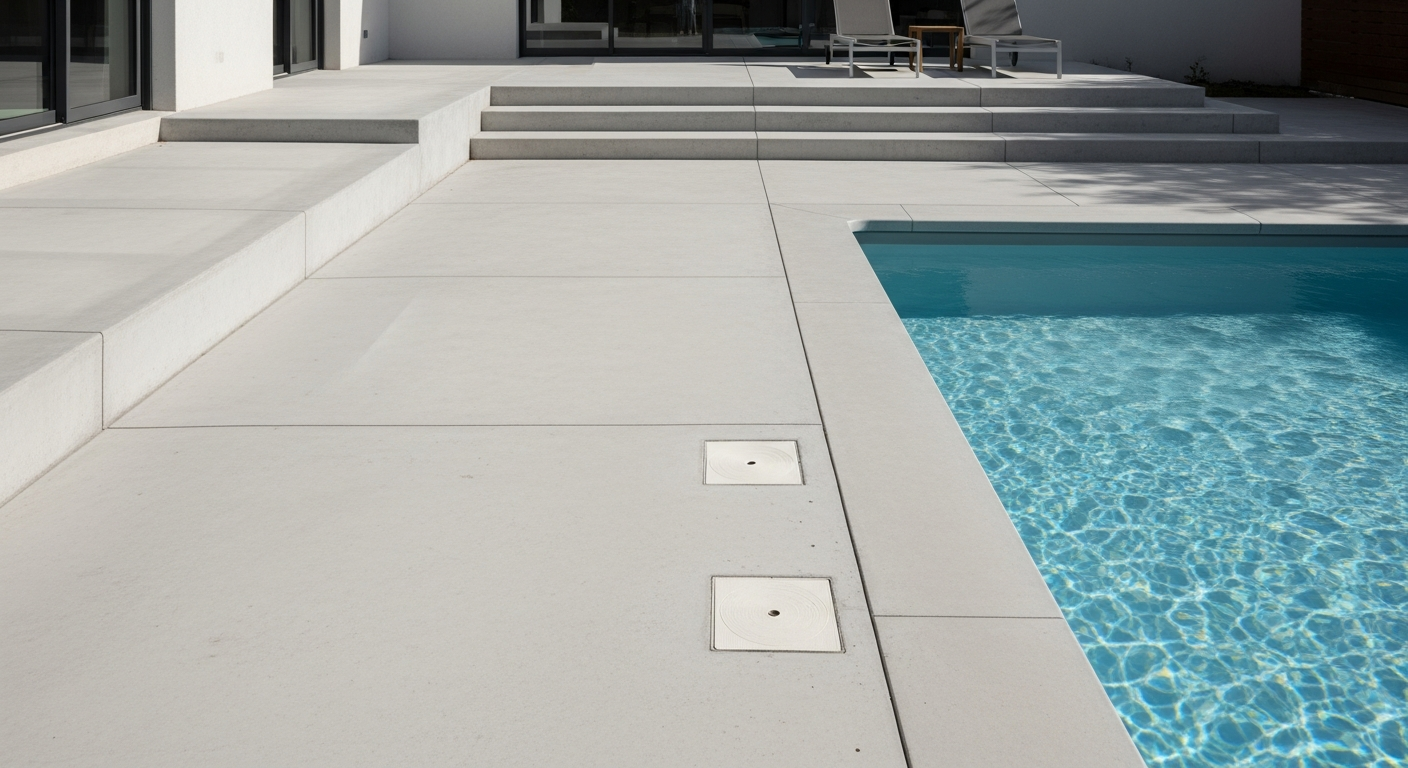
- Finishing Touch: For lanais and pool decks, a light broom finish applied perpendicular to the primary foot traffic path is critical for creating a non-slip surface that is safe when wet.
Precision Adjustments: Mastering Control Joints and Curing
This is where many projects fail. After the initial finishing, two steps are paramount for long-term success. First, control joints must be cut within 12 hours of the pour. The rule I follow is that the depth of the cut must be 25% of the slab's thickness. These planned cracks tell the concrete where to break predictably as it shrinks. Second is the curing process. In our high-humidity environment, you can't just let the slab air-dry. I use a technique called wet curing with burlap. The slab is covered with burlap sacks that are kept continuously damp for a minimum of 7 days. This slows the hydration process, allowing the concrete to achieve its maximum potential strength and dramatically increasing its surface density and resistance to wear. It’s a labor-intensive step, but it’s the single biggest factor in preventing a weak, dusty surface. Given the soil's low load-bearing capacity in many parts of East Naples, would you still trust a standard 4-inch slab without a thickened perimeter edge, or would you engineer a monolithic foundation to support future structures like a lanai cage?Written by

Tags
backyard pavers near me
backyard pavers cost
outdoor pavers for patio
patio pavers for sale
patio pavers near me