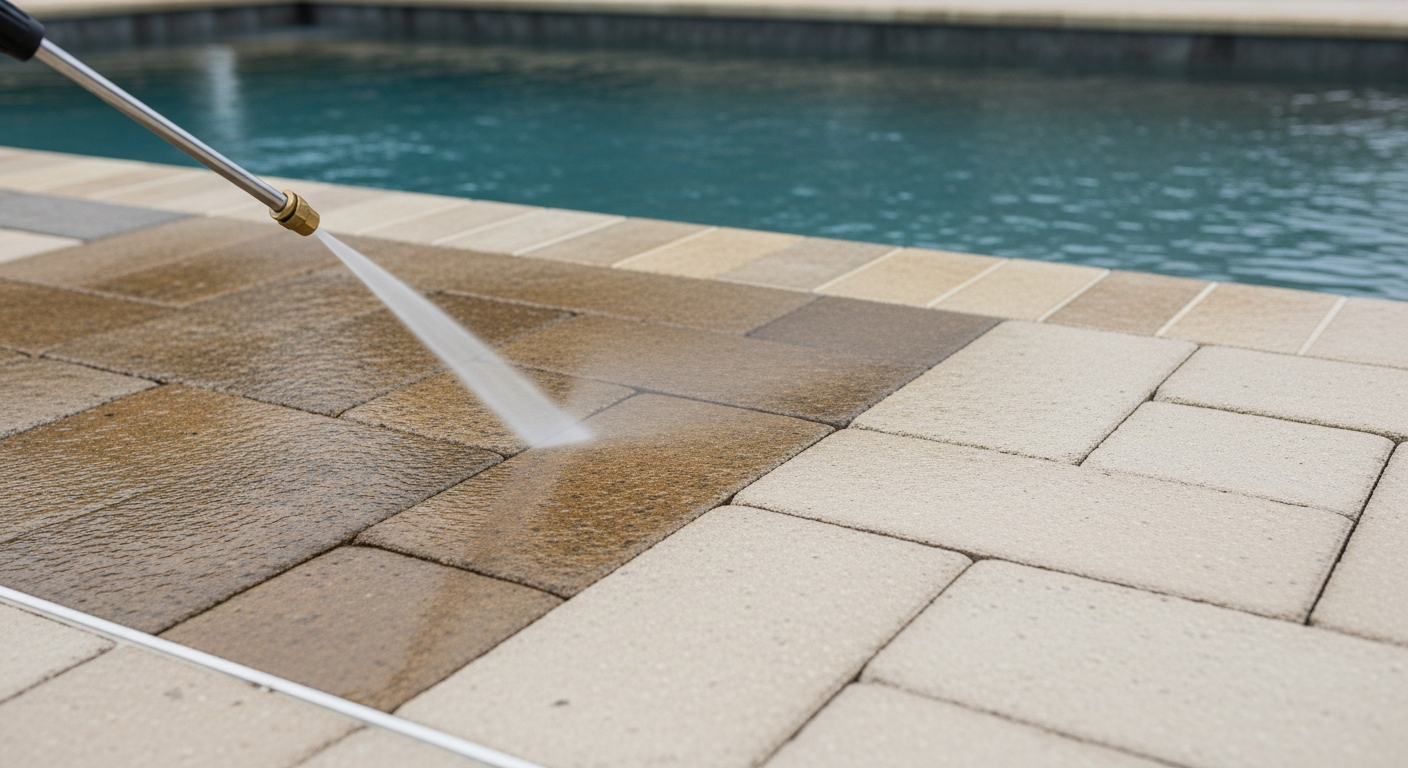
Cleaning Pavers With Pressure Washer: My Protocol for Preventing Sub-Surface Damage and Joint Sand Erosion
As a specialist working across Lee County, I’ve corrected countless paver cleaning jobs gone wrong, from pristine lanais in Cape Coral to sprawling driveways in Lehigh Acres. The most common mistake isn't a lack of effort; it's a fundamental misunderstanding of paver porosity and the destructive force of improperly calibrated pressure. A pressure washer in untrained hands can cause more long-term damage than years of Florida's subtropical climate. My entire approach is built on a single principle: clean the paver surface without compromising its structural integrity or the crucial joint sand that locks it in place. Forget blasting away dirt at 4,000 PSI. My methodology focuses on a low-pressure, high-volume technique combined with a chemical pre-treatment that does the heavy lifting. This prevents etching, preserves color, and stops the dreaded "paver shifting" I see months after a botched DIY job.My Diagnostic Protocol: Decoding Lee County Paver Distress Before You Pull the Trigger
Before I even connect a hose, I perform a diagnostic that dictates the entire project's parameters. I’ve seen homeowners in Bonita Springs use the same technique on their soft travertine pool deck as they would on their dense concrete pavers, leading to irreversible surface spalling. This assessment is non-negotiable. It involves identifying the type of paver, the type of stain (Is it organic mildew from our rainy season, or rust from patio furniture?), and the current condition of the polymeric sand in the joints. My analysis is what separates a professional result from a liability.Calibrating for Local Conditions: Pressure, Nozzles, and Pre-Treatments
Once the paver type is identified, I calibrate my equipment. This is where most DIY attempts fail. Using the wrong nozzle tip—especially the zero-degree (red) tip—is like using a needle to sand a floor; it concentrates all the force in one spot, etching the surface permanently. My technical specifications are precise:- For Soft Travertine/Limestone: I never exceed 1,200 PSI. I use a 40-degree (white) fan tip or, preferably, a surface cleaner attachment to distribute pressure evenly.
- For Concrete/Brick Pavers: I operate between 1,600 and 2,100 PSI. The key is volume (gallons per minute), not just pressure.
- The Pre-Treatment Formula: For the pervasive black mold and algae common in Fort Myers, my go-to is a carefully measured solution of sodium hypochlorite. This isn't just bleach; it’s a buffered solution that kills the organic growth at the root, allowing it to be rinsed away with minimal pressure. For properties near the coast on Sanibel, I also incorporate a salt-neutralizing agent.
The Step-by-Step Implementation of the Surface Saturation Technique
Executing the cleaning process requires methodical precision. Rushing this stage is what leads to inconsistent results and "tiger striping"—those ugly, clean-and-dirty lines that mark an amateur job.- Site Preparation and Saturation: First, I thoroughly saturate the pavers and all surrounding vegetation with plain water. This prevents the cleaning solution from absorbing into dry, porous surfaces and protects your landscaping.
- Application of the Cleaning Solution: Using a downstream injector, I apply my proprietary cleaning solution at a very low pressure. I let it dwell for 10-15 minutes, but I never let it dry under the intense Florida sun. This dwell time is when the solution breaks down the organic matter.
- The Cleaning Pass: This is the most critical phase. I use a surface cleaner attachment for all large, flat areas. This tool guarantees a uniform, streak-free finish. For edges and tight spots, I use the wand with a fan tip, always maintaining a consistent 45-degree angle and a safe distance. This angle is crucial for cleaning the paver without aggressively blasting out the joint sand.
- Thorough Rinsing Protocol: I switch back to a low-pressure, high-volume rinse. The goal is to guide the dirt and solution off the surface, not blast it away. I work from the highest point to the lowest, ensuring no cleaning solution is left to pool.
Post-Wash Quality Control: Preventing Tiger Stripes and Efflorescence Bloom
After the wash, my job is only halfway done. The final steps are what ensure a 25% longer-lasting result. Improper rinsing can draw mineral salts from within the paver to the surface as it dries, causing a white, chalky residue known as efflorescence. My multi-stage rinsing process mitigates this risk almost completely. The most important step, and one almost always skipped by homeowners, is the final one. After allowing the pavers to dry for at least 24-48 hours, I return to apply new polymeric sand to the joints. This sand hardens and locks the pavers together, preventing weed growth and shifting. Finally, applying a quality silicate-based sealer protects the pavers from UV damage and moisture intrusion, which is essential in our demanding Lee County climate. Now that the surface is professionally cleaned and stabilized, have you considered how the specific mineral content in your municipal water source might affect the longevity and color of your paver sealer over the next five years?Written by

Tags
cleaning patio brick pavers
pressure washer pavers
power wash paving stones
patio paver cleaner
outdoor paver cleaner