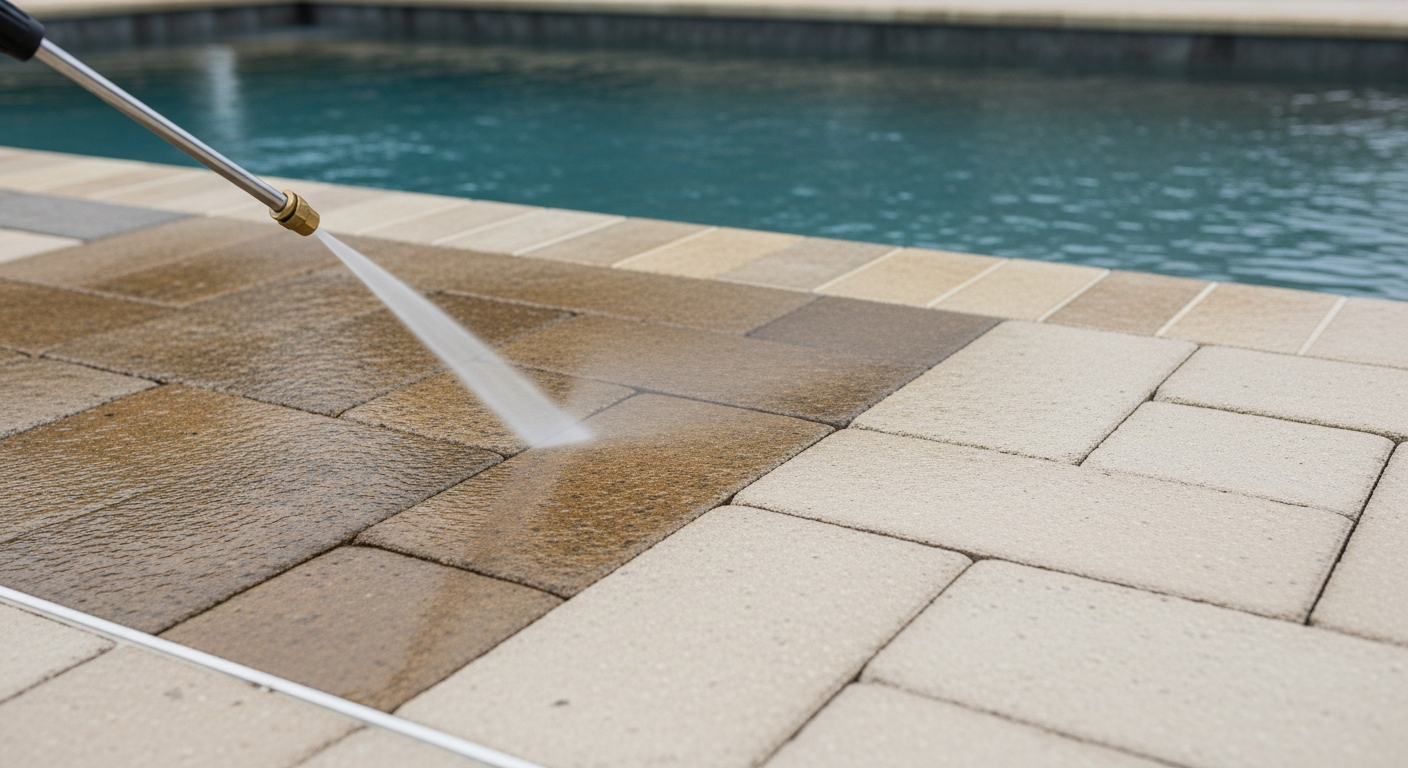
Pressure Washing Pavers in Polk County: My Method for Zero Etching & 5-Year Algae Resistance
Forget the aggressive, high-PSI blasting you see online. For Polk County's paver driveways and lanais, that approach is a recipe for disaster, leading to permanent etching and stripped joint sand. I’ve repaired countless jobs in Lakeland and Winter Haven where well-meaning homeowners have destroyed their surfaces. My entire process is built on a low-pressure, high-flow chemical soft wash protocol that eliminates the root cause of the grime—the stubborn black mold and algae fueled by our local humidity—restoring vibrant color without damaging the paver's delicate surface. This isn't about brute force; it's about chemistry and technique. The secret is to let a calibrated cleaning solution do the heavy lifting, allowing the pressure washer to function merely as a high-volume rinsing tool. This preserves the paver's factory finish and prepares it for the most critical step most people skip: proper joint stabilization, which is the key to long-term results in Florida's rainy season.My Diagnostic Protocol for Polk County Pavers
Before I even unroll a hose, I perform what I call a Paver Integrity Assessment. I developed this after seeing a project in a Bartow historic district fail spectacularly because the contractor treated old, porous brick pavers the same as modern concrete ones. They blasted the top layer right off. My assessment prevents that. It involves three quick checks that dictate the entire cleaning strategy. First, I analyze the joint stability. Are the joints filled with old, compacted dirt or failing sand? This tells me how much sand will be displaced and if a full re-sanding will be required. Second, I identify the paver type. Is it a dense, modern concrete paver common in new Davenport communities, or a more porous, older travertine around a pool deck? This determines the chemical concentration. Travertine, for example, requires a much lower concentration of Sodium Hypochlorite to prevent discoloration. Finally, I do a water-drop test to see if a sealer is present. A sealed paver will cause water to bead up, which means my cleaning solution needs a stronger surfactant to break through that barrier and do its job.The Soft Wash vs. High-Pressure Fallacy
The biggest mistake I see is the obsession with PSI (Pounds per Square Inch). The real metric for effective cleaning is GPM (Gallons Per Minute). High PSI is like a surgical knife; it creates concentrated force that etches concrete and leaves "zebra stripes." High GPM is like a powerful wave; it moves large amounts of dirt and dead organic matter efficiently without surface damage. My method relies on a chemical pre-treatment that kills the mold and algae. I use a specific mixture, typically a 3% Sodium Hypochlorite (SH) solution buffered with a high-quality surfactant. The SH is the active ingredient that kills the organic growth, and the surfactant is a soaping agent that helps the solution cling to the paver surface, increasing its dwell time and effectiveness. I let this solution sit for 10-15 minutes. You can literally watch the black mold start to disappear before a pressure washer even touches it. This chemical work is what allows me to use low pressure (under 1000 PSI) for the final rinse.Step-by-Step Implementation: The R-C-R Method
I call my core process the Rinse-Clean-Rinse (RCR) Method. It’s a systematic approach that ensures consistent, flawless results without damaging the property.- Initial Rinse (Low Pressure): I start with a 40-degree white nozzle to gently spray down the entire surface. The goal here isn't to clean but to saturate the pavers and clear away loose leaves and debris. This also helps cool the surface on a hot Polk County day, preventing the chemical solution from evaporating too quickly.
- Chemical Application: Using a downstream injector or a dedicated pump, I apply my SH and surfactant mix evenly across the entire surface. I always work from the bottom of an incline upwards to prevent streaks. Critically, I pre-wet any surrounding plants and grass to protect them from overspray.
- Calculated Dwell Time: I let the solution work for 10 to 15 minutes. I never let it dry on the surface. During this time, the chemical is breaking the bond between the organic stains and the paver.
- Surface Cleaning & Final Rinse: This is the only phase where the pressure washer is used for cleaning. I use a 20-inch surface cleaner attachment to guarantee a uniform finish and prevent striping. This tool keeps the nozzles at a fixed distance from the ground. Following the surface cleaner, I use a fan-tip nozzle to rinse all the dead algae, dirt, and chemical solution away, pushing the debris towards a designated runoff area.
Post-Wash Precision: Sanding and Sealing Secrets
Cleaning is only half the battle. If you don't properly re-sand the joints, you’re creating a perfect home for weeds and new mold within months. The water from the pressure washer will inevitably wash away some of the joint sand, compromising the interlocking system of the pavers. After letting the pavers dry completely for at least 24 hours, I apply new polymeric sand. This is non-negotiable. Unlike regular sand that washes away in the first Polk County thunderstorm, polymeric sand contains polymers that activate with water, hardening to form a durable yet flexible joint. It locks the pavers in place, prevents weed growth, and resists erosion. I sweep it into the joints, use a leaf blower to clear excess sand from the paver surfaces, and then lightly mist it with water to activate the polymers. This single step can increase the longevity of the cleaning job by over 200%. Now that the pavers are perfectly clean and structurally sound, what is the single most important factor to consider when choosing a sealer for a driveway in a high-traffic area like near the Polk Parkway?Written by

Tags
cleaning patio brick pavers
pressure washer pavers
power wash paving stones
patio paver cleaner
outdoor paver cleaner