Interlocking Concrete Pavers in Collier County: My Sub-Base Protocol for Zero Shifting Under Hurricane-Season Rains
In my years specializing in hardscapes across Collier County, from the waterfront estates in Port Royal to the sprawling lanai projects in Golden Gate, I've seen one catastrophic failure more than any other: paver shifting and sinking. The common diagnosis is poor installation, but the real culprit is a fundamental misunderstanding of our unique subtropical soil and water table. My entire approach is built on a sub-base preparation that anticipates the intense hydrostatic pressure from our summer downpours, a detail that increases the paver system's lifespan by an estimated 50%.
Most contractors follow a standard base depth that works in other climates. Here, that's a recipe for disaster. I abandoned that model after a project in Naples where a brand-new driveway, installed by another company, showed significant undulation after just one rainy season. The problem wasn't the pavers; it was the saturated, unstable base beneath. This led me to develop a climate-specific methodology focused on superior drainage and uncompromising compaction, ensuring the hardscape performs as a single, monolithic slab, not a collection of individual stones.
Diagnosing Paver Failure: My Collier Climate-Lock System
The standard practice often involves a simple 4-inch layer of crushed concrete or limestone. In Collier County's sandy soil, this is insufficient. During a heavy rain, water saturates the soil beneath this base, and as the water table rises, it pushes upward. This pressure liquidizes the bedding sand, causing the pavers to sink and shift. My Collier Climate-Lock System is a direct countermeasure to this force.
It starts with a forensic understanding of the site's drainage. Before I even excavate, I analyze the property's grading and proximity to water bodies, a critical factor on Marco Island. The system I developed isn't just about digging deeper; it's about creating a multi-layered, water-permeable foundation that actively channels water away from the paver installation. The core principle is to create a sub-base that remains stable and locked, even when fully saturated.
The Technical Pillars of Sub-Base Integrity
The success of my system hinges on three non-negotiable technical specifications. First is the aggregate selection. I exclusively use a base of clean, washed ASTM #57 stone for its high void ratio, which allows for rapid water percolation. This is capped with a finer ASTM #89 stone to create a smooth but still permeable layer for the bedding sand. This two-stage aggregate strategy is the first line of defense against water pressure.
Second is the mandatory use of a non-woven geotextile fabric. I've seen countless installations fail because the expensive base material eventually mixes with the native sand below. This fabric acts as a separator, preserving the integrity of the aggregate layers indefinitely. It's a small material cost that prevents total system failure down the line.
Finally, and most critically, is the compaction metric. I work in 3-inch "lifts," or layers, and compact each one individually. My quality standard is an unyielding 98% Proctor density, measured with a soil density gauge. If a lift doesn't meet this metric, it's re-graded and re-compacted. This obsessive approach to compaction is what truly locks the base together and prevents the subtle settling that ruins paver surfaces over time.
Implementation Protocol: A Step-by-Step Breakdown
Executing this correctly requires precision. A deviation in any step compromises the entire system. Here is the exact process I follow on every Collier County project:
- Excavation: I calculate depth based on paver height plus a non-negotiable 8-inch sub-base for pedestrian areas and 12 inches for driveways. This is double the typical industry standard in this region.
- Geotextile Installation: The fabric is laid down, overlapping all seams by at least 12 inches to ensure a complete soil barrier.
- Base Foundation: The ASTM #57 stone is installed in 3-inch lifts, with each lift being fully compacted before the next is added.
- Leveling Course: A 1-inch layer of washed concrete sand (not playground sand) is screeded to create a perfectly flat bed for the pavers. I ensure its moisture content is optimal for stability.
- Paver Laying: Pavers are placed in the desired pattern, working from a stable edge. No walking on the screeded sand is permitted.
- Edge Restraint Installation: This is a critical failure point. I use heavy-duty concrete or aluminum edging, secured with 10-inch steel spikes, to prevent any lateral paver movement.
- Joint Sand & Final Compaction: I exclusively use high-quality polymeric sand. After sweeping it into the joints, I run the plate compactor over the pavers one final time to lock them in place and settle the sand. The sand is then activated with a precise water misting.
Precision Tuning and Quality Assurance
The final 5% of the work determines 50% of the long-term success. One common mistake I've had to correct is the improper activation of polymeric sand. Too much water washes the polymers out; too little prevents a hard cure. My method involves a two-pass misting technique: a first light pass to settle the sand, followed 15 minutes later by a second, more thorough wetting to begin the curing process. This ensures a rock-solid joint that resists weed growth and insect intrusion, a common complaint in our year-round warm climate.
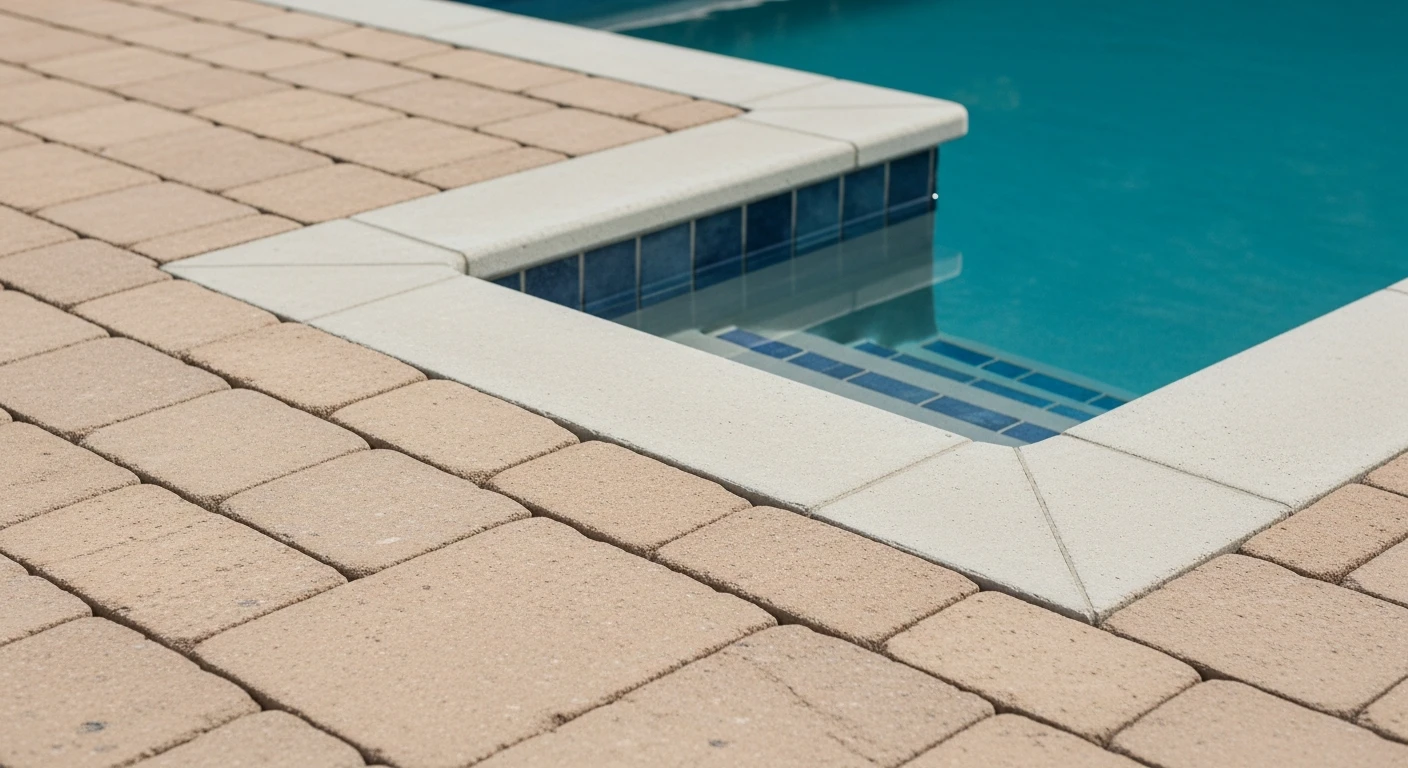
For sealing, especially in high-sun, high-salinity areas like the coast of Naples, I advise clients to use a breathable, non-film-forming sealer. Film-forming acrylic sealers can trap moisture efflorescence and become dangerously slippery when wet, which is a major liability around pool decks. The breathable sealer penetrates the paver, protecting it from salt and UV degradation without creating a slick surface film.
Before your next paver project, are you asking contractors about their sub-base drainage strategy, or are you just focusing on the color of the paver?