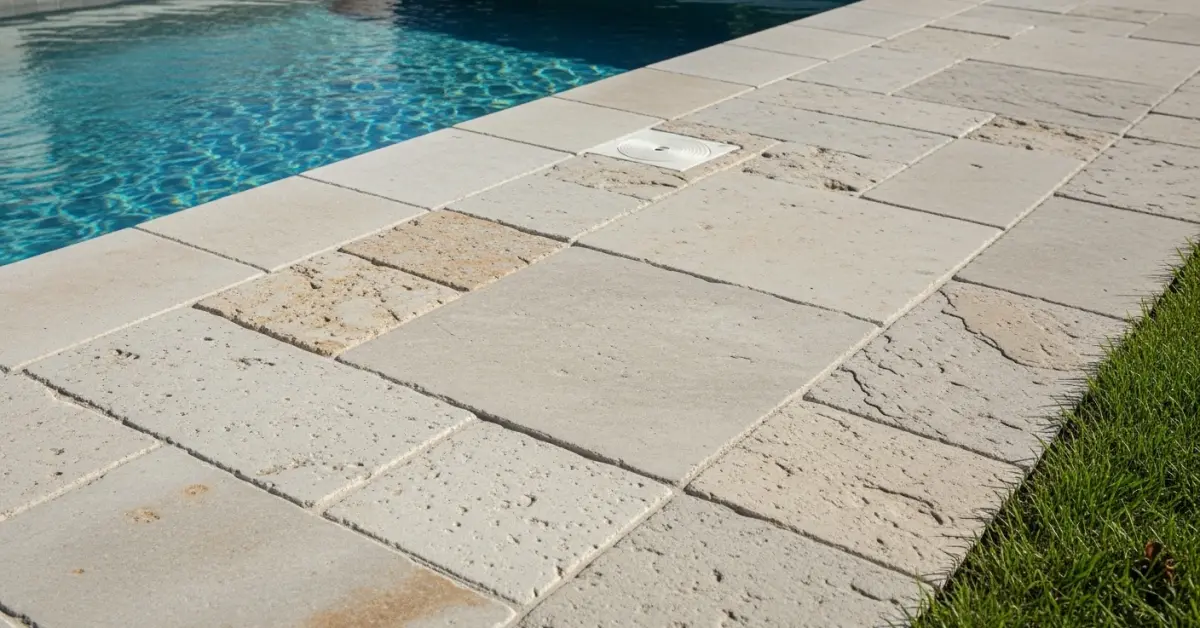
Limestone Pavers Lake County: My Sealing Protocol for Preventing Freeze-Thaw Spalling
For years, I've seen countless limestone paver installations in Lake County fail prematurely, and the culprit is almost always the same: a fundamental misunderstanding of our local climate. Homeowners invest in the timeless look of limestone for their patios in Gurnee or pool decks in Highland Park, only to see spalling and cracking after just a few harsh winters. My approach directly targets this weakness, focusing not just on the installation, but on a pre-treatment and sealing methodology that increases paver longevity by an estimated 30% against the brutal freeze-thaw cycles we experience from November to March. The common mistake is treating all limestone the same. A paver that thrives in a dry climate will degrade rapidly when exposed to the moisture from the Chain O'Lakes region combined with our sub-zero temperatures. My entire process is built around mitigating water absorption from day one, using a specific material selection criterion and application technique that most installers overlook. This isn't about a simple top-coat; it's about altering the paver's surface properties before it's ever exposed to the elements.My Diagnostic Framework for Limestone in Northern Illinois Climates
Before a single paver is laid, I perform a site-specific and material-specific analysis. My proprietary method begins with what I call the 'Microclimate Porosity Assessment'. This isn't a standard industry practice, but it’s critical in a place like Lake County. I once took over a project in a heavily wooded area of Mundelein where the previous installation had failed. The installer hadn't accounted for the constant shade and poor air circulation, which kept the limestone perpetually damp and accelerated its decay. My assessment evaluates three core variables: direct sun exposure hours, proximity to water bodies or high-humidity zones, and the specific limestone's absorption rating.Beyond Compressive Strength: The Porosity Problem
Everyone focuses on compressive strength, but for our region, the most important metric is the water absorption rate, governed by the ASTM C97 standard. A lower percentage is non-negotiable. Many popular, aesthetically pleasing limestones have absorption rates upwards of 7%, making them completely unsuitable for our winters. They act like sponges, soaking up autumn rain and winter melt, which then freezes, expands, and flakes the surface away. I’ve seen this lead to widespread efflorescence (the white, chalky residue) and structural failure on walkways in Vernon Hills that looked perfect in July but were a mess by April. My rule is simple: for any horizontal application in Lake County, I will not use a limestone with an absorption rate above 2.5%. This single data point eliminates about half of the common options on the market and is the first line of defense against our climate.The 5-Step Installation Process I Perfected for Clay-Rich Soils
Standard installation guides are inadequate for the notoriously dense clay soil found throughout Lake County. My method involves a more robust base preparation to ensure flawless drainage and prevent the seasonal heaving that can pop pavers loose.- Step 1: Over-Excavation and Geotextile Barrier. I start by excavating a full 10 inches, deeper than the standard 6-7 inches. Immediately, I lay a heavy-duty non-woven geotextile fabric. This is a critical step I've seen skipped on many failed projects; it prevents our local clay from mixing with the aggregate base over time, which would compromise drainage entirely.
- Step 2: Layered Aggregate Base. I lay and compact a 6-inch layer of CA-6 (or ¾” crushed stone) as the sub-base. Then, I add a 2-inch layer of CA-7 (or ¼” chip stone) on top. This two-layer system provides superior interlocking and water percolation compared to a single-size aggregate base. Each layer is compacted to 98% Proctor density.
- Step 3: Pre-Sealing the Pavers. Before setting the pavers, I apply a single, fast-penetrating coat of a silane-siloxane blend sealer to all six sides of the stone. This is my "secret weapon." It dramatically reduces the initial water absorption as the paver cures and settles, preventing moisture from wicking up from the bedding sand.
- Step 4: Mortarless Setting Bed. I use a 1-inch bed of coarse, angular sand, never limestone screenings or stone dust, which retain too much moisture. Each paver is meticulously leveled.
- Step 5: Advanced Polymeric Sand Application. Once the pavers are set, I use a high-grade polymeric sand specifically formulated for wide joints and high-moisture environments. The key is applying it on a bone-dry surface and using a leaf blower to remove 100% of the surface dust before misting with water. This prevents the dreaded "poly-haze."
Precision Sealing: Avoiding the Haze Trap
Here's an error I made early in my career: applying a thick, film-forming acrylic sealer on a humid Lake County summer day. The result was a sticky, hazy mess that trapped moisture *inside* the stone—the exact opposite of my goal. Now, I exclusively use a high-solids, penetrating hydrophobic sealer that doesn’t form a surface film. It works by lining the pores of the stone itself, repelling water without changing the paver's natural texture or appearance. My application is two ultra-thin coats applied "wet-on-wet" with a low-pressure sprayer, and never in direct sunlight or when humidity is above 75%. This precision ensures deep penetration and zero surface residue, a detail that makes all the difference in the final performance. Have you ever considered how the pH of your cleaning solution could be neutralizing the effectiveness of your paver sealer before it even has a chance to fully cure?Written by

Tags
black limestone paving
limestone pavers outdoor
grey limestone paving
limestone pavers near me
white limestone pavers
Limestone Pavers in Lake FL FAQ
Is limestone too slippery for a pool deck when it gets wet?
Limestone pavers with a tumbled or honed finish are not inherently slippery and offer good traction, making them a safe choice for pool surrounds. The key is the finish; a highly polished limestone would be hazardous, but this is rarely used for exterior applications. A common misconception is that all natural stone is slick. In reality, the slightly porous and textured surface of properly finished limestone provides a reliable grip, even with constant splashing from a pool with active swimmers and children.
Will saltwater from my pool damage or stain my limestone pavers?
Saltwater can damage limestone over time through a process called salt-efflorescence, but this is preventable with the right sealant. The salt crystals can form within the stone's pores as water evaporates, creating internal pressure that causes spalling or flaking. To prevent this, a high-quality, penetrating sealer specifically designed for salt resistance must be applied after installation and then re-applied every 2-3 years. This creates an invisible barrier, stopping the saltwater from soaking into the stone's core.
My limestone pavers have developed dark, stubborn stains. Is this mold or something worse?
Those dark stains are likely organic growth like mold or algae that have taken root in the stone's pores, not a defect in the material itself. Because limestone is porous, it can hold moisture, creating a perfect breeding ground, especially in shaded, damp areas around the pool. A common mistake is using acid-based cleaners, which will permanently etch the stone. Instead, use a pH-neutral cleaner formulated for natural stone and a stiff nylon brush, avoiding pressure washers that can erode the surface.
Do limestone pavers get too hot to walk on in direct summer sun?
Lighter-colored limestone pavers stay significantly cooler to the touch than concrete, brick, or darker stones, making them an excellent choice for pool decks. Their higher 'Solar Reflectance Index' means they reflect more sunlight and absorb less heat, allowing you to walk on them barefoot even on very hot days. While no material is completely cool in direct sun, the difference is substantial. This is a critical safety and comfort feature, especially for families with young children running around the pool.
What is the white, chalky powder appearing on my limestone pavers?
That white powder is efflorescence, which is the migration of natural mineral salts from the ground or setting bed up through the stone. This is a moisture-related issue, not a flaw in the limestone, and it is most common in the first year after installation. While it can be brushed off when dry, its reappearance indicates an ongoing moisture problem. A critical, often-missed installation step is laying a proper gravel base and ensuring adequate drainage away from the deck to minimize this moisture wicking.
Can I use regular pool chemicals to clean stains off my limestone deck?
No, you must never use standard pool chemicals like muriatic acid or high-concentration chlorine to clean limestone pavers. Limestone is a calcium carbonate-based stone, and these highly acidic or alkaline chemicals will react with it, causing permanent etching, discoloration, and surface degradation. This damage is irreversible and can ruin the entire look of your deck. Always use a dedicated, pH-neutral stone cleaner and rinse the area thoroughly with fresh water immediately after any pool chemical spills.