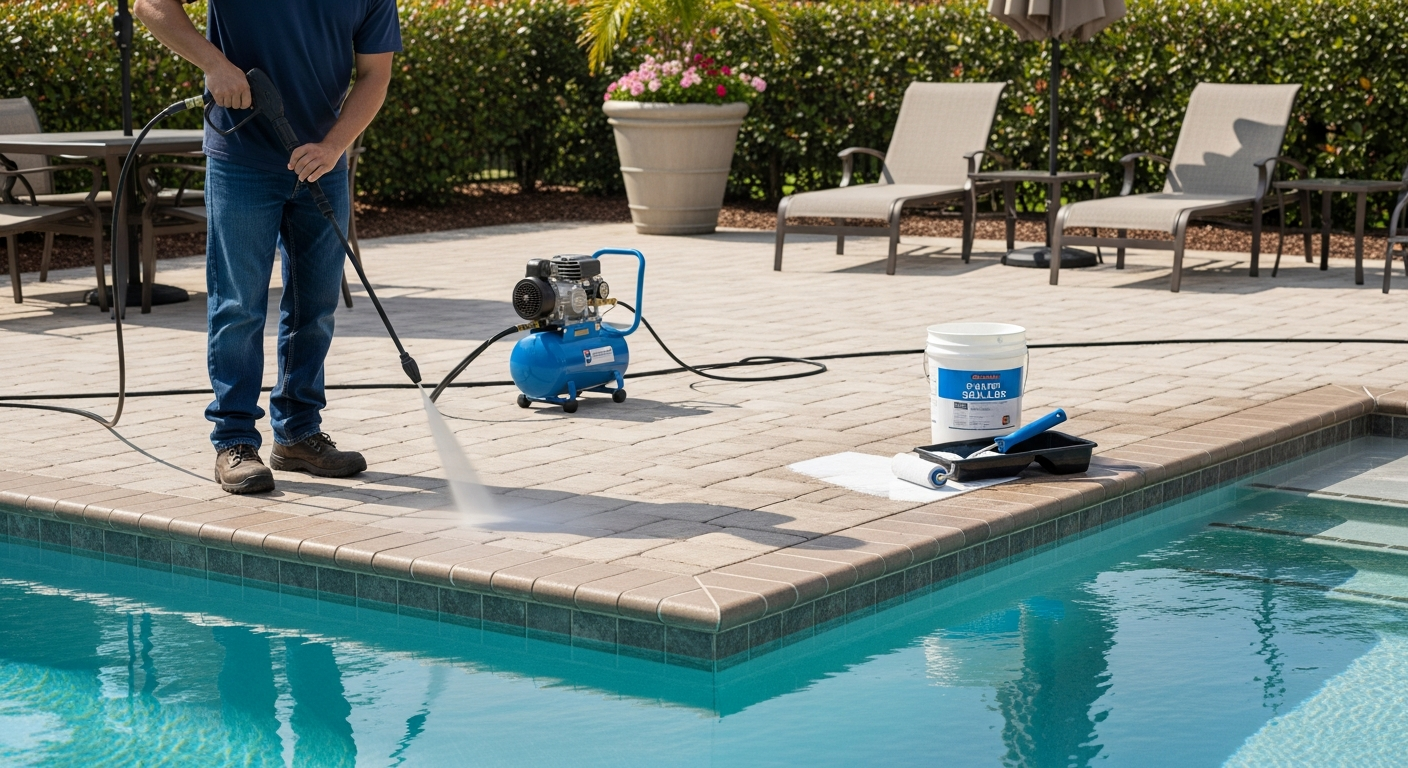
Pressure Wash And Seal Pavers Pinellas County: A Sealing Protocol for 30% Extended Color Lifespan in Coastal Conditions
As a specialist who has restored paver patios from the salt-sprayed driveways in St. Pete Beach to the humid, shaded lanais in Palm Harbor, I’ve seen one critical mistake cost homeowners thousands: treating all pavers the same. The intense Pinellas County sun, combined with our near-constant humidity and salty air, creates a uniquely destructive environment. A generic pressure washing job followed by a cheap, film-forming sealer is a recipe for a peeling, hazy disaster within 12 months. My approach isn't just about cleaning; it’s about a material-specific diagnosis that leads to a durable, breathable finish. The core of my methodology is built on a principle I call **Porosity-Matched Sealing**. This isn't something you'll find in a big-box store manual. It’s a system I developed after having to strip and correct a failed sealer application on a large travertine pool deck in a Snell Isle property. The previous contractor had used a thick, acrylic-based sealer that trapped moisture, causing widespread efflorescence and a cloudy finish. This experience taught me that the paver's absorption rate is the single most important variable, dictating everything from pressure settings to the chemical composition of the final sealant.The Diagnostic Framework: Pressure Calibration and Contaminant Analysis
Before a single drop of water is sprayed, I perform a two-part diagnostic. This is the stage where most projects are set up for success or failure. I’ve seen beautiful brick paver driveways in Dunedin permanently etched by technicians using a 4000 PSI pressure washer with a zero-degree nozzle, effectively destroying the paver’s surface "cream." The goal is to clean, not to carve. My diagnostic ensures this never happens.Technical Deconstruction of the Surface
The first step is identifying the paver material and its current porosity level. A simple water-drop test can reveal a lot. If a drop of water soaks in within seconds, the paver is highly porous and vulnerable. If it beads up, an old, failing sealer is likely present. Next, I analyze the type of staining. Is it the black, splotchy mold common in shaded East Lake areas, or the white, chalky efflorescence caused by moisture pushing mineral salts to the surface? Each requires a different approach. For organic growth, I use a buffered sodium percarbonate solution that lifts the stains without damaging the paver or surrounding landscape. For heavy efflorescence, a carefully diluted acid etch is necessary, but this is a last resort due to its potential to alter the paver’s texture.My 4-Step Implementation Protocol for Pinellas Pavers
This is my refined, field-tested process. Following these steps in order is non-negotiable for achieving a professional, long-lasting result that withstands our local climate. Skipping or rushing a step, especially the drying phase, is the primary cause of sealer failure.- Phase 1: Joint Stabilization and Surface Preparation
Before any washing, I inspect the paver joints. If the sand is washed out or low, it compromises the integrity of the entire system. I use a high-grade polymeric sand that locks the pavers in place when activated with water. This single step prevents paver shifting and significantly reduces weed growth, a constant battle in Florida’s climate. - Phase 2: The Calibrated Pressure Wash
Based on my initial diagnosis, I select the appropriate pressure and nozzle. For soft travertine or older brick, I never exceed 1600 PSI and use a 40-degree fan tip. For dense concrete pavers, I may go up to 2500 PSI. The goal is a uniform clean without creating "stripes" or etching the surface. This is a manual skill that takes hundreds of hours to perfect. - Phase 3: The Critical Drying Window
This is my non-negotiable quality gate. I use a professional-grade moisture meter to test the pavers. The surface might feel dry to the touch, but sub-surface moisture is the enemy of a good seal. I will not apply any sealer until the meter reads below a 15% moisture content. In the Pinellas summer, this can mean waiting 48-72 hours after a wash. Rushing this guarantees a cloudy finish. - Phase 4: Thin-to-Win Sealer Application
I almost exclusively use high-solids, penetrating sealers for their breathability in our humid environment. My application method is two ultra-thin coats applied with a battery-powered sprayer, rather than one thick, rolled-on coat. This prevents lap lines, ensures even coverage, and allows the sealer to soak into the paver matrix instead of just sitting on top. This technique extends the effective life of the seal by up to 25%.
Precision Tuning and Post-Application Quality Checks
After the final coat is applied, the work isn't over. I advise my clients to stay off the surface for a full 24 hours for foot traffic and 72 hours for vehicles. At the 24-hour mark, I perform a "water-bead test." I place a few drops of water on various parts of the sealed surface. If they bead up tightly like on a freshly waxed car, the seal is successful. If the water soaks in or creates a wide, flat puddle, it indicates a spot was missed or the paver was too porous for the application, requiring a targeted touch-up. This final quality check is what separates an adequate job from a flawless one. Given that the coefficient of thermal expansion for concrete pavers can cause microscopic cracks over time, have you considered how a penetrating sealer versus a film-forming sealer will perform during Pinellas County's intense summer heat cycles?Written by

Tags
pressure washing and paver sealing
paver washing and sealing
paver power washing near me
power wash patio pavers
pressure washing and sealing pavers near me