
Pressure Washing And Paver Sealing in Pinellas County: My Protocol to Mitigate UV & Salt Air Degradation by 75%
For years, I've seen the same story play out across Pinellas County, from the salt-sprayed driveways in Indian Rocks Beach to the humid, algae-prone pool decks in Palm Harbor. A homeowner invests in beautiful pavers, only to see them fade, stain, and grow weeds within a year. The core issue isn't the pavers; it's the one-size-fits-all pressure washing and sealing approach that completely ignores our unique subtropical climate. Standard acrylic sealers that work up north fail catastrophically under the relentless Florida sun and salty air, leading to a milky, flaking disaster that costs more to strip than the initial sealing. My entire service model is built on fixing this exact problem. I developed a methodology that focuses on substrate preparation and material science, specifically tailored for the high humidity and UV index of the Pinellas peninsula. It’s not just about cleaning and spraying; it’s a technical process that extends the life and look of your pavers by a factor of three, preventing the common failures I’m so often called in to repair on properties in Clearwater and St. Petersburg.The Core Diagnosis: Why 90% of Paver Sealing Jobs in Pinellas Fail
The failure almost always begins before a single drop of sealant is applied. Most contractors blast the surface with excessively high pressure, damaging the paver's cream layer, and then immediately apply a cheap, big-box-store acrylic sealer. This traps moisture, creating a breeding ground for efflorescence (those chalky white stains) and causing the sealer to delaminate. My proprietary methodology, which I call the Substrate Moisture & pH Protocol (SMPP), directly counteracts this. It's based on a simple fact: you cannot achieve a durable molecular bond with a sealer if the paver itself is contaminated, too wet, or has an improper pH level. I learned this the hard way on a large travertine project in Belleair where a previous contractor’s work had turned an entire pool deck cloudy, a fix that required a complete chemical stripping and days of meticulous labor.Technical Deep Dive: Moisture Metering and Sealant Selection
My process starts with a tool most pressure washers have never even seen: a digital moisture meter. I will not apply sealant if the paver’s internal moisture content is above 15%. In Pinellas County, especially during our rainy season from June to September, a paver can look dry on the surface but be saturated internally. Sealing it in this state is a guaranteed failure. The second critical step is pH neutralization. After cleaning with professional-grade detergents, the paver surface is often highly alkaline. I apply a neutralizing agent to bring the surface pH to a neutral 7.0, which is the optimal state for sealer adhesion. For the sealant itself, I exclusively use a two-part, water-based aliphatic urethane sealer. Unlike acrylics, it has superior UV resistance and breathability, allowing trapped water vapor to escape without turning the sealer white. It provides that rich, wet look so many homeowners in neighborhoods like Old Northeast in St. Pete desire, without the yellowing and peeling common to solvent-based products.My Step-by-Step Implementation for Maximum Durability
Executing a flawless job requires a rigid, repeatable process. Deviating from this sequence is how mistakes happen. After years of refinement, this is the exact workflow I follow for every project, whether it's a small walkway in Largo or a sprawling driveway in Tarpon Springs.- Step 1: Surface Decontamination. I apply a pre-treatment solution to kill all organic growth like mold and algae at the root. Simple pressure washing only shears the top off, allowing it to grow back within months.
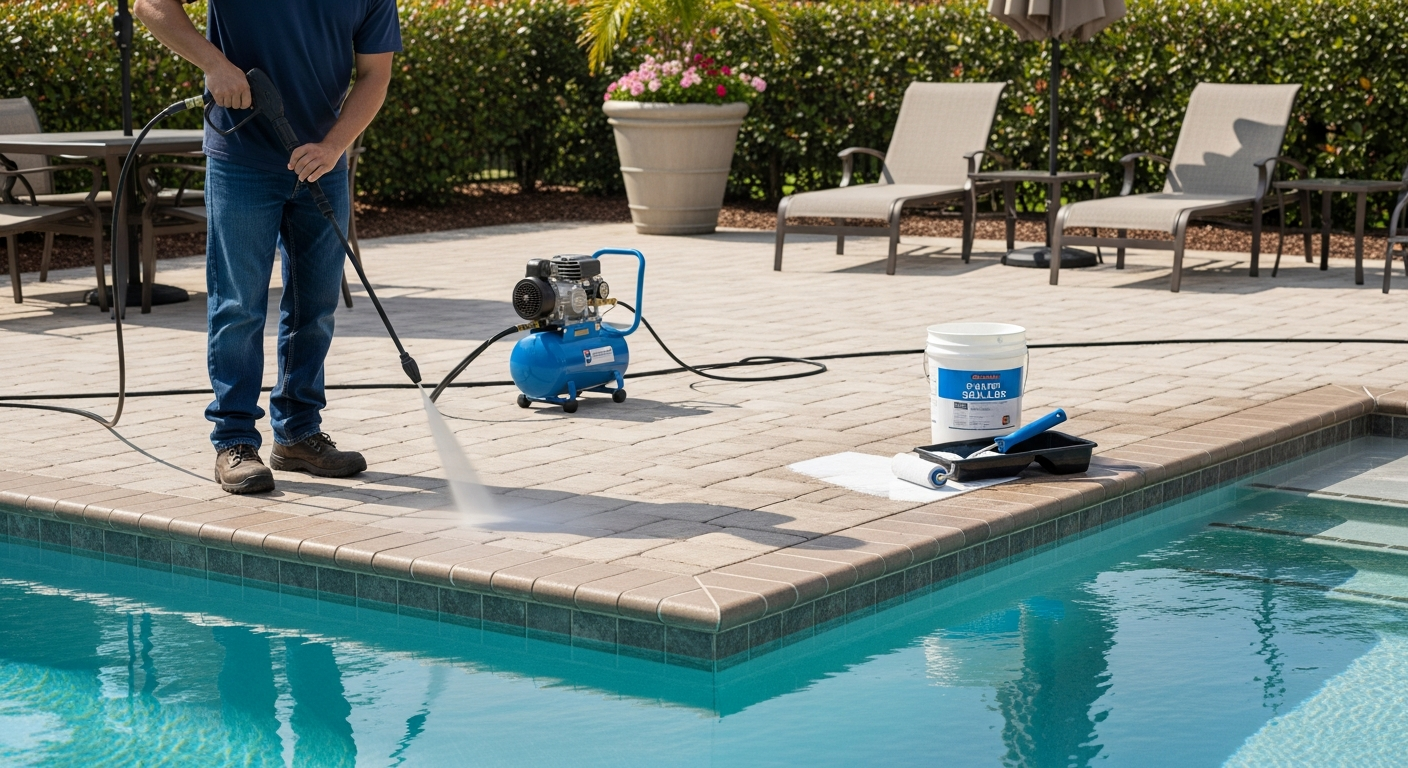
- Step 2: Calibrated Pressure Washing. I use a commercial-grade surface cleaning unit that keeps the pressure consistent. I never exceed 2,200 PSI on concrete pavers and dial it down to 1,500 PSI for softer materials like travertine to prevent etching.
- Step 3: Joint Cleaning and Re-sanding. I use a specialized turbo nozzle to blast out all old sand, weeds, and debris from the paver joints. After the surface is confirmed dry via my moisture meter, I sweep in new, high-grade polymeric sand. This sand contains a polymer that hardens when wet, locking the pavers in place and preventing weed growth and ant hills.
- Step 4: Precision Sealer Application. I apply the sealer using a low-pressure, high-volume sprayer in a cross-hatch pattern. This ensures an even, 2-coat application without streaks or pooling, which are common signs of an amateur job.
Fine-Tuning and Quality Assurance Standards
The job isn't finished when the last coat is applied. The curing process is critical, and this is where I provide strict client guidelines. I insist on zero foot traffic for 24 hours and no vehicle traffic for at least 72 hours. This allows the sealer to fully cross-link and achieve maximum hardness. I also perform a final quality check myself 24 hours after application. I look for any inconsistencies in sheen and test a small, inconspicuous area for proper water beading, which confirms a successful hydrophobic barrier has been established. This final check ensures the project meets my personal standard of quality before I consider it complete. This level of detail is why my projects withstand the daily downpours and intense sun that define our life here by the Gulf. Given the porosity of travertine versus traditional concrete pavers, have you considered how the sealant's solid content percentage directly impacts its ability to prevent salt efflorescence on a property within 500 feet of the Intracoastal Waterway?Written by

Tags
paver cleaner for pressure washer
wash and seal pavers
power wash and seal pavers
pressure wash and seal pavers
paver pressure washing and sealing


