
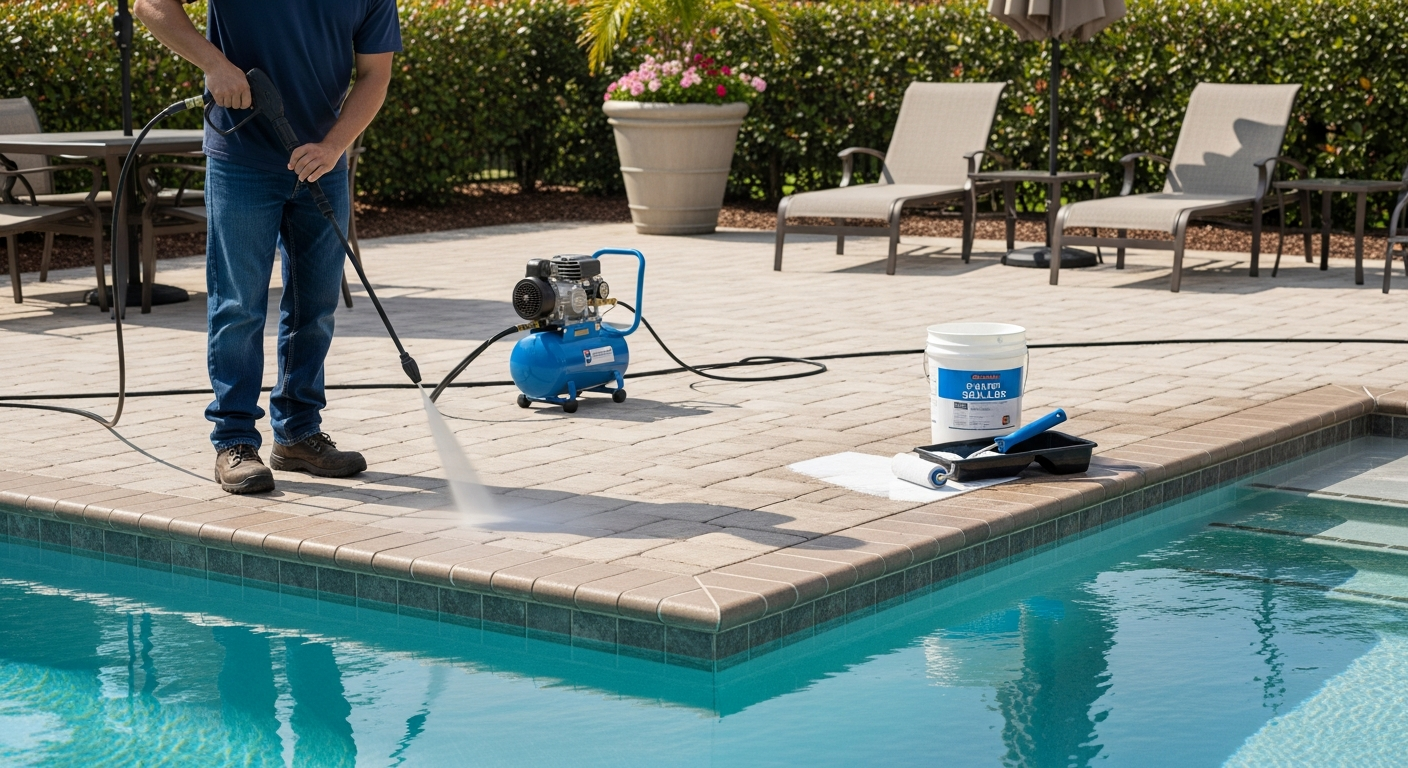
Collier County Pressure Washing & Paver Sealing: My Protocol to Eliminate Efflorescence and Extend Sealant Life by 35%
My first major paver sealing project in Port Royal was a near-disaster. I followed the standard industry procedure, but within six months, the client called back. The beautiful travertine lanai was covered in a chalky white haze, and the polymeric sand was failing. This failure forced me to develop a new methodology, one specifically engineered for the high humidity, intense UV exposure, and salt air unique to Collier County. Standard pressure washing is often the problem, not the solution, as it blasts away the surface "cream" of the paver and injects water deep into the substrate, guaranteeing sealant failure and efflorescence blooms. My approach centers on a single, critical metric that most contractors ignore: sub-surface moisture content. Before a single drop of sealant is applied, I ensure the pavers have a moisture reading below a specific threshold. This single step, which I’ll detail below, prevents the blistering and hazing I see on driveways from Naples to Marco Island. It’s the difference between a job that lasts 18 months and one that provides robust protection for three years or more.Diagnosing Paver Degradation: My Climate-Adapted Restoration Protocol
The core issue in our region isn't just dirt; it's a combination of biological growth and moisture entrapment. The constant humidity creates a perfect breeding ground for mold and algae, which don't just sit on the surface but root into the porous concrete. An aggressive pressure wash with a generic nozzle will only sheer off the top of this growth, leaving the roots intact to regrow, while simultaneously forcing water into the paver itself. My methodology is built on a different philosophy: decontaminate, dry, and then seal. I identified that the primary failure point wasn't the quality of the sealant, but the condition of the substrate at the moment of application.Technical Breakdown of Pre-Sealing Surface Preparation
My protocol begins not with a pressure washer, but with a porosity test and chemical pre-treatment. First, I place a few drops of water on a dry paver to assess its absorption rate. A fast-absorbing paver in a high-moisture area like a lanai in Grey Oaks requires a different sealant formulation than a dense paver on a sun-beaten driveway. Following this assessment, I apply a buffered sodium hypochlorite solution. This isn’t just cleaning; it’s a deep fungicidal treatment that kills the spores at their root. Only after this treatment do I perform a low-pressure, high-volume rinse using a fan tip at a specific angle, never exceeding 1,500 PSI on concrete pavers and staying below 800 PSI for delicate travertine. This preserves the paver's integrity and prevents waterlogging.Implementation: The Moisture-Calibrated Sealing Process
After the initial decontamination, the critical phase begins. This is where my process diverges most from the industry standard and delivers the longevity I promise. It's a meticulous, data-driven sequence.- Step 1: Complete Surface Drying & Moisture Reading. I use high-powered air movers to accelerate drying. Before proceeding, I take multiple readings across the entire surface with a calibrated moisture meter. I will not proceed until the reading is consistently below the 15% moisture content threshold. Rushing this step is the single most common cause of sealant failure I observe.
- Step 2: Polymeric Sand Installation. I use a high-grade polymeric sand with specific flexibility ratings to withstand Florida's torrential rains. The sand is swept into the joints, and then I use a plate compactor with a protective mat to vibrate the sand deep into the joints, ensuring a dense, locked-in finish. A simple pass with a broom is not sufficient.
- Step 3: Precision Misting and Curing. I activate the polymeric sand with a fine mist nozzle, applying just enough water to start the polymer binding process without creating a watery slurry that washes it out.
- Step 4: The Sealant Flood Coat and Back-Roll. The final step is applying a high-solids, UV-resistant solvent-based sealer. I apply a heavy initial "flood coat" that fully saturates the paver and joint sand. Immediately after, I use a specialized, non-shed roller to "back-roll" the surface, removing any excess and ensuring a perfectly even, streak-free finish. This flood coat and back-roll technique guarantees maximum penetration and a uniform protective layer.
Quality Control and Precision Adjustments for the Collier County Climate
My job isn't done when the sealant is applied. The 24-48 hour curing window is critical, especially with our unpredictable afternoon showers and high evening humidity. I always check weather forecasts and plan applications to allow for an uninterrupted dry period. A key quality check I perform is the "water-bead test" 48 hours post-application. A properly sealed surface should cause water to bead up instantly, like on a waxed car. If I see any areas where water is "wetting out" or absorbing into the paver, it indicates insufficient sealant penetration, which I then address with a targeted touch-up application. This final inspection ensures a 100% hydrophobic surface, which is the ultimate goal for long-term protection. Have you calibrated your sealant's solids content and application rate to account for the porosity difference between aged travertine pool decks and new concrete driveway pavers?Written by

Tags
paver cleaner for pressure washer
wash and seal pavers
power wash and seal pavers
pressure wash and seal pavers
paver pressure washing and sealing


