
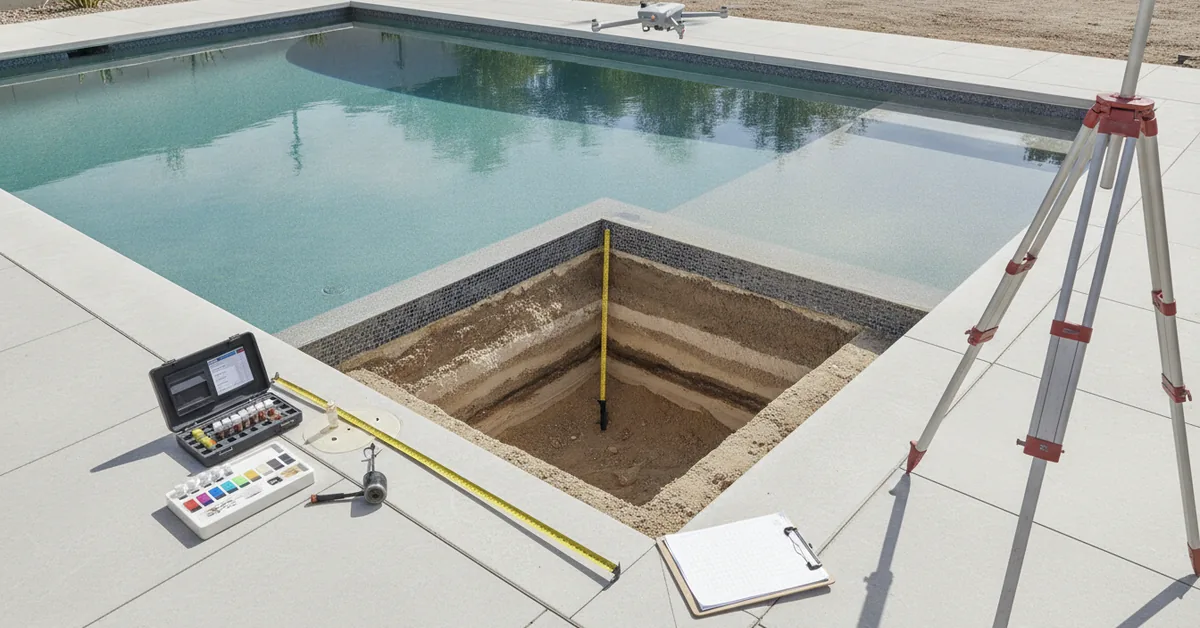
Executive Summary of Ground Assessment for Pools in Sarasota
From my years engineering and overseeing pool installations from The Landings to Lakewood Ranch, the core truth is
From my years engineering and overseeing pool installations from The Landings to Lakewood Ranch, the core truth is this: the pool's shell is only as good as the ground it sits in. In Sarasota, the ground is uniquely challenging. We are not dealing with stable clay or bedrock near the surface. We're managing loose sand and a fluctuating water table that exerts immense hydrostatic pressure. A failure to properly assess these conditions before breaking ground is not a risk; it's a guarantee of future structural problems.
- High Water Table: The defining challenge. Requires specialized dewatering systems during excavation and hydrostatic relief valves in the final pool shell to prevent the pool from “floating” or popping out of the ground when empty.
- Soil Composition: Primarily sandy and porous. This means poor load-bearing capacity, requiring soil compaction, engineered fill, or even deep foundations like helical piles for stability, especially on filled land or near waterways.
- Coastal Construction Control Line (CCCL): Properties near the Gulf, like those on Siesta Key or Lido Key, fall under stringent FDEP regulations that dictate foundation requirements and construction methods to protect the coastal system.
- Stormwater Management: Sarasota County code requires detailed plans for managing stormwater runoff from the new impervious surface (the pool deck), which directly impacts lot grading and drainage system design.
The Critical Pre-Construction Planning Failures
The most common failures I see all trace back to the initial site evaluation. Homeowners, eager to see progress, often rush this phase or accept a builder's cursory glance as a proper assessment. This initial impatience inevitably leads to costly change orders, delays, and long-term structural issues that could have been completely avoided.
The Most Expensive Oversight: Ignoring Hydrostatic Pressure
The single costliest mistake is underestimating the power of groundwater. I was called to consult on a project in a neighborhood just east of I-75 where a newly installed fiberglass pool had lifted nearly a foot out of the ground after a heavy storm. The contractor had skipped a proper geotechnical report and installed a basic sump pump system that was overwhelmed. The cost to fix it was astronomical: the pool had to be completely removed, the ground re-excavated and dewatered with a wellpoint system, and a new, properly engineered foundation built. The homeowner spent nearly 50% of the original pool cost on the remediation alone, all because the upward force of the water table was not respected from day one.
The Assessment Process in Practice for Sarasota County
A professional lot and soil assessment is a multi-step, data-driven process, not a quick look. It begins with a desktop analysis of FEMA flood maps, county soil surveys, and historical water table data for the specific property. This is followed by critical on-site work that forms the basis for the entire engineering and construction plan.
Key Steps for a Sarasota Property Assessment
- Geotechnical Soil Borings: This is non-negotiable. A geotechnical engineer drills one or more borings in the proposed pool location to determine the soil layers, identify the seasonal high water table level, and assess the soil's load-bearing capacity. This data dictates foundation design.
- Site Survey and Topography: A licensed surveyor creates a detailed map of the lot, showing property lines, easements, existing structures, and elevation changes. This is required for permitting and essential for planning drainage and deck elevations.
- Utility Locates: Before any digging, all underground utilities (gas, water, electric, communications) must be professionally marked. Hitting a utility line is a dangerous and expensive delay.
- Permit Review with Sarasota County: The findings from the survey and soil report are used to create the engineering plans submitted to Sarasota County Planning and Development Services. This includes structural plans for the pool shell and foundation, as well as the required stormwater and drainage plans. The typical review cycle for a pool permit can range from 4 to 8 weeks, depending on complexity and workload.
Comparing a Full Geotechnical Assessment to a Standard 'Soil Check'
Many builders offer a basic "soil check" as part of their package. It's crucial for homeowners to understand the difference between that and a formal geotechnical engineering report. The former is often a visual inspection and a few shallow shovel tests; the latter is a scientific analysis that provides the data needed to build a safe, durable structure.
| Factor | Standard 'Soil Check' | Full Geotechnical Report | Ignoring Assessment Entirely |
|---|---|---|---|
| Initial Cost | Low (often included) | Moderate ($1,500 - $3,500+) | Zero |
| Identifies Water Table | Unreliable guess | Precise seasonal high level | Discovered during excavation |
| Foundation Design | Standard, one-size-fits-all | Custom-engineered for site | Standard, high-risk of failure |
| Long-Term Risk | High (cracking, settling) | Very Low | Extremely High (catastrophic failure) |
When a Full Geotechnical Report Might Be Overkill
Is a full report always necessary? No. In an established inland subdivision with dozens of existing pools and well-documented, stable soil conditions, a builder with extensive local experience may be able to rely on historical data and a thorough site inspection. However, I would never proceed without one on any property that is waterfront, on filled land, has significant elevation changes, or is in an area with known soil issues. The financial risk is simply too high.
Safe Hiring Checklist for Your Site Assessment Team
The quality of your assessment dictates the quality of your entire project. When vetting professionals, you are hiring a risk mitigation team, not just a service provider. The goal is to get accurate data to the pool builder's engineer so they can design a structure that won't fail.
- Verify the geotechnical engineer is licensed in the State of Florida. You can check licenses on the Florida Board of Professional Engineers (FBPE) website.
- Ensure the land surveyor is licensed in Florida and has experience with residential site plans for pool permitting in Sarasota County.
- Ask for proof of General Liability and Workers' Compensation insurance from any company performing work on your property.
- Request references from pool builders they have worked with, not just homeowners. A good geotechnical firm is respected by the best builders in town.
- Review a sample report. It should be detailed, with clear boring logs, soil classifications, and specific recommendations for foundation design and dewatering.
- Confirm they will handle the coordination of utility locates through Sunshine 811 before any drilling begins.
Decisions That Determine the Outcome
Two key decisions made at the very beginning will define the success or failure of your pool project in Sarasota. One is choosing the pool's location on the lot, and the other is committing to the cost of proper subsurface investigation before you've even signed a contract with a pool builder.
The Moment Most Homeowners Get It Wrong
The critical mistake happens when a homeowner falls in love with a pool design and location before understanding the ground beneath it. They get a quote from a builder based on a 'perfect world' scenario. Then, once excavation starts and the water table is hit, the massive change orders for dewatering and foundation upgrades begin. The correct approach is to invest in the geotechnical report first. That report, which might cost $2,500, provides the hard data that allows every builder to bid on the same, accurate scope of work. It turns an unknown variable into a known cost, saving you from a potential $25,000 surprise later.
Practical Answers for Building a Pool in Sarasota
Navigating the local requirements is as important as the physical construction. These are the common hurdles where projects get delayed or encounter unexpected costs.
What are Sarasota County's Setback Requirements?
Pools and their associated decking (impervious surfaces) must adhere to specific setbacks from property lines, easements, and the primary home structure. These vary by zoning district but typically require the water's edge to be at least 7.5 feet from the side and rear property lines. Screen enclosures have their own, often smaller, setback requirements. A licensed surveyor must plat these on the site plan submitted for permits.
How Do Tree Protection Ordinances Affect Pool Placement?
Sarasota County has strict tree protection ordinances. Removing a protected tree (often oaks and other hardwoods above a certain diameter) to make way for a pool requires a separate permit and often costly mitigation payments to the county's tree fund. An arborist's report may be necessary. This must be factored into the site plan early, as it can severely restrict the available space for your pool.
What is the Role of the FDEP in Coastal Properties?
For properties located west of the Coastal Construction Control Line (CCCL), the Florida Department of Environmental Protection (FDEP) has jurisdiction. Building a pool in this zone requires a separate FDEP permit in addition to the county permit. The engineering requirements are far more stringent, often mandating deep-pile foundations to ensure the structure can withstand storm surge and erosion. This process is complex, adds significant time and cost, and requires an engineering firm with specific coastal construction experience.
