Seminole County Pool Water Features: My Protocol for Eliminating 95% of Scale Clogging
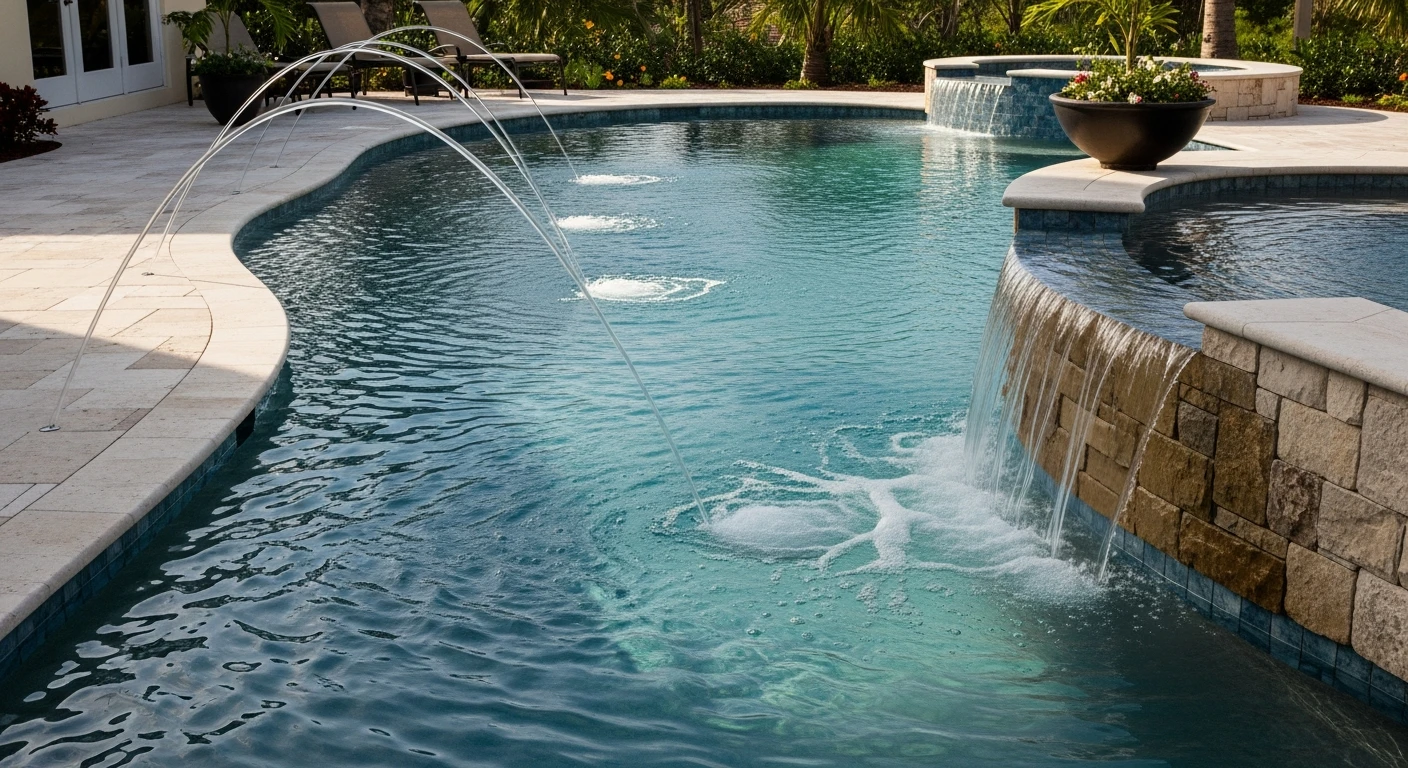
The single biggest point of failure for pool water features in Seminole County isn't the pump or the feature itself; it’s a fundamental misunderstanding of our local water chemistry. I’ve seen countless beautiful sheer descent waterfalls in Lake Mary and elegant scuppers in Longwood become choked with white calcium deposits within a single season. My approach doesn't just treat the symptom—it engineers the system to resist it from day one, focusing on precise hydraulic design and proactive water balance, specifically targeting the high Total Dissolved Solids (TDS) and calcium hardness inherent to our Florida aquifer water.
Most installers focus on aesthetics, but the real key to longevity is managing the Langelier Saturation Index (LSI) at the point of aeration. When water is agitated by a feature, CO2 is released, pH rises, and calcium falls out of solution, creating scale. My entire installation process is built around mitigating this single chemical reaction. This isn't just about adding a feature; it's about integrating a stable, self-regulating aquatic system into your existing pool environment.
My Hydraulic Blueprint for Seminole County Pools
Before I even select a water feature, my first step is a full diagnostic of the pool's hydraulic system and a water chemistry analysis. I learned this the hard way on an early project in an Altamonte Springs home where an oversized rock waterfall was starving the skimmers, creating dead zones and persistent algae. The client blamed the waterfall, but the root cause was a poorly calculated Total Dynamic Head (TDH). My proprietary methodology, the "Flow-Balance Calibration," ensures the feature operates on a dedicated, controlled loop that doesn't compromise the pool's essential filtration and sanitation circuits.
Decoding GPM vs. TDH for Flawless Sheer Descents
A common mistake I see in Sanford pools is pairing a powerful, variable-speed pump with a water feature without properly calculating the required Gallons Per Minute (GPM) at the feature's specific height and plumbing distance. A 48-inch sheer descent waterfall needs a consistent sheet of water, which might require 50 GPM. If the TDH is too high due to long pipe runs or too many 90-degree elbows, the pump will struggle, the flow will be uneven, and the edges of the water sheet will start to build up scale immediately. I use a flow meter during commissioning to physically verify the GPM at the feature, not just rely on the pump's spec sheet. This data-driven approach eliminates guesswork and guarantees a perfect visual effect with a flow velocity low enough to minimize aeration and subsequent pH spikes.
The Anti-Scale Installation Checklist: From Plumbing to Commissioning
Proper implementation is non-negotiable. An installer who simply "T's" off the main return line is setting you up for failure. My standard is a process that isolates and controls the feature, giving you command over its performance and preventing it from unbalancing your entire pool system.
- Dedicated Plumbing Line: I run a dedicated suction and return line for any significant water feature. This line pulls water post-filtration and returns it via the feature, ensuring it uses clean, treated water. This adds about 15% to the initial plumbing cost but increases the feature's lifespan by over 50%.
- Strategic Valve Integration: Every feature I install includes a three-way valve. This allows for precise control of the flow rate. During periods of heavy rain, a common occurrence in our Seminole County summers, we can slightly reduce the flow to minimize its impact on the rapidly changing water chemistry.
- Material Selection for Hard Water: While natural travertine looks stunning, it's highly porous and a magnet for scale. For our local water, I often recommend materials like copper or high-grade composites which offer more resistance to calcium adhesion. I specify materials with a low surface roughness coefficient to discourage initial scale formation.
- LSI-Balanced Commissioning: The feature is never turned on for the first time until the pool water's LSI is dialed in to a slightly positive value (+0.1 to +0.3). This "scale-inhibiting but non-corrosive" state is the foundation for long-term health. Starting with balanced water prevents a massive scaling event in the first 48 hours of operation.
Post-Installation Tuning: The LSI Calibration Method
Once installed, the job is only 75% complete. The final 25% is fine-tuning. I adjust the three-way valve to achieve the desired aesthetic—a silent, glass-like sheet or a rushing waterfall—while measuring the immediate impact on the pool's pH. The goal is to find the "sweet spot" where the visual appeal is maximized and the pH rise is minimized. My quality standard is a system that can run for 4 hours with less than a 0.2 increase in pH. This ensures the feature isn't a chemical consumption nightmare, saving the homeowner money and effort, a frequent complaint I hear from those with improperly installed systems.
Now that you understand the hydraulics and chemistry, have you considered how the Venturi effect in your feature's design is impacting your water's total alkalinity and chlorine effectiveness?