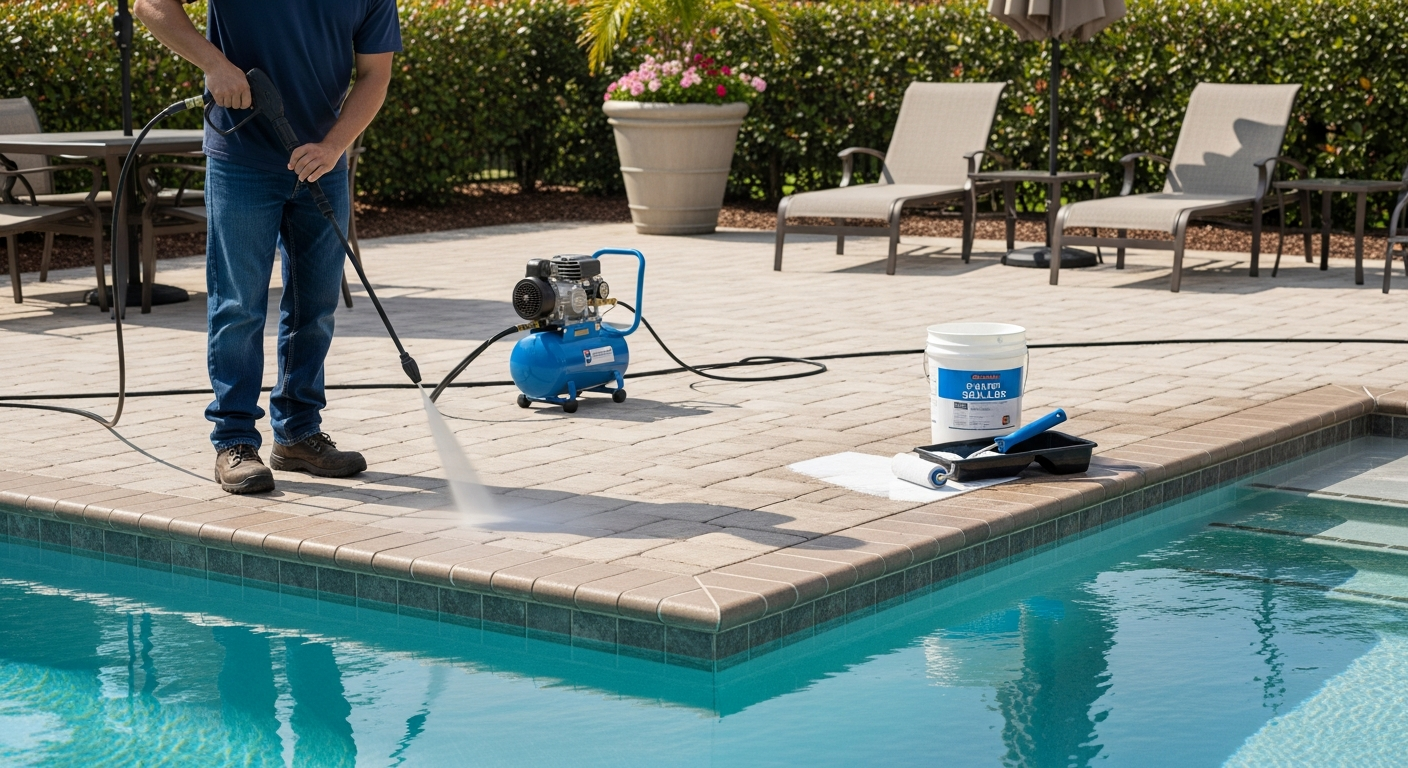
Pressure Cleaning And Sealing Osceola County: A Protocol for 3X Sealant Longevity in Florida’s Climate
In my years specializing in surface restoration, the most common failure I see in Osceola County is a sealed paver or driveway that looks cloudy, peels, or is covered in green algae again within a year. This isn't due to a bad sealant; it's a fundamental failure in the preparation and application process, one that ignores the brutal combination of our local humidity, intense UV exposure, and frequent downpours. A generic pressure wash followed by a quick coat of sealant simply traps microscopic moisture and organic spores, guaranteeing a premature breakdown. My approach is built on a single principle: the surface must be surgically clean and its porosity must be perfectly prepared before a single drop of sealant is applied. I developed my methodology after a project in Celebration where a high-end travertine pool deck failed in just eight months. The original contractor blamed the Florida weather. I found the real culprit was trapped moisture and a sealant type completely mismatched for the stone's density, a costly but invaluable lesson. This led to my proprietary protocol that consistently delivers a protective barrier lasting 2-3 times longer than standard applications.My Diagnostic Framework for Osceola County Properties
Before any equipment is even started, I perform a multi-point surface analysis. A "dirty driveway" in Kissimmee is rarely just dirt; it's a living ecosystem. My initial assessment identifies the specific contaminants, the material's condition, and any pre-existing issues that will dictate the entire restoration strategy. This isn't a simple visual check; it’s a technical audit. I've seen beautifully sealed surfaces in St. Cloud begin to pit and spall because the underlying efflorescence was never properly treated, it was simply sealed over. My proprietary diagnostic process, the Subtropical Surface Integrity Protocol, focuses on three core areas:- Organic Contaminant Typing: I differentiate between green algae (Gloeocapsa magma), which requires a specific algaecide, and black mold (Stachybotrys chartarum), which demands a stronger biocide and different dwell time. This dictates the precise chemical formulation I'll use.
- Porosity & Moisture Test: I conduct a simple but critical water drop test. How quickly the water absorbs tells me the surface porosity. This is the single most important factor in selecting the correct sealant—a penetrating silane/siloxane for dense concrete or a film-forming acrylic for more porous pavers.
- Previous Sealant Failure Analysis: Is the old sealant peeling, yellowing, or hazy? This tells me if the original product was solvent-based or water-based and helps me determine the correct stripping method to avoid chemical incompatibility, which is a disaster for the new application.
The Technical Nuances of Surface Preparation
The "pressure washing" phase is the most misunderstood. Using excessive pressure is the fastest way to permanently damage a surface. On a recent project on a home with a stucco facade near Lake Tohopekaliga, I discovered etching marks from a previous contractor who used a high-PSI wand. This is an irreversible error. My technique relies on chemistry to do the heavy lifting, not force. The key is calibrated soft washing. This involves a precisely metered solution of sodium hypochlorite, surfactants, and water applied at extremely low pressure—often less than 500 PSI, which is just slightly more than a garden hose. For durable concrete driveways, I may go up to 2,500 PSI, but never the 4,000+ PSI that inexperienced operators use. After the chemical solution has had its specified dwell time to kill all organics, a high-volume, low-pressure rinse removes all contaminants. The final, non-negotiable step before sealing is a complete surface rinse with a pH neutralizer to ensure the concrete or paver is not chemically "hot," which would prevent the sealant from properly bonding at a molecular level.Step-by-Step Implementation: The Sealing Application Process
Applying sealant in Osceola's humidity is a science. The window for application is often small, typically in the morning after the dew has evaporated but before the afternoon rains and peak sun. Rushing this stage or ignoring atmospheric conditions is what leads to 90% of sealant failures. Here is my core application checklist:- 1. Final Moisture Verification: I use a professional-grade moisture meter to confirm the surface is below the 5% moisture content threshold required for most penetrating sealers. Sealing over damp concrete is what causes that milky, cloudy haze.
- 2. Sealant Selection: Based on my initial diagnosis, I select the product. For a typical Poinciana driveway with high vehicle traffic, I specify a high-solids, solvent-based acrylic for its durability and resistance to hot-tire pickup. For a lanai or pool deck, a water-based, low-slip penetrating sealer is a much safer and more appropriate choice.
- 3. Application Technique: The sealant is applied with a battery-powered, low-pressure sprayer to ensure an even coat. For pavers, I immediately back-roll the sealant with a specialized roller to work it into the joints and ensure a uniform, non-blotchy finish. A second coat is applied "wet-on-wet" if the surface porosity demands it.
- 4. Curing & Site Control: The surface is roped off. I provide the homeowner with strict instructions to disable irrigation systems for at least 48 hours and to avoid foot traffic for 24 hours and vehicle traffic for 72 hours. This curing period is critical for the sealant to achieve its maximum hardness and chemical cross-linking.
Precision Curing and Long-Term Quality Assurance
The job isn't done when I pack up my equipment. The final phase is ensuring the sealant cures perfectly. In our humid environment, surface condensation overnight can compromise the cure. I often advise clients on the optimal time of day based on the upcoming 24-hour forecast. My quality standard is simple: a uniform finish with no roller marks, no cloudy spots, and perfect water beading (hydrophobic effect) across 100% of the sealed area. A properly sealed surface should look natural, or have a consistent sheen if an enhancement product was used, and it must feel dry and non-tacky to the touch after 24 hours. This meticulous, science-based approach is the only way to deliver a result that withstands the unique challenges of Osceola County. So, before you consider sealing your exterior surfaces, have you properly identified the specific organic growth present and how its biological film will interfere with the sealant's molecular bond?Written by

Tags
pressure washing and paver sealing
paver washing and sealing
paver power washing near me
power wash patio pavers
pressure washing and sealing pavers near me