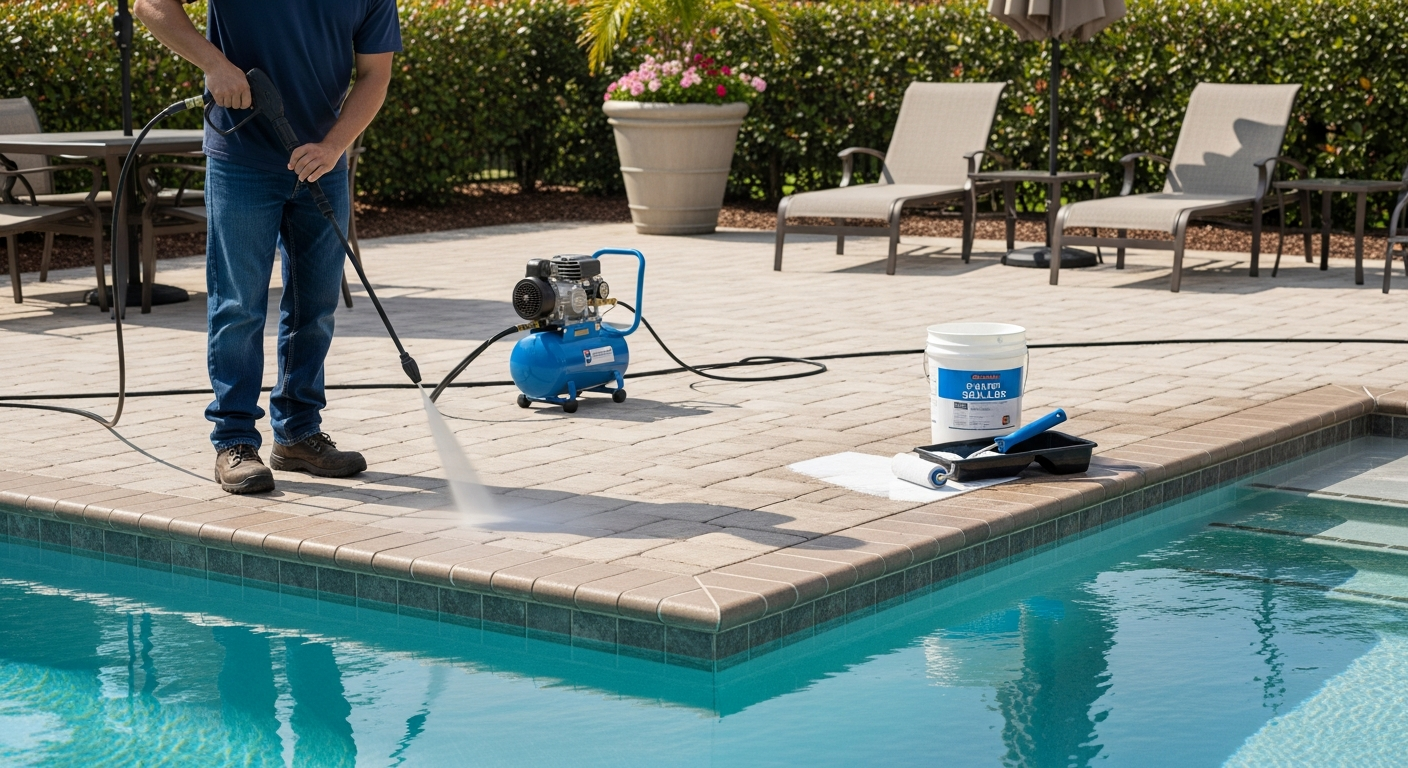
Pressure Wash And Seal Pavers in Osceola County: My Protocol for 300% Longer Color Retention
After years of restoring paver patios and driveways across Osceola County, from the newer developments in Celebration to the established homes in Kissimmee, I've seen one critical failure point repeat itself: sealants that can't withstand the Florida climate. The combination of intense UV exposure and high humidity creates a perfect storm for premature sealant degradation, leading to faded colors and rampant algae growth within a year. Most contractors apply a thick, film-forming acrylic that sits on the surface, essentially suffocating the paver and trapping moisture. This is a fatal flaw here. My approach is fundamentally different. It's not about just cleaning and coating; it's about deep cleaning at a microbial level and using a penetrating sealer that integrates with the paver itself. This method focuses on preparing the paver's capillaries to accept a **silane/siloxane blend**, which creates a hydrophobic barrier *inside* the paver, not just on top of it. The result is a surface that resists mold, maintains its color against harsh sun, and prevents the chalky white haze known as efflorescence, a common sight on properties near Lake Tohopekaliga due to the high moisture levels.The Diagnostic Phase: My Paver Integrity Assessment Protocol
Before a single drop of water is sprayed, I perform a mandatory three-point diagnostic. This is where most projects fail before they even begin. I once took over a job in a St. Cloud community where the previous contractor had sealed directly over active efflorescence, trapping the white mineral salts under a cloudy layer of cheap acrylic. It was a costly and entirely avoidable mistake. My assessment prevents this by focusing on the unseen issues.Technical Deep Dive: Efflorescence, Joint Sand, and Sealant Conflicts
My analysis begins with a moisture meter and a core sample of the joint sand.- Efflorescence Potential: I measure the paver's subsurface moisture content. Readings above 15% indicate a high risk of **efflorescence** (salt migration). If this is the case, I must first apply a specific efflorescence remover and let the pavers dry for a full 48 hours before proceeding. Sealing over damp pavers, especially in our humid Osceola climate, is the number one cause of sealant failure.
- Joint Sand Analysis: I physically check the integrity of the joints. Is it regular sand or degraded **polymeric sand**? Regular sand is a highway for weeds and ant colonies. In Osceola, our heavy afternoon downpours wash it out quickly, leading to paver shifting. A successful project requires the joints to be completely excavated and refilled with high-grade polymeric sand.
- Existing Sealant Test: If there's an old sealant, I apply a small amount of xylene in an inconspicuous area. If the sealant becomes sticky and soft, it's an acrylic base. If it beads up, it's likely a solvent-based product. This dictates the specific stripping agent I must use; applying the wrong one can permanently stain the pavers.
Implementation: The Hydrophobic Penetration Method
Once the diagnostics are complete, I proceed with my proprietary application method. This isn't a simple "spray and pray" technique; every step is calibrated to Osceola's unique environmental pressures.- Surface Decontamination and Profiling: I don't just "pressure wash." I use a variable-pressure wand, never exceeding **2200 PSI** to avoid etching the pavers. The first pass is with a specialized **biocide** that kills mold and algae spores at the root. A simple pressure wash just spreads them around. This is followed by a surface cleaner attachment to ensure a uniform finish without leaving "zebra stripes."
- Joint Stabilization: After cleaning, I wait for the surface to be bone-dry. I then sweep in new polymeric sand, ensuring every joint is filled. The critical step I see amateurs miss is using a plate compactor to vibrate the sand deep into the joints. I then use a leaf blower at a very low angle to set the sand to a depth of 1/8 inch below the paver's edge. This creates a perfect lock.
- Penetrating Sealer Application: I exclusively use a penetrating silane/siloxane sealer, which has low solids content and doesn't create a glossy, slippery film. I apply it using a **two-coat wet-on-wet method** with a battery-powered sprayer for consistent pressure. The first coat is a heavy saturation coat. Within 10 minutes, while the first coat is still damp, I apply a lighter second coat. This ensures maximum penetration into the paver's pores before the surface starts to repel the liquid.
Precision Tuning for Osceola's Climate
The final stage is all about managing the cure. This is where my local experience provides the biggest advantage. A job can be perfect up to this point and still fail in the last 24 hours.- Cure Window Management: I will never start a sealing project if the forecast shows a chance of rain within 8 hours. The afternoon thunderstorms common in Kissimmee and Poinciana can be catastrophic to a fresh seal coat, causing it to re-emulsify and turn milky white.
- The Sheen Test: Thirty minutes after the final coat, I inspect the surface from a low angle. If I see any puddles or overly glossy spots, it means the paver has absorbed all it can in that area. I immediately use a foam roller to back-roll the excess sealer and redistribute it, ensuring a uniform, matte finish.
- My 72-Hour Traffic Mandate: I am adamant about this rule. No foot traffic for at least 12 hours. No vehicle traffic for a full 72 hours. This allows the sealer to fully cross-link below the surface, which is essential for its long-term hydrophobic properties.
Written by

Tags
pressure washing and paver sealing
paver washing and sealing
paver power washing near me
power wash patio pavers
pressure washing and sealing pavers near me