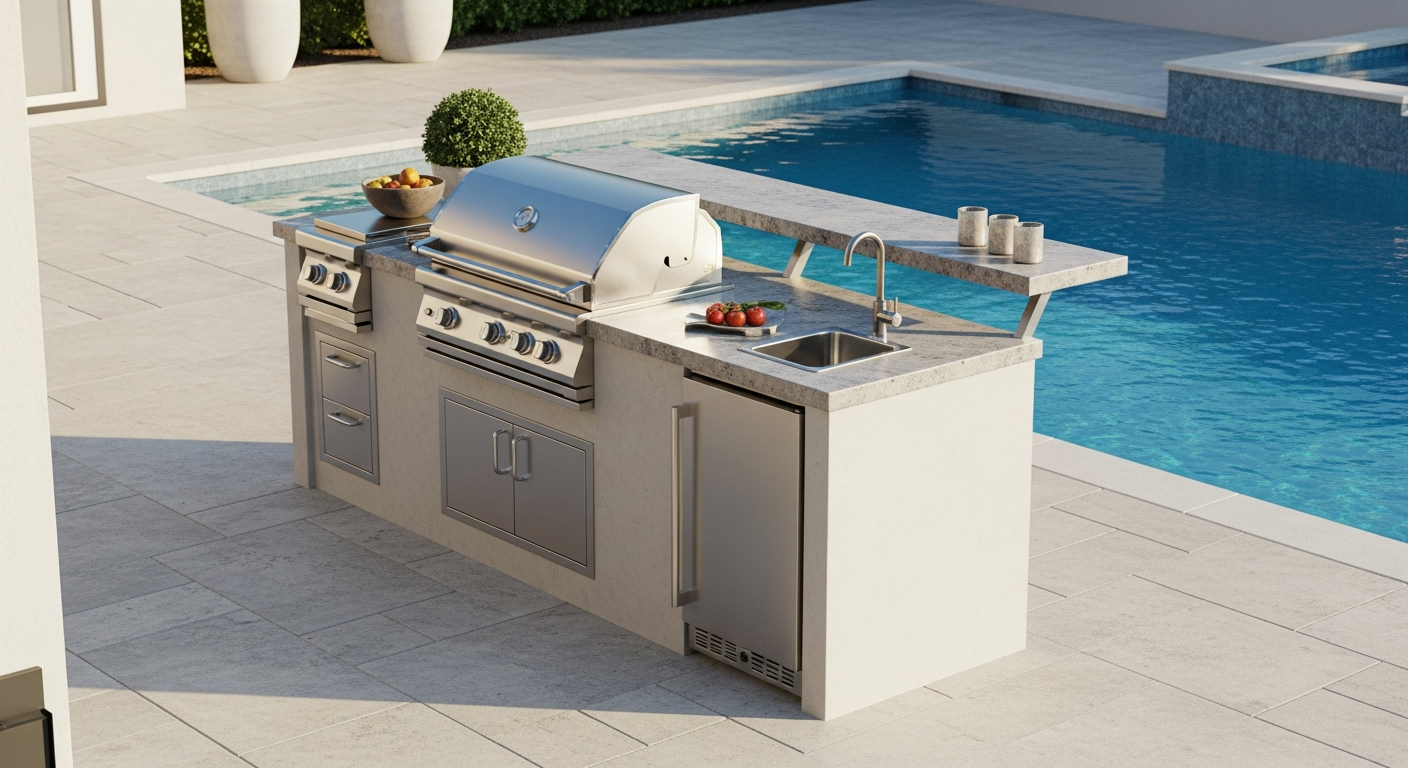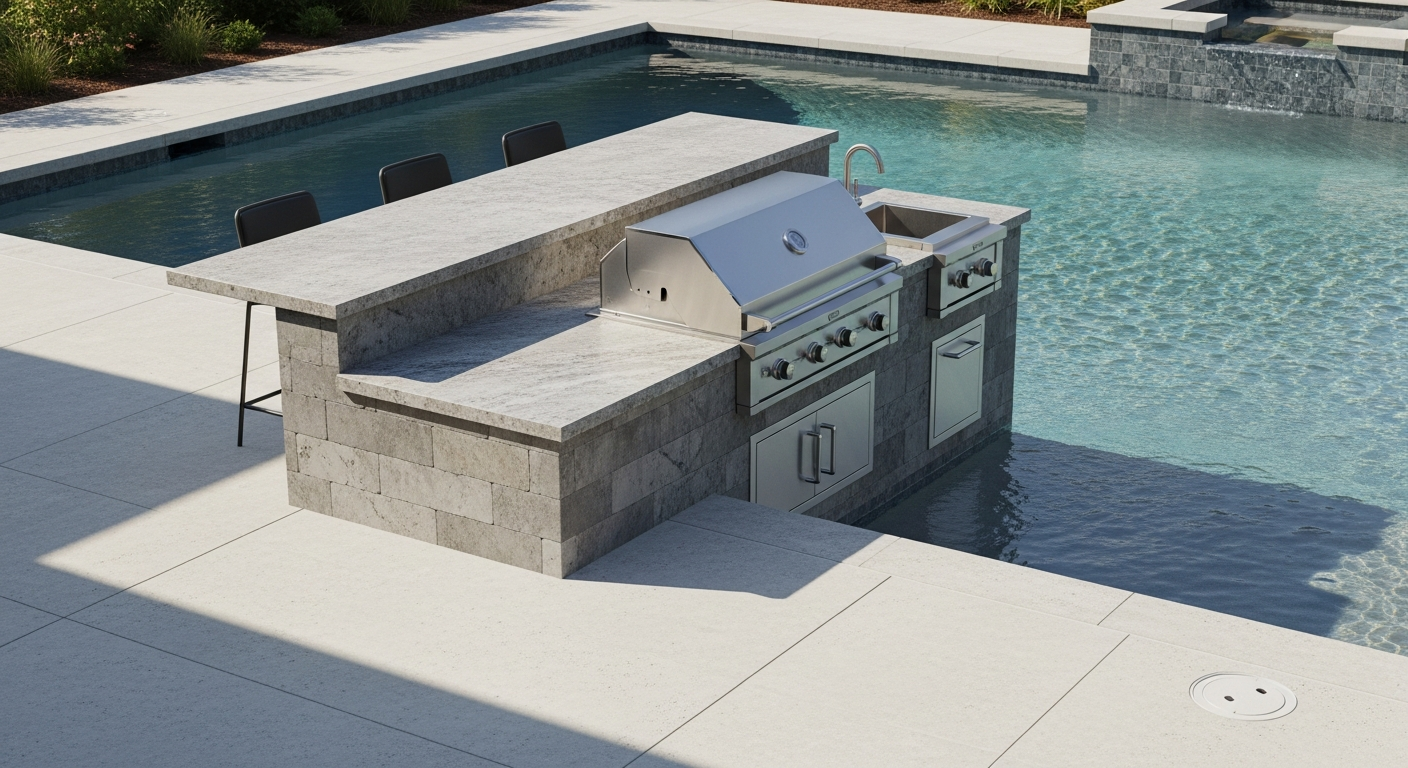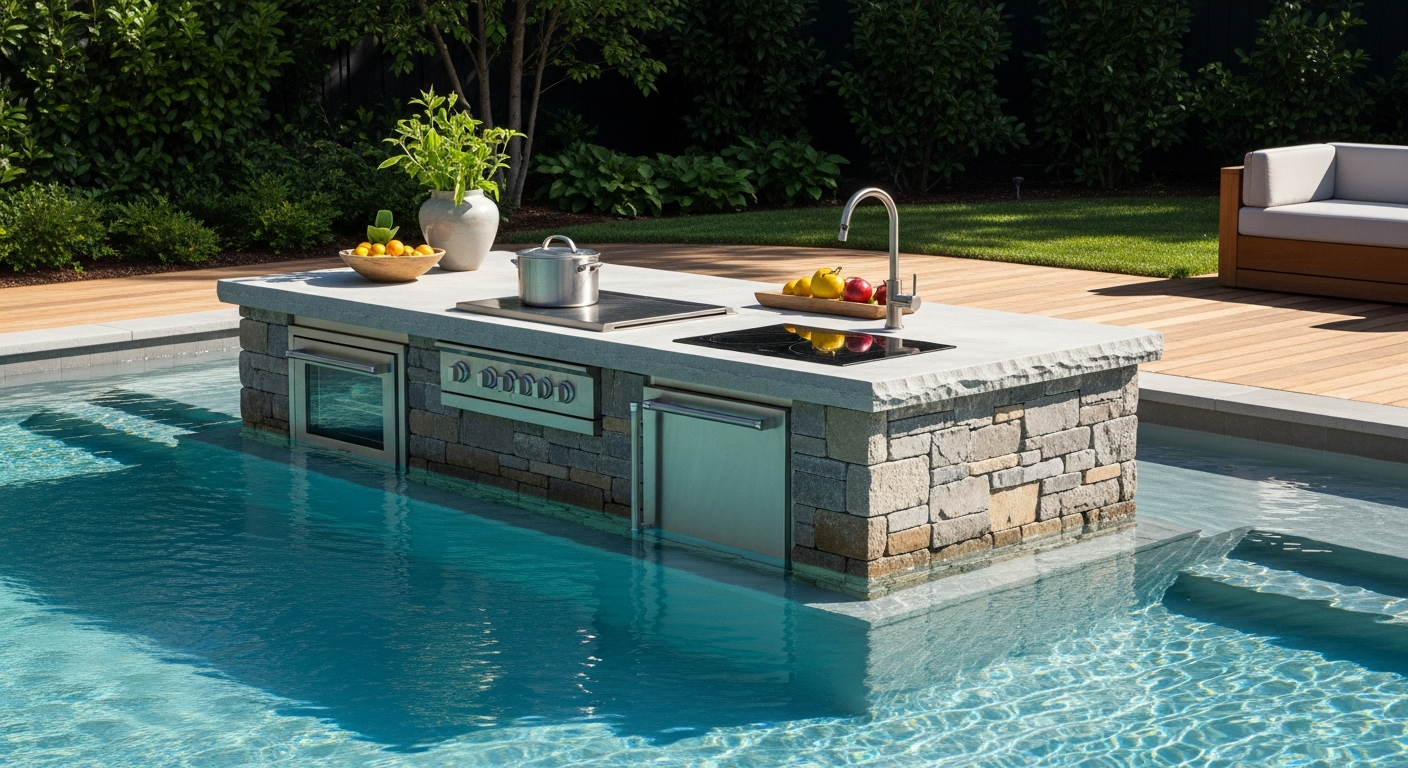
Backyard Kitchen Island in Collier County: My Framework for 20-Year Durability Against Salt & Humidity
Building a backyard kitchen island in Collier County isn't about aesthetics alone; it's a battle against the elements. My primary focus is engineering an outdoor structure that can withstand the relentless humidity, intense UV exposure, and corrosive salt air that defines our coastal living, from the waterfront estates in Port Royal to the beautiful lanais in Pelican Bay. The biggest mistake I see is applying interior construction logic to an exterior environment, leading to material failure in as little as three years. My methodology ensures a minimum 20-year structural lifespan by focusing on a material-first, climate-proof framework. This isn't just about picking "weather-resistant" materials off a shelf. It's about understanding how those materials interact with each other and with our specific Collier County climate. I developed my proprietary "Coastal Core Construction" framework after a project in Marco Island where a client's two-year-old island, built by another contractor, was showing catastrophic failure. The rebar inside the concrete block frame had rusted and expanded—a process called spalling—cracking the entire structure from within. It was a beautiful but fundamentally flawed design. My approach prevents this from day one.The Coastal Core Construction Framework: A Diagnostic Approach
My entire process is built on a diagnostic foundation that preemptively solves Collier County’s unique environmental challenges. Before any design is sketched, I assess three critical vectors: **salt spray exposure**, **direct sunlight hours**, and **moisture drainage potential** of the lanai or patio space. A home on Gordon Drive in Naples has a vastly different salt exposure profile than one in an inland community like Ave Maria. This initial diagnosis dictates every subsequent decision, particularly the core structure. My framework rejects standard wood or galvanized steel framing outright—they are simply not long-term solutions here. The core philosophy is to build an inert, non-reactive chassis that will outlive the appliances it houses.Technical Deep Dive: Material Synergy and Appliance Isolation
The secret to longevity lies in the materials and, more importantly, how they are assembled. The "Coastal Core" is not just a single material but a system. For the frame, I exclusively use welded 6061-T6 aluminum tubing. It's lightweight, incredibly strong, and completely impervious to rust, unlike steel. The cladding is the next critical layer. I avoid traditional stucco over metal lath, as it traps moisture. Instead, I specify marine-grade polymer panels (like StarBoard) or a poured-in-place glass-fiber reinforced concrete (GFRC) shell. Both create a non-porous barrier. One of my most critical, non-negotiable specifications is appliance isolation. A common, costly error is allowing a stainless steel grill to make direct contact with the island's masonry or metal frame. This creates a galvanic cell, accelerating corrosion on the grill. To prevent this, I mandate the use of high-density polyethylene (HDPE) insulating liners within the appliance cutouts. This creates a small air gap and a non-conductive barrier, which can increase the functional life of a high-end grill by up to 40%.Implementation Protocol: From Foundation to Finish
Building a backyard kitchen island that lasts requires a precise, non-negotiable sequence of actions. Deviating from this protocol is where failures begin. I've refined this process over dozens of projects across Collier County.- Step 1: The Monolithic Slab Foundation. The sandy soil here requires more than a simple floating slab. I specify a monolithic pour with integrated 12-inch footers around the island's perimeter. This prevents shifting and cracking as the ground settles.
- Step 2: Frame Fabrication and Welding. The aluminum frame is cut to spec. All joints are TIG welded for maximum strength and a clean finish. All welds are then treated with a corrosion-inhibiting primer, even though the aluminum itself won't rust. This is a redundancy I insist on.
- Step 3: Cladding and Ventilation. The cladding panels are mounted to the frame using stainless steel fasteners. Crucially, I engineer a 3/4-inch rainscreen gap between the frame and the back of the cladding. This allows any penetrating moisture to drain and air to circulate, preventing mold and mildew growth—a constant issue in our humid environment.
- Step 4: Countertop Installation. The choice of countertop is vital. I recommend sintered stone (like Dekton) or low-porosity quartzite over more porous granites that can stain and harbor mildew. The countertop is adhered using a specialized, flexible outdoor-rated epoxy, not a rigid mortar.
Precision Adjustments and Quality Control Checkpoints
The details are what separate a 5-year island from a 20-year investment. First, for countertop overhangs designed for seating, I enforce a strict 2:1 support-to-overhang ratio to eliminate the risk of stress fractures over time. This means for a 12-inch overhang, there must be at least 24 inches of cabinet supporting it. Second, all electrical wiring is run through liquid-tight flexible conduit, and every outlet must be a GFCI-protected circuit with a weatherproof-in-use cover. Finally, my last quality check is the sealant protocol. I apply a two-stage sealant to all countertop and grout surfaces: first, a deep-penetrating silane/siloxane sealer, followed 24 hours later by a topical fluoropolymer-based coat for stain resistance. Given the substantial investment of an outdoor kitchen, have you considered if your builder's material plan accounts for the specific galvanic corrosion potential between your chosen grill and the island's structural frame?Written by

Tags
kitchen outdoor grill
outdoor kitchen propane grill
prefabricated outdoor grill islands
prefab grill island
outdoor grill with sink