Cheap Outdoor Kitchen: My Framework for a 70% Cost Reduction Without Sacrificing Durability
Building a cheap outdoor kitchen that doesn't rot or crumble after two seasons is the real challenge. The common approach—focusing on a flashy grill and skimping on the structure—is a recipe for failure. I've seen it happen on client projects where I was called in to fix a disintegrating structure built just a few years prior. The core issue is a fundamental misunderstanding of material science and load distribution in an outdoor environment.
My entire methodology revolves around a principle I call the Modular Durability Framework. It inverts the typical budget allocation. Instead of prioritizing expensive finishes, we over-invest in a rock-solid, weather-proof frame using inexpensive but robust materials. This allows you to use budget-friendly (and even temporary) finishes that can be upgraded later, ensuring the core investment has a 15-year-plus lifespan, not a 3-year one.
The Core Misconception: Why Most DIY Budget Kitchens Fail Within 3 Years
The most frequent mistake I encounter is a frame built from untreated or poorly sealed pine. The builder spends a fortune on granite tile, only to have the underlying plywood and 2x4s swell, delaminate, and rot from moisture intrusion. The grout cracks, water gets in, and the entire structure is compromised. The "expensive" kitchen is now worthless because its skeleton failed.
My methodology attacks this problem at the source. The structural frame and countertop substrate are non-negotiable zones for quality. These components represent less than 30% of the total project cost but are responsible for 90% of its structural longevity. By focusing the budget here, we create a base that can withstand weather, thermal expansion, and frequent use, allowing for immense savings on the visible cladding and surfaces.
Deconstructing My Modular Durability Framework
I’ve refined this framework over dozens of personal and client builds. It’s based on three critical technical pillars that are often overlooked in online tutorials.
- Pillar 1: The Frame Material. Forget standard lumber. The optimal choice for a budget frame is either 20-gauge steel studs or pressure-treated lumber rated for ground contact. Steel studs are my preference; they are perfectly straight, impervious to rot and insects, and surprisingly cost-effective. Assembly requires self-tapping screws, but the resulting frame is dimensionally stable for decades.
- Pillar 2: The Countertop Substrate. Never apply tile or any finish directly to plywood or OSB outdoors. It will fail. The correct substrate is 1/2-inch cement backer board (like HardieBacker or Durock). It's waterproof, stable, and provides an ideal bonding surface for thinset mortar. I mandate that all seams be taped and sealed with thinset, creating a monolithic, water-resistant shell.
- Pillar 3: Appliance and Heat Isolation. A common fire hazard I've seen is a drop-in grill's heat jacket resting directly against wood framing. My standard is to build the grill cavity entirely from steel studs and cement board, creating a non-combustible zone that isolates the heat source from any structural wood, even if it's pressure-treated. This is a non-negotiable safety protocol.
- Step 1: Frame Assembly. Build your kitchen's boxes using steel studs or pressure-treated lumber. Use galvanized or stainless steel screws. Ensure every joint is perfectly square. A flawed frame will translate into a nightmare when you try to apply finishes. Measure your appliances three times and build the openings with a 1/4-inch tolerance for easy installation.
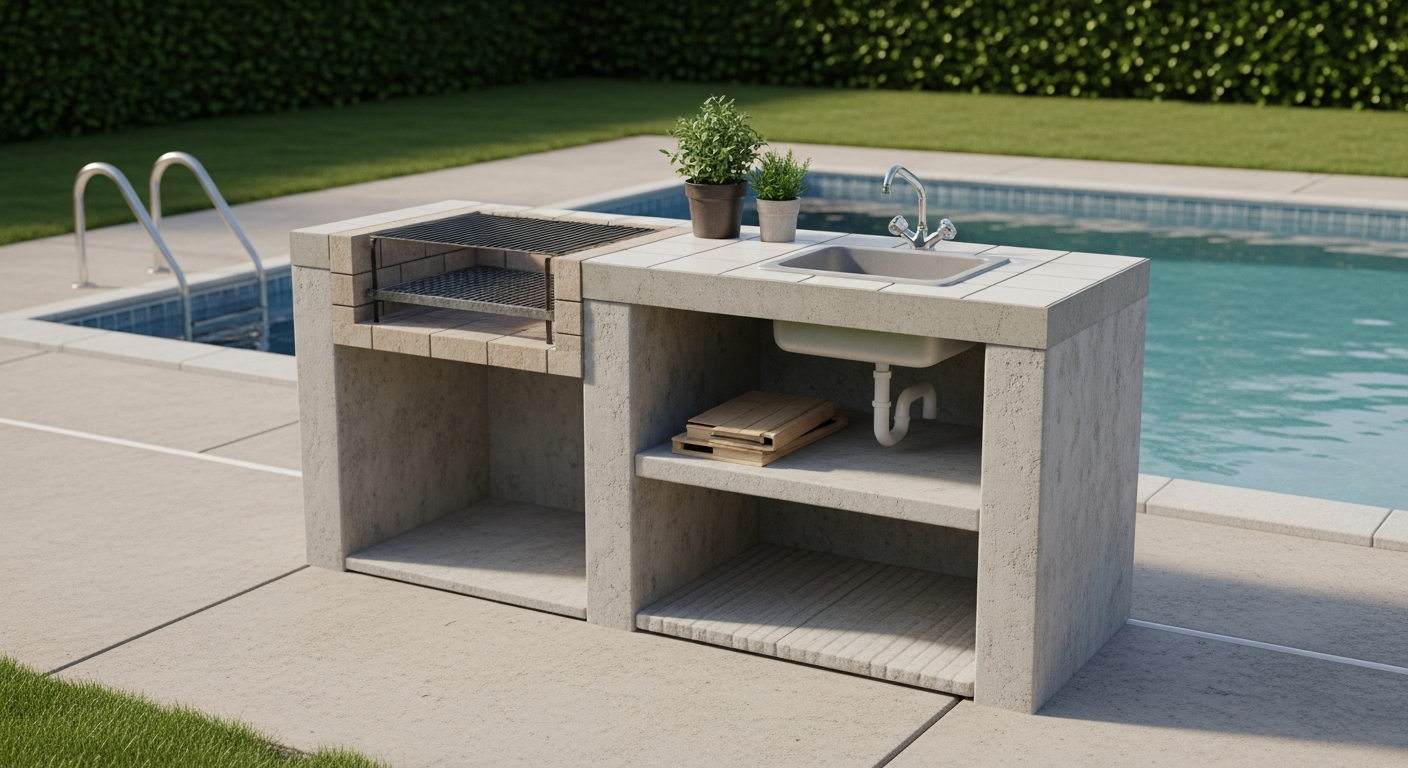
- Step 2: Sheathing and Substrate. Clad the entire frame, inside and out, with cement backer board. This is your armor. Secure it with the manufacturer-specified screws, ensuring you hit the studs. Tape and mud all joints with polymer-modified thinset mortar. At this stage, your kitchen should look like a plain gray box, but it's now virtually indestructible and weatherproof.
- Step 3: Countertop Fabrication. The biggest money-saver is a pour-in-place concrete countertop. Form the countertop directly on the kitchen base using melamine boards. A simple mix of standard countertop concrete, reinforced with wire mesh, costs a fraction of granite and provides an industrial, high-end aesthetic. The key is vibrating the form to remove air bubbles. I've used a simple orbital sander against the form sides to achieve a dense, professional finish.
- Step 4: Budget-Friendly Cladding. With a bulletproof core, you can get creative and cheap with the finish. I often recommend large-format porcelain tiles from a clearance center for the sides. Another fantastic option is to install horizontal cedar fence pickets, stained and sealed, for a modern look at a minimal cost. Because the structure underneath is sound, you can easily remove and replace this cladding in 5-7 years if you want a new look.
Tags
stainless steel outdoor kitchen units
prefab outdoor kitchen island
high end outdoor grills built in
u shaped outdoor kitchen
outdoor kitchen u shape