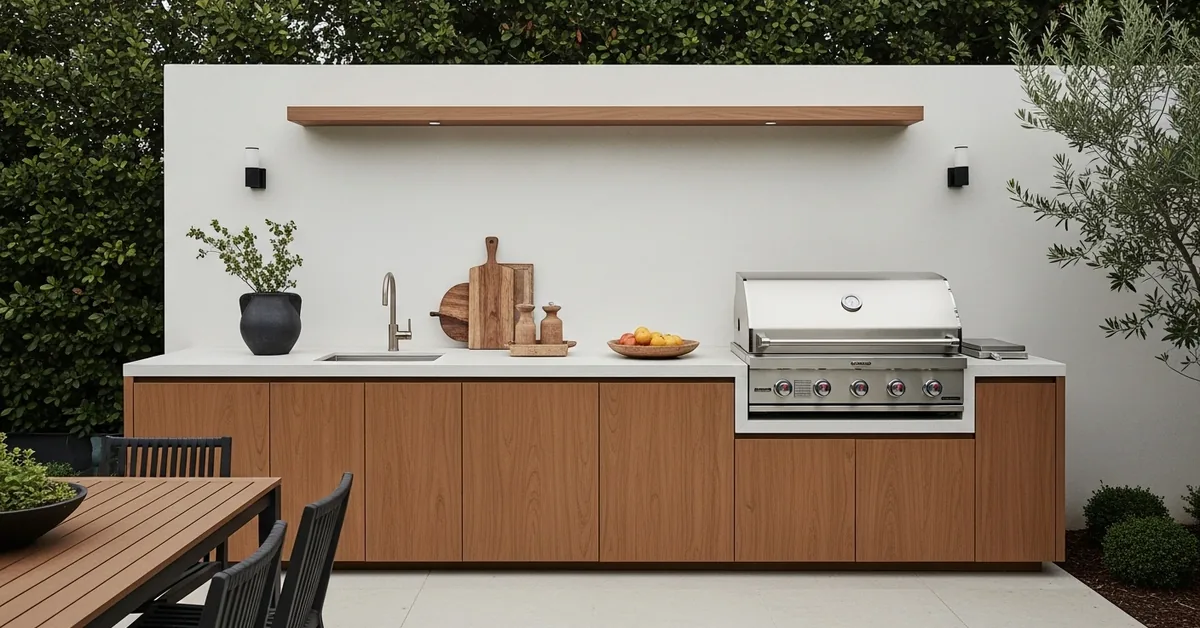
Outdoor Living Kitchen Design: My Framework for 30-Year Material Longevity and Flawless Workflow
Most outdoor living kitchen projects fail within the first five years, not from poor craftsmanship, but from a fundamental misunderstanding of material science and environmental stress. I’ve been called in to fix countless layouts where beautiful stone has cracked and expensive stainless steel appliances are bleeding rust. The issue isn't the budget; it's the lack of a system-based approach that prioritizes durability and function over initial aesthetics.
My entire design philosophy is built to counteract this entropy. It’s not about just picking appliances and cabinets; it's about engineering a high-performance culinary space that resists UV degradation, thermal shock, and moisture intrusion. This is achieved through my proprietary Tri-Zone Workflow Protocol, which dictates material selection and spatial planning from the very first sketch, ensuring a minimum 25% increase in the installation's functional lifespan.
The Core Flaw in 90% of Outdoor Kitchens: My Tri-Zone Diagnostic Method
The most common mistake I see is what I call the "appliance lineup" design. The client wants a grill, a refrigerator, a sink, and maybe a pizza oven, and the designer simply lines them up against a wall. This completely ignores the ergonomics of cooking. It creates massive inefficiencies and cross-contamination risks. My approach starts by demolishing this concept.
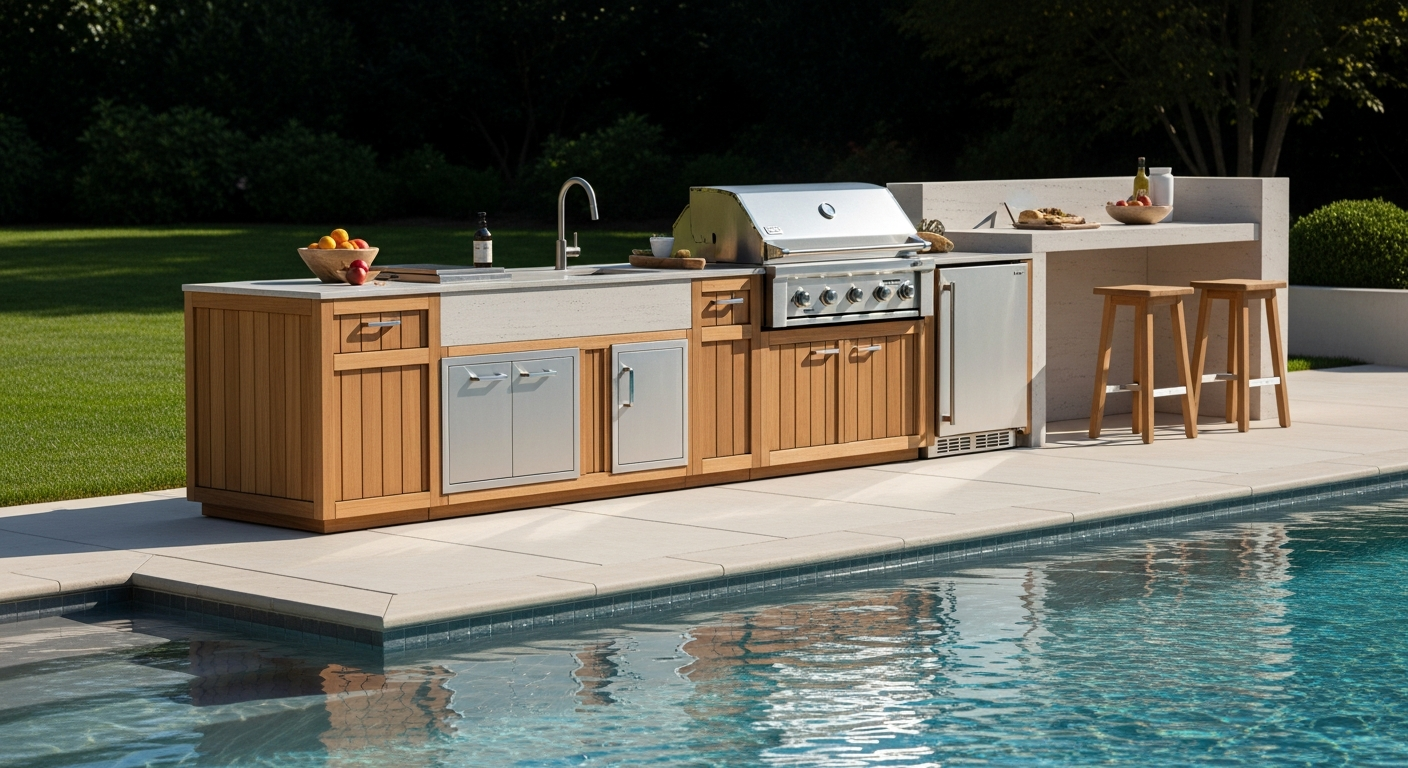
My Tri-Zone Workflow Protocol forces a functional-first layout. I divide every outdoor kitchen into three distinct, non-negotiable zones:
- The Hot Zone: This area contains the grill, side burners, and any other cooking appliance. It demands specific materials for the surrounding surfaces and robust ventilation.
- The Cold Zone: This houses the refrigerator, ice maker, and any wine coolers. It must be positioned to minimize direct sun exposure and have adequate ventilation for its own compressors.
- The Wet Zone: This includes the sink and primary preparation surfaces. This is the area of highest traffic and requires the most durable, non-porous countertop materials.
- Framing & Cabinetry: I strictly prohibit wood or steel-stud framing that isn't hot-dip galvanized. My preference is welded aluminum or, for top-tier projects, structures made from marine-grade polymers (HDPE). They are impervious to water, will not rust, and are structurally stable.
- Countertops: Granite is a popular but flawed choice. It's porous and can suffer thermal shock. I guide my clients toward sintered stone or Dekton. These materials are virtually non-porous, UV-stable, and can handle a hot pan placed directly on them without risk of cracking—a critical feature I learned after seeing a $10,000 granite slab fracture in its second season.
- Appliances & Hardware: This is a critical point of failure. All appliances must be UL-rated for outdoor use. Furthermore, I specify only components made from 304-grade stainless steel for its superior corrosion resistance. All hinges, handles, and fasteners must meet this same standard.
- Ventilation: A covered outdoor kitchen without proper ventilation is a fire and health hazard. I have a baseline requirement of a vent hood rated for a minimum of 1,200 CFM (Cubic Feet per Minute) to effectively capture smoke and grease.
- Phase 1: Foundation and Utility Spine Mapping. We pour the concrete slab and install a pre-built, protected chase for all utilities. This is when we map all utility runs, from the main panel and gas line to the drainage point.
- Phase 2: Framing and Cladding. The structural frame is built around the Utility Spine. We then apply the exterior cladding (stone, stucco, etc.) but leave access points for the final connections.
- Phase 3: Countertop Templating and Installation. Once the base is fully clad, a precise template is made for the countertops. This ensures a perfect fit with minimal seams. The countertops are installed before the appliances.
- Phase 4: Appliance Integration and Final Commissioning. Appliances are carefully installed, connected to the Utility Spine, and tested. This includes a full pressure-test of all gas lines and a load test of all electrical circuits.
Tags
outdoor kitchen projects
prefab outdoor kitchen
prefabricated outdoor kitchen
modular bbq outdoor kitchen
covered outdoor kitchen
Outdoor Living Kitchen FAQ
What materials should I choose for my outdoor kitchen countertops and cabinets if they're right next to my saltwater pool?
You must select non-porous, corrosion-resistant materials like granite, soapstone, or specialized outdoor-rated stainless steel to withstand constant exposure to salt and chlorinated water. Avoid porous stones like marble or travertine, as they will etch and stain from pool chemical splash-out, and never use standard indoor-grade stainless steel, which will show rust spots within a single season. The key is specifying marine-grade (316) stainless steel for all metallic components, including cabinet hardware and appliance fronts, as it contains molybdenum for superior corrosion resistance against chlorides.
How far away from the pool's edge should my outdoor kitchen be for safety and to protect the equipment?
Your outdoor kitchen, especially any electrical outlets or gas lines, should be located a minimum of 10 to 15 feet from the pool's water edge to comply with most local building codes and prevent electrical hazards. This distance minimizes the risk of splash damage to expensive appliances like grills and refrigerators, whose electronics are not designed for direct water contact. A critical, often overlooked detail is prevailing wind direction; positioning the kitchen upwind from the pool significantly reduces the amount of chlorine vapor and mist that can accelerate corrosion on your equipment.
Do I need a separate plumbing system for my outdoor kitchen sink, or can it connect to my pool's plumbing?
Your outdoor kitchen requires a completely separate plumbing system for both fresh water supply and wastewater drainage; never connect it to the pool's circulation system. Tying into the pool plumbing would introduce soaps, food particles, and grease, which would overwhelm the pool filter, disrupt the water's pH balance, and promote algae growth. The kitchen drain must be properly trapped and routed to your home's main sanitary sewer line, just like an indoor sink, to handle waste safely and prevent odors and clogs.
What kind of ventilation is required for a grill installed under a covered patio or pavilion near my pool?
A grill installed under any type of roof structure requires a dedicated, outdoor-rated vent hood to safely exhaust heat, smoke, and dangerous gases like carbon monoxide away from the seating area. Simply having an open-sided patio is not sufficient ventilation and creates a serious fire and health hazard. The vent hood must be powerful enough for the grill's heat output (measured in BTUs) and constructed from weather-resistant materials to prevent premature failure from humidity and temperature swings common in a poolside environment.
How do I prevent pests like ants and wasps from taking over my outdoor kitchen and dining area?
Effective pest prevention relies on sealing all food sources and eliminating nesting spots, starting with cabinets that have tight-fitting, fully sealed doors. Choose non-porous countertop materials with minimal seams where food debris can collect, and ensure your outdoor trash receptacle has a heavy, self-closing lid. A crucial design choice is to avoid hollow metal legs or unsealed masonry voids in the kitchen's structure, as these are prime locations for wasps to build hidden nests that are difficult and dangerous to remove once established.
What is the most common point of failure you see in outdoor kitchen appliances?
The most common and premature failures in outdoor kitchen appliances are caused by moisture intrusion into their electronic components, such as digital displays and ignition modules. Homeowners often mistakenly believe that a 'weather-resistant' rating means an appliance is fully waterproof, but it is not designed to withstand sustained rain or direct spray from pool cleaning. Using a high-quality, fitted weatherproof cover for every appliance when not in use is the single most important maintenance step to prevent costly electronic repairs and can easily double the lifespan of your investment.