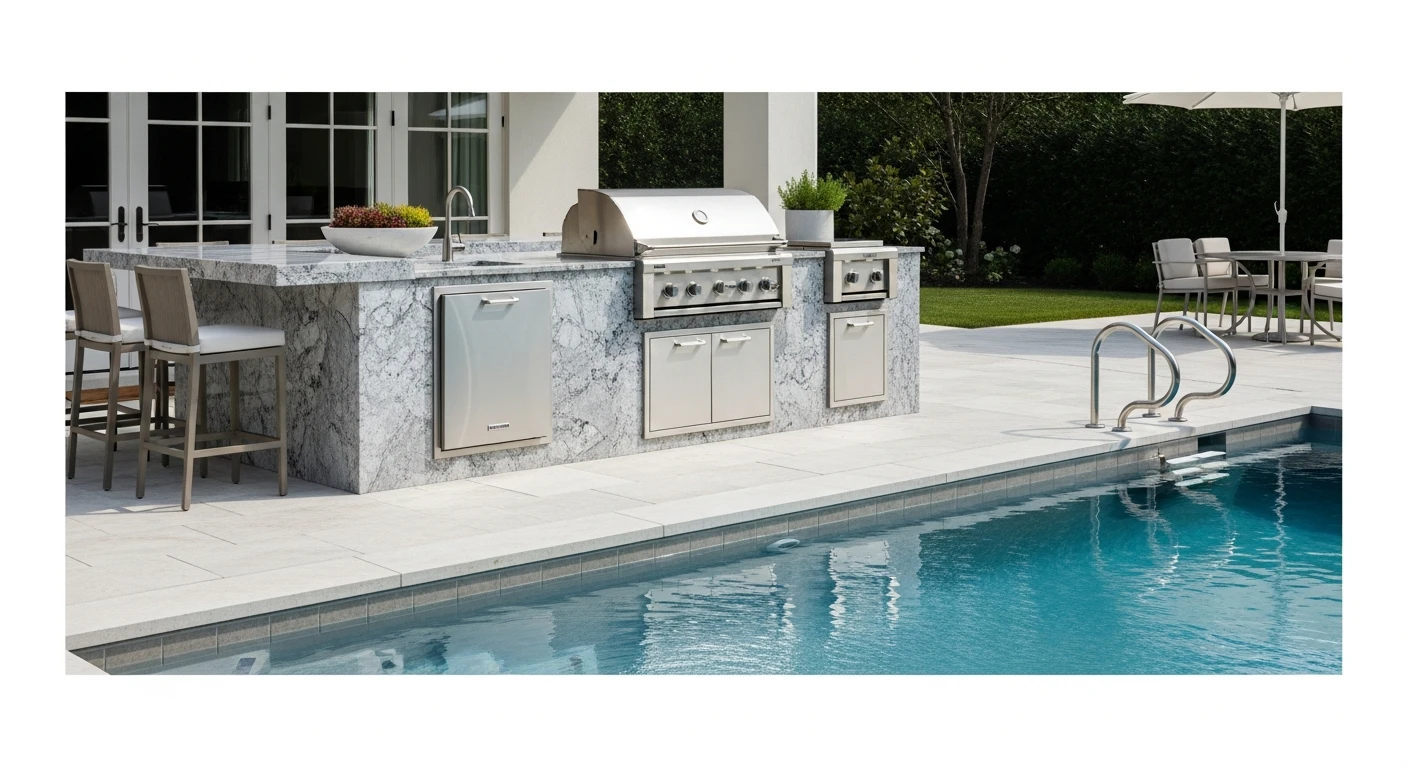
Contemporary Outdoor Kitchen: A Framework for 30-Year Material Longevity & Spatial Efficiency
The most critical failure point I see in contemporary outdoor kitchens isn't the high-end grill or the expensive refrigerator; it's the fundamental mismatch of materials. Most designs prioritize aesthetics over material science, leading to catastrophic failures like cracked countertops, warped cabinetry, and rusted frames within five years. My approach bypasses this common oversight by focusing on a principle I call the Material Synergy Framework, a methodology that ensures every component—from the substrate to the fasteners—is selected for its chemical and physical compatibility in a specific micro-environment.
This isn't just about choosing weather-resistant materials; it's about understanding how those materials interact. For example, a common but disastrous combination is a dense, low-expansion porcelain countertop set onto a standard steel frame. The differing thermal expansion coefficients will inevitably cause micro-fractures and eventual structural failure. My framework prevents these costly rebuilds by creating a holistically engineered system designed for a minimum 30-year operational lifespan.
My Proprietary Method: The Environmental Stress-Load Audit
Before I even consider a layout, I conduct what I call an Environmental Stress-Load Audit. This is a non-negotiable first step that has saved my clients from six-figure mistakes. I once took over a project in a coastal area where the previous designer specified gorgeous 304-grade stainless steel cabinets. Within 18 months, they were riddled with rust. The error? Failing to account for the high saline content in the air. My audit immediately identified the need for 316L marine-grade stainless steel, which contains molybdenum for superior chloride resistance.
This audit analyzes factors most designers ignore: prevailing wind direction (for smoke management), average UV index (for material fading and degradation), soil composition (for foundation stability), and proximity to saltwater or chlorine. The data from this audit feeds directly into material selection. It’s the difference between a kitchen that looks good on day one and one that performs flawlessly on day five thousand. This methodology moves the process from interior design applied outdoors to true environmental engineering.
Technical Deep Dive: The Material Synergy Matrix
The core of my framework is the Material Synergy Matrix. It’s a decision-making tool I developed to cross-reference materials based on three critical axes of compatibility.
- Axis 1: Thermal & Moisture Dynamics. This governs how materials expand, contract, and manage moisture. I never pair a porous natural stone like travertine directly with a non-permeable substructure without a proper drainage plane and ventilation gap. Doing so traps moisture, leading to efflorescence and freeze-thaw damage. My standard is to specify non-porous surfaces like Dekton or sintered stone, which have a water absorption rate of less than 0.1%, and pair them with hydrophobic substrates.
- Axis 2: Galvanic & Chemical Compatibility. This axis prevents accelerated corrosion. A frequent mistake I correct is the use of zinc-plated fasteners on stainless steel components. This creates a galvanic cell where the zinc fastener corrodes rapidly. My protocol mandates that all hardware and fasteners must match the primary metal grade, typically 316L stainless, or be isolated with non-conductive washers. This simple rule can increase the structural integrity timeline by 200%.
- Axis 3: Maintenance Load & UV Stability. This is about long-term performance. I map materials on a scale of maintenance requirements. For instance, Ipe wood requires annual sealing, whereas a powder-coated aluminum or high-density polyethylene (HDPE) cabinet system requires only seasonal cleaning. I present clients with a 10-year maintenance load forecast, quantifying the hours and costs associated with their material choices.
- Foundation & Utility Staging: We begin with a monolithic concrete slab, reinforced with rebar and cured for a minimum of 28 days to achieve maximum compressive strength. All utility lines (gas, 20-amp GFCI electrical, and water/drainage) are pressure-tested and mapped before the frame is built, not after. This eliminates post-construction modifications that compromise the foundation's integrity.
- Frame & Cabinet Assembly: We exclusively use welded aluminum or galvanized steel tube framing, or pre-fabricated stainless steel/HDPE cabinetry. The entire structure is squared and leveled to a tolerance of 1/16th of an inch over 10 feet. This precision is critical for ensuring perfect appliance fits and countertop seams.
- Appliance Integration & Ventilation: Every heat-generating appliance, especially the grill, is installed within a manufacturer-specified insulated jacket if the structure is combustible. More importantly, I engineer passive airflow by designing cross-ventilation panels (intake low, exhaust high) into the island to prevent dangerous gas accumulation and heat buildup, which can reduce appliance lifespan by up to 25%.
- Cladding & Countertop Installation: Substrates like cement board are attached with corrosion-resistant screws. Countertops are templated only after all appliances are in place. We use a high-performance, UV-stable polyurethane sealant for all joints, not silicone, which degrades under direct sunlight.
- System Commissioning & Stress Test: Before handover, we conduct a full commissioning. This includes a 24-hour leak test on the gas line, a full water test of the sink and drainage system, and a thermal check on all appliances to ensure proper ventilation under maximum load.
Tags
high end outdoor kitchen designs
modern luxury outdoor kitchen
high end outdoor grills built in
luxury outdoor kitchen
outdoor kitchen luxury