
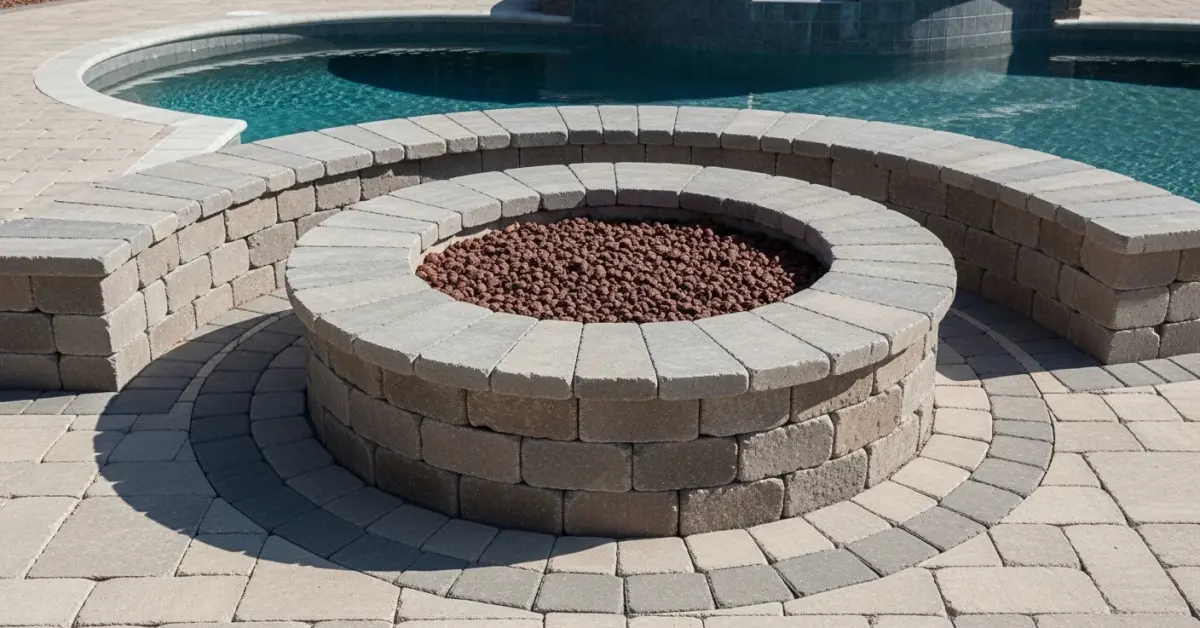
In my years installing hardscapes in Sarasota County, I’ve seen that a successful curved paver fire pit hinges entirely
In my years installing hardscapes in Sarasota County, I’ve seen that a successful curved paver fire pit hinges entirely on two factors most people overlook: the paver's taper and the base's compaction. A non-tapered paver forced into a curve creates wide, unstable joints that fail under our heavy rains. The sandy, shifting soil here requires a deeper, more meticulously compacted aggregate base than in other parts of the country. Get these wrong, and the beautiful circle you paid for becomes an uneven, weed-infested problem within a few seasons.
- Material Focus: Use circle kit pavers or specially tapered wall blocks designed for tight radii to minimize joint gaps.
- Base Preparation: A minimum 6-inch compacted aggregate base (FDOT #57 stone followed by screenings) is essential for stability on Sarasota's sandy soil.
- Heat Safety: A steel fire ring insert is not optional; it protects the paver adhesive and concrete caps from direct flame, preventing cracking and discoloration.
- Drainage: Incorporate weep holes or a gravel base inside the fire pit to manage rainwater, preventing it from becoming a stagnant pool that damages the structure.
The Planning Mistake That Drives Up Project Costs
The most common and costly error I see is selecting a standard rectangular paver for a curved fire pit to save a few dollars on materials. Homeowners see a paver they like for their main patio and assume it can be cut to form the fire pit circle. This approach is a recipe for long-term failure and aesthetic disappointment in our specific climate.
When you cut rectangular pavers to make a curve, you create numerous small, irregular pieces. This leads to excessively wide mortar or polymeric sand joints. In Sarasota, with our torrential summer downpours, these wide joints are the first point of failure. The sand washes out, weeds take root almost immediately, and the small, custom-cut pieces start to shift on the unstable base. Within a year, the perfect circle is no longer perfect.
Why Material Selection Is a Budget Decision, Not Just an Aesthetic One
I worked on a project in The Landings where the client insisted on using leftover 4x8 brick pavers from their driveway to build a matching fire pit. We warned them about the joint issue, but they wanted to use the material they already had. Six months after completion, they called us back. The polymeric sand had failed in the huge V-shaped gaps, the small cut pieces were loose, and the fire pit looked a decade old. The cost to dismantle the failing pit and rebuild it correctly with a proper circle kit was nearly double the initial savings. Choosing a dedicated circle paver kit from the start is a critical budget decision, not a luxury.
The Anatomy of a Durable Curved Fire Pit in Sarasota
Building a paver fire pit that lasts involves more than just stacking stones. It's an engineered system designed to handle heat, water, and shifting ground. The process begins with a precise excavation, followed by the most critical phase for our local soil conditions: base preparation. We use a plate compactor to create a solid foundation of crushed stone, ensuring it won't settle over time.
The first course of pavers is the most important. It must be perfectly level, as every subsequent layer will amplify any imperfections. We use high-strength, heat-resistant construction adhesive between each course. Finally, a steel ring is inserted to contain the fire, and a capstone or coping is installed to provide a finished look and protect the structure. The entire process, for a standard 4-foot diameter pit, typically takes two to three days when done correctly.
Paver Selection Criteria for the Sarasota Climate
- Colorfast Technology: Choose pavers with integrated color throughout the stone, not just a surface coating. The intense Florida sun will fade surface-dyed products in as little as three years.
- Low Porosity: Select dense, low-absorption pavers. Porous stones will hold moisture from our humid air and frequent rain, promoting algae and mold growth.
- Tapered Design: Insist on pavers specifically manufactured for circles (tapered wall blocks or circle kits). This ensures tight, uniform joints that hold polymeric sand effectively.
- Salt Resistance: If you live near the coast (Siesta Key, Longboat Key), verify the paver is rated for saltwater environments to prevent spalling and degradation from salt air.
Comparing Paver Fire Pits to Other Options
Homeowners often weigh building a custom paver fire pit against buying a portable metal one or installing a natural gas unit. Each has its place, but the decision depends on your goals for permanence, aesthetics, and maintenance.
| Feature | Curved Paver Fire Pit | Portable Metal Fire Pit | Natural Gas Fire Pit |
|---|---|---|---|
| Upfront Cost | High ($2,500 - $6,000) | Low ($150 - $800) | Very High ($5,000 - $12,000+) |
| Durability in FL Climate | Excellent (if built correctly) | Poor (rusts quickly in salt air/humidity) | Good (requires stainless steel components) |
| HOA Approval | Often requires detailed plans/ARC review | Usually no approval needed | Requires permits and ARC approval |
| Heat Output | High (wood-burning) | Moderate | Moderate to High (adjustable) |
When a Paver Fire Pit Isn't the Right Choice
A custom paver fire pit is a permanent structure. If you are renting, plan to move within a few years, or have a small yard where a permanent feature would limit flexibility, it's not the best investment. I advised a client in a Southgate patio home that a permanent fire pit would overwhelm their limited outdoor space and make it harder to sell later. They opted for a high-quality portable unit, which gave them the ambiance without the permanent footprint and cost.
Safe Installation and Contractor Vetting Checklist
Building a fire pit is not just a landscaping project; it involves fire, which means safety and liability are paramount. Vetting your contractor properly is essential to protect your home and investment.
- Verify State License: Ensure the contractor holds a relevant and active license with the Florida Department of Business and Professional Regulation (DBPR). A basic lawn care company is not qualified.
- Check for Sarasota County Permits: While a simple fire pit may not always require a permit, any associated gas lines or extensive patio work absolutely will. Ask the contractor when a permit is triggered under Sarasota County code. A professional will know the answer instantly.
- Request Proof of Liability and Workers' Comp Insurance: Do not proceed without seeing the certificates. If an uninsured worker gets injured on your property, you could be held liable.
- Inspect Their Portfolio for Curved Work: Ask to see pictures of other curved or circular projects they have completed. Look closely at the joints. Are they tight and uniform, or wide and sloppy?
- Discuss the Base Preparation Method: A legitimate contractor will be happy to explain their multi-step process for excavating and compacting the aggregate base. Vague answers are a major red flag.
- Confirm Use of a Fire Ring Insert: Ask specifically if a steel ring insert is included in the quote. If they say it's unnecessary, walk away. They are cutting corners that will cost you later.
Decisions That Separate a Great Project from a Mediocre One
Over the years, I've noticed the most successful projects are defined by decisions made long before the first paver is laid. The client who ends up happiest is the one who prioritizes the system over the surface. They understand that the invisible parts—the compacted base, the drainage, the adhesive—are what guarantee the longevity of the visible part.
Integrating the fire pit into a larger paver patio design is another key decision. A standalone fire pit often looks like an afterthought. A thoughtfully designed patio that flows into the fire pit area creates a cohesive, high-end outdoor living space. This is where planning pays dividends, turning a simple feature into the centerpiece of your backyard.
The Moment Most Homeowners Get It Wrong
The critical mistake often happens during the quote comparison stage. Homeowners see two quotes for a "4-foot paver fire pit" and assume they are comparing the same product. They choose the lower price, not realizing it omits the steel insert, uses a shallower base, and relies on non-tapered blocks. The right approach is to demand that every quote breaks down the specific materials and construction methods. Ask: What is the base depth? What type of paver will be used (standard vs. tapered)? Is a steel fire ring included? The detailed quote is always the more honest one.
Practical Answers for Building in Sarasota
Navigating local regulations and site conditions is part of any successful hardscape project. Here are the realities of building a fire pit in this area.
What Are the Setback Requirements in Sarasota County?
Sarasota County fire code generally requires open-flame cooking devices and recreational fires to be at least 25 feet from any structure or combustible material. While some HOAs may have different rules, this is the standard safety guideline we build to. Before finalizing the location, we always measure the distance to your house, lanai screen, trees, and fences. Placing it too close is a safety hazard and a code violation.
How Do HOAs in Communities like Lakewood Ranch View Fire Pits?
Most higher-end HOAs, like those in Lakewood Ranch or Palmer Ranch, require an application to their Architectural Review Committee (ARC) for any permanent hardscape addition. You will need to submit a site plan showing the location, dimensions, and materials. They are primarily concerned with aesthetics, safety setbacks, and ensuring the materials are harmonious with the home's exterior. We often provide material samples and design drawings to include with the HOA application package to streamline approval.
Does a Simple Paver Fire Pit Require a Permit?
Typically, a standalone, wood-burning paver fire pit under a certain size does not require a building permit from Sarasota County. However, the project crosses into permit territory the moment you add a natural gas or propane line. All gas work requires a permit, a licensed gas contractor, and an inspection to ensure it's installed to code. Trying to add a gas line without a permit is illegal and dangerous, and it can create major problems with your homeowner's insurance.



