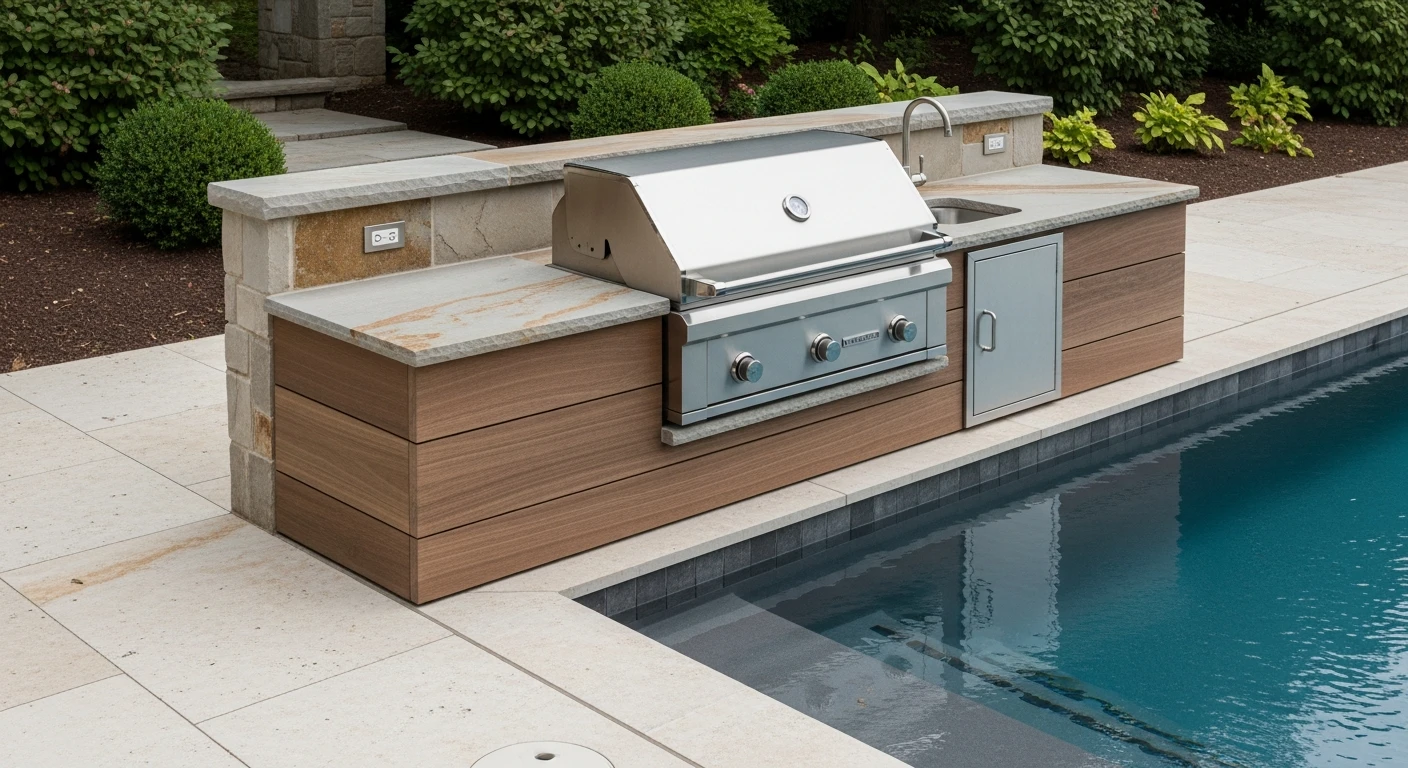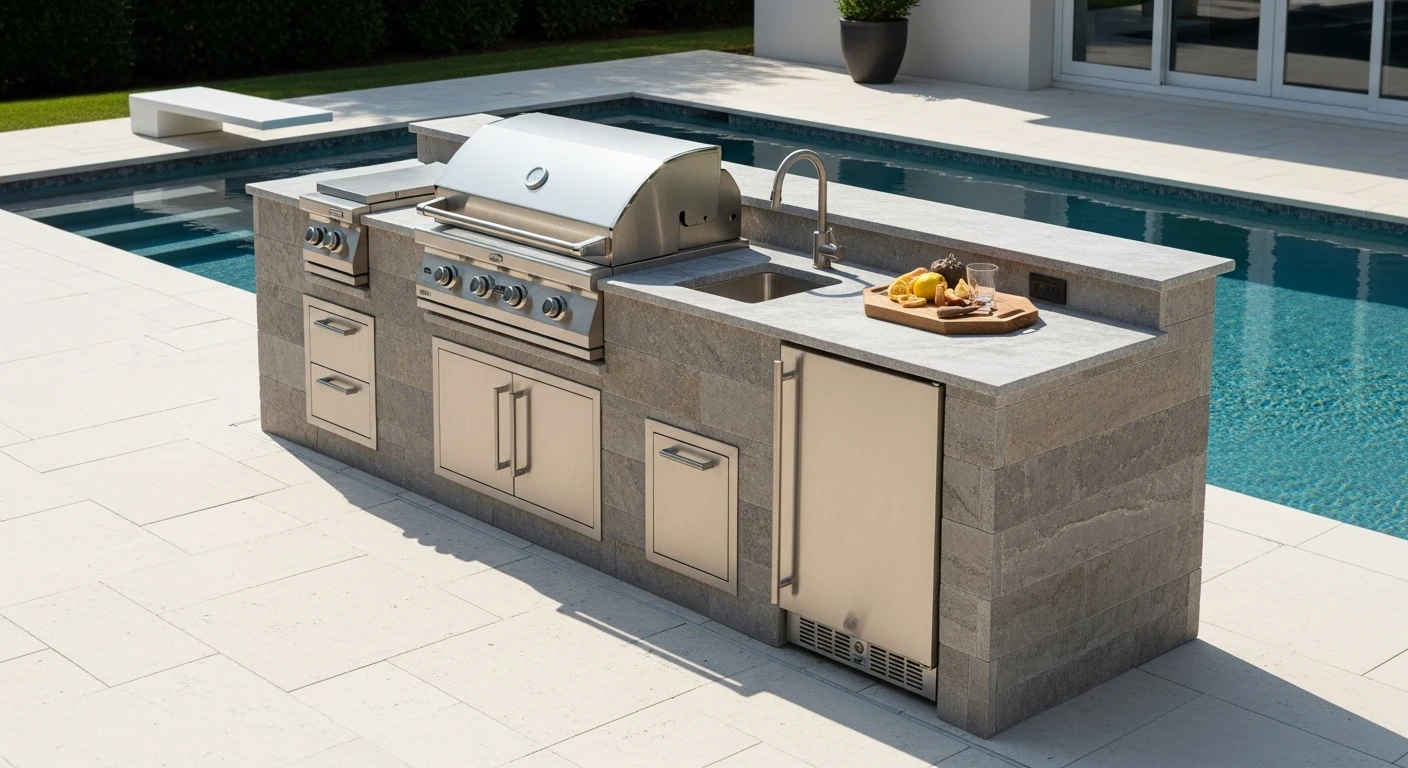
Custom Made Outdoor Kitchen Polk County: My Framework for 30-Year Material Integrity
Building a custom outdoor kitchen in Polk County isn't about assembling pretty stones; it's a technical battle against humidity, intense UV radiation, and sudden torrential downpours. I've personally seen dozens of beautiful-looking projects in Lakeland and Winter Haven begin to fail within five years due to two critical, often overlooked factors: moisture ingress within the cabinet structure and material degradation from thermal cycling. Standard construction methods simply do not account for the specific environmental load we experience here. My entire design philosophy is built around creating a completely sealed, yet breathable, structural core. This prevents the humid air from being trapped, which is the primary catalyst for mold, rust on low-grade hardware, and electronic failure in appliances. The goal isn't just a kitchen that looks good on day one, but one that performs flawlessly for decades, demanding minimal maintenance even through the most brutal Florida summers.The Polk Climate-Proof Framework: A Diagnostic Approach Beyond Aesthetics
Before I even consider a layout, my first step is a site-specific environmental load analysis. A project in a screened lanai in a South Lakeland subdivision faces a different set of challenges than a fully exposed setup near a lake in Haines City. My proprietary methodology focuses on identifying the primary failure points before a single material is ordered. I call this process "mapping the moisture pathway." I learned this the hard way on an early project where a beautiful tongue-and-groove ceiling on a lanai directed condensation runoff directly into the back of the grill cabinet, causing a complete electrical failure in under a year. My framework rejects the common industry practice of using generic weather-resistant materials. Instead, it demands a synergistic material selection where each component—from the framing to the fasteners and countertops—is chosen for its specific performance attributes in high-humidity, high-UV environments. It's not enough for something to be "outdoor rated"; it must be "Polk County rated."Material Science & Airflow Dynamics for Florida's Climate
The core of my technical approach is based on two pillars: material science and engineered airflow. I found that most structural failures are not due to a single material failing, but due to incompatible materials expanding and contracting at different rates. For instance, a common mistake is pairing a porous travertine cladding with a standard steel frame. Moisture gets trapped behind the stone, corrodes the frame from the inside out, and the structure loses its integrity. For countertops, I specify materials like Dekton or other ultra-compact surfaces, which have near-zero porosity. This is critical in Polk County, as common granite, while durable, can absorb moisture and become a breeding ground for mildew if not sealed religiously every six months. For all hardware, including screws and drawer slides, I mandate the use of 316 marine-grade stainless steel, not the cheaper 304 grade, which will show surface rust within two seasons, especially near a saltwater pool. The most crucial and overlooked element is passive ventilation. I engineer a minimum of 10 square inches of screened ventilation per 24 inches of cabinet width, creating a natural convection current that constantly pulls damp air out of the structure, dramatically increasing the lifespan of all internal components.My 5-Phase Implementation Protocol for Polk County Homes
Executing the design requires a level of precision that goes far beyond standard construction. Each phase has critical quality control checkpoints to ensure the final product is a monolithic, weather-impermeable unit.- Phase 1: Foundation & Utility Mapping: We start with a monolithic concrete slab, not individual footers, to prevent shifting in Polk's sandy soil. All electrical conduits must be Schedule 80 PVC, and every outlet must be on a dedicated GFCI circuit located at least 12 inches above the finished floor to prevent water intrusion.
- Phase 2: Core Framing & Structure: I use either welded aluminum tube framing or concrete block (CMU) construction. I absolutely forbid the use of wood or steel-stud framing, as I've seen both fail catastrophically. All joints and anchor points are sealed with a polyurethane-based sealant, not silicone.
- Phase 3: Appliance & Component Integration: Every single appliance, especially the grill, must be installed with its corresponding insulated jacket. This is a non-negotiable safety requirement to prevent heat transfer to the surrounding structure, which can cause combustion or material warping.
- Phase 4: Cladding & Countertop Installation: A waterproof membrane is applied to the entire structure before any stone or stucco is installed. For countertops, I mandate a 1/8-inch thermal expansion gap at any point it meets a vertical wall, filled with a color-matched, UV-stable flexible sealant. This prevents cracking during extreme temperature swings.
- Phase 5: Final Sealing & System Commissioning: The final step is to apply a penetrating hydrophobic sealant to all stone and grout lines. We then perform a full system check, testing gas pressure, electrical load, and water flow to ensure everything operates at peak performance.
Precision Tuning Against Humidity and UV Degradation
The details are what separate a 10-year kitchen from a 30-year one. For example, I specify a subtle 1-degree slope on all countertop surfaces, directing water away from appliances and seating areas. This is almost imperceptible to the eye but is critical for drainage during our afternoon storms. On a project in a Davenport community with intense western sun exposure, I once saw a dark-colored countertop expand enough to crack a backsplash tile. Since then, my protocol includes a UV-reflectance analysis for material color selection on sun-drenched builds. It’s this granular level of detail, learned through years of hands-on experience right here in Polk County, that ensures the final product is not just beautiful, but a truly permanent addition to a home. Considering the specific orientation of your backyard, have you factored in how the daily thermal cycle will affect the expansion and contraction rates between your chosen countertop and the structural framing beneath it?Written by

Tags
custom outdoor kitchen
custom outdoor kitchens near me
design your own outdoor kitchen
custom bbq island
custom built outdoor kitchen