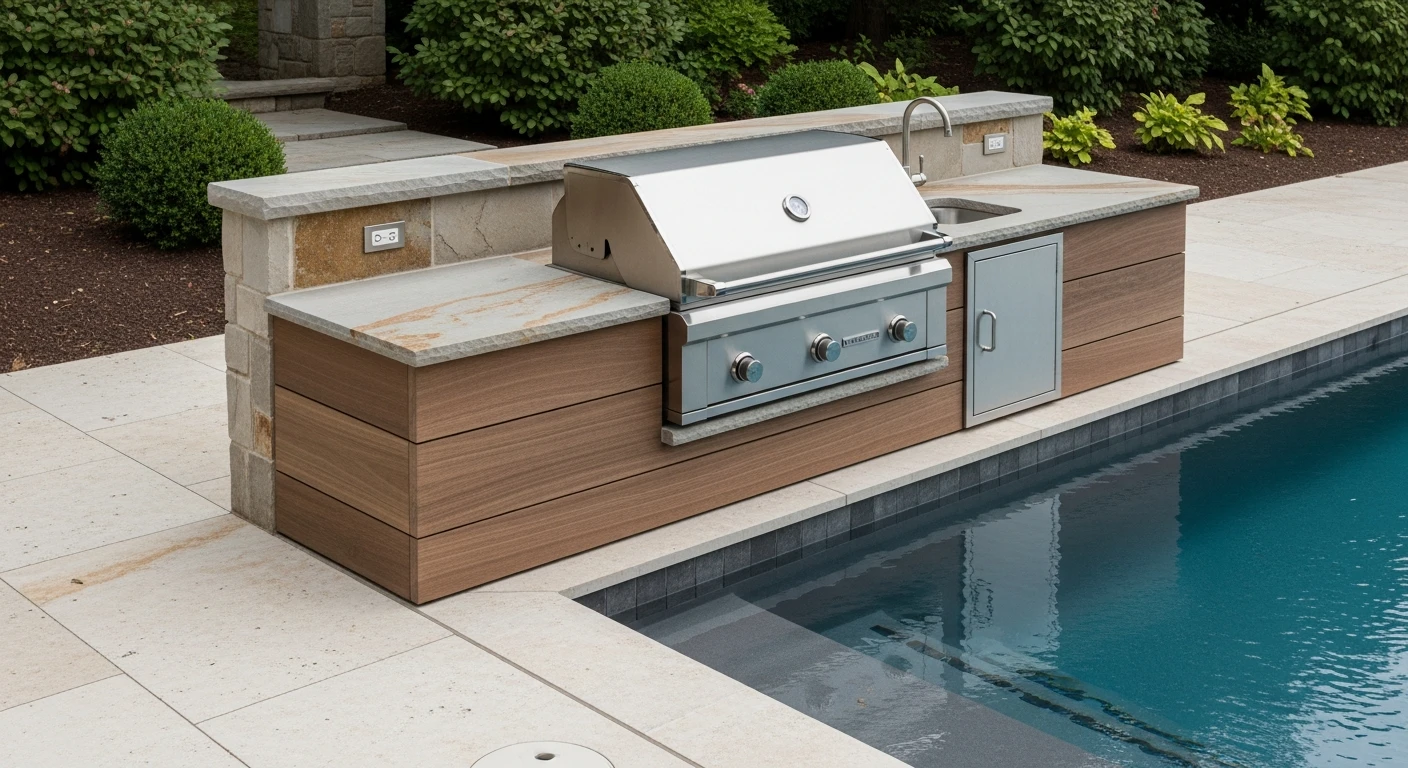
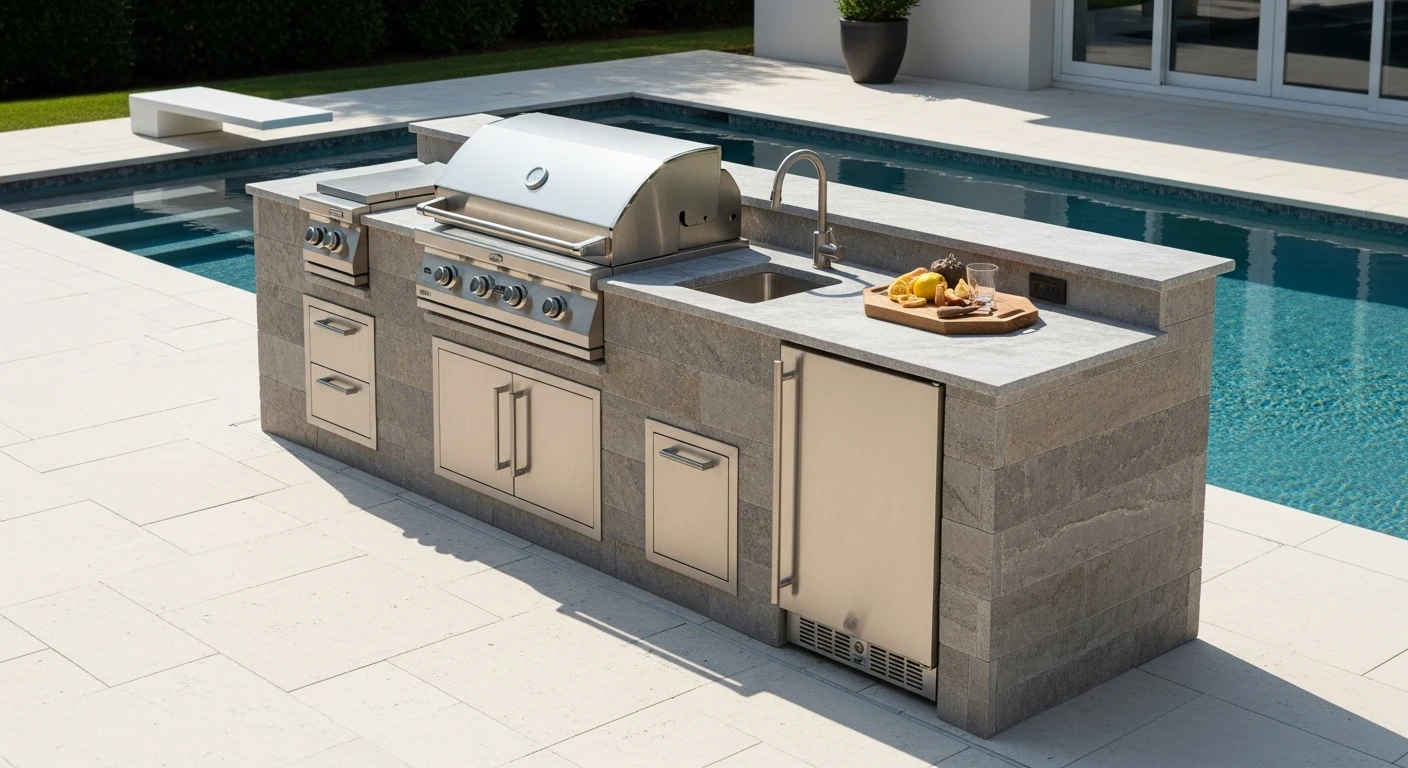
Custom Outdoor Kitchen Islands Lake County: A Framework for 99.9% Weatherproof Durability
In Lake County, the biggest challenge for a custom outdoor kitchen isn't the design; it's the relentless humidity and intense UV exposure. I’ve seen far too many projects in beautiful homes from Clermont to Mount Dora start to fail within five years due to material degradation. The most common error is using standard "exterior grade" materials that simply can't handle Florida's specific subtropical climate, leading to warped cabinetry, corroded hardware, and cracked countertops. My approach is built on a material-first principle that prioritizes long-term resilience over initial aesthetics. This isn't about just building an outdoor kitchen; it's about engineering a permanent outdoor appliance that performs flawlessly for decades. I developed this methodology after being called to salvage a high-end project in a Tavares lakefront property where the stainless steel components were already showing rust pitting after just two seasons. The issue wasn't the steel itself, but the wrong grade being used.The Climate-Adaptive Framework: A Diagnostic for Lake County Builds
Most contractors follow a standard build process, but Lake County's environment requires a pre-build diagnostic I call the Climate-Adaptive Framework. It analyzes three critical local variables before a single plan is drawn: direct sun exposure hours, proximity to water (like the Harris Chain of Lakes), and ventilation potential within the lanai or patio structure. A kitchen on an open pool deck in Leesburg faces a completely different set of environmental stressors than one tucked into a covered lanai in The Villages. This framework dictates the core material selection. For example, a high-sun area immediately disqualifies certain types of granite that can become dangerously hot and are more susceptible to fading. Instead, the framework points toward materials with a low thermal expansion coefficient and high UV resistance. It's a system designed to prevent problems, not just fix them after they appear.Technical Material Specification: Beyond "Weather-Resistant"
The term "weather-resistant" is dangerously vague. My specifications are precise and non-negotiable for a successful Lake County installation.- Structural Frame: I exclusively use welded, heavy-gauge aluminum tubing or concrete block (CMU) construction. Steel frames, even powder-coated ones, will eventually rust from the inside out due to condensation caused by our high humidity. Aluminum provides the structural integrity without the corrosion risk.
- Cabinetry & Hardware: The only stainless steel I will specify for cabinetry, access doors, and hardware is 316L marine-grade stainless steel. The common 304 grade used in many pre-fabricated islands lacks the molybdenum content needed to resist pitting from the moist, slightly saline air we sometimes get. For a non-metallic look, I rely on high-density polyethylene (HDPE) or PVC cabinetry, which is completely impervious to moisture and will not warp.
- Countertops: While granite is popular, my primary recommendation for durability is Dekton or other ultra-compact surfaces. These materials are non-porous, meaning they won't stain, and have near-zero water absorption. Crucially, they are completely UV-stable, ensuring the color you choose is the color you have in 15 years.
Implementation Protocol: From Foundation to First Use
Building an outdoor kitchen island that lasts requires a rigid installation sequence. Skipping or reordering these steps is where catastrophic failures originate. I learned this the hard way on an early project where we installed the countertop before the heavy grill, causing a micro-fracture that became a major issue a year later.- Site Preparation & Footing: The process starts with a proper concrete footing. For islands on paver patios, we remove pavers and pour a dedicated slab to prevent settling and ensure a perfectly level base. This is a non-negotiable first step.
- Frame & Utility Runs: The structural frame is built, and all electrical conduits and plumbing lines (gas, water, drain) are run within the frame. All electrical connections must be housed in weatherproof boxes with GFCI-protected circuits. This is a critical safety and code compliance step.
- Cladding & Siding Installation: The chosen exterior finish (stacked stone, stucco, etc.) is applied to the frame, ensuring proper weep holes or ventilation are integrated at the base to allow any trapped moisture to escape.
- Appliance & Countertop Installation: Heavy appliances like grills and refrigerators are set first. The countertop template is then made with the appliances in place for a perfect fit. The countertop is installed last, using a specialized, flexible outdoor-rated adhesive to accommodate for thermal expansion.
Precision Tuning for Peak Performance & Longevity
The final 10% of the work is what separates a good build from a great one. These are the precision adjustments that ensure usability and durability. I’ve found that proper grill ventilation is the most overlooked aspect. Without it, heat gets trapped in the island's cavity, which can damage wiring and even cause the countertop to discolor over time. My standard is to install at least two insulated ventilation jackets per gas appliance. Another key detail is creating a subtle, almost imperceptible slope on the countertop—about 1/8 inch per foot—directing water away from the seating areas and appliances. Finally, I perform a 24-hour leak test on all gas and water connections before the final sign-off. This simple test has prevented major issues by catching minuscule fitting leaks that would have otherwise gone unnoticed. How have you calculated the required CFM for ventilation based on your grill's BTU output and your island's internal cubic volume?Written by

Tags
custom outdoor grill station
custom made outdoor kitchen
custom outdoor grill
custom outdoor kitchen design
custom bbq island