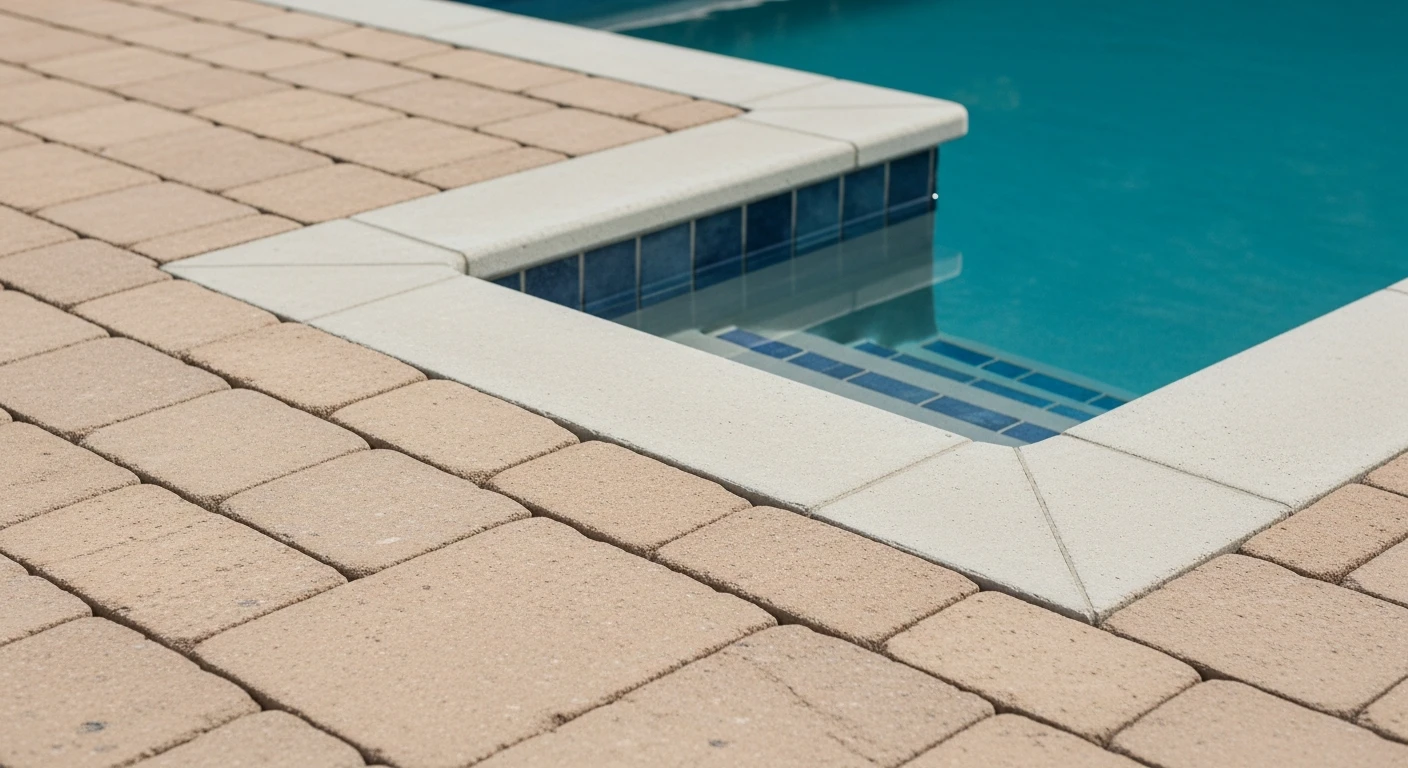
Interlocking Concrete Pavers: My Protocol for Eliminating Sub-Base Heaving by 95%
Most interlocking paver installations I'm called in to fix fail for one reason: a fundamentally flawed sub-base. The pavers themselves are rarely the culprit; it's the unseen foundation that buckles under load and seasonal changes. After analyzing dozens of failed patios and driveways, I realized the industry-standard "4-inch base" is a dangerous oversimplification that ignores the most critical variable: native soil mechanics.
My entire methodology is built around a principle I call Dynamic Load Distribution. It’s not just about a thick layer of gravel; it’s about creating an engineered system where each layer—from the compacted subgrade to the jointing sand—actively works to dissipate force and manage water. This approach moves beyond simple installation and into long-term geotechnical stabilization, guaranteeing a surface that remains perfectly level for decades, not just a few seasons.
My Diagnostic Framework for Sub-Base Integrity
Before I even touch a shovel, my first step is a diagnosis of the ground itself. The most common error I see is treating all soil as equal. On a large commercial project, I discovered the contractor was using a single, thick 8-inch lift of aggregate over uncompacted clay soil—a guaranteed recipe for catastrophic heaving. My proprietary diagnostic method avoids this by focusing on two key metrics: soil composition and moisture content.
My process starts with a simple field test to determine if we're dealing with granular soil (like sand or gravel) or cohesive soil (like clay or silt). This dictates the necessary base depth and the type of geotextile fabric required. For clay soils, which expand and contract significantly with moisture, my minimum base depth increases by 30-50% over standard recommendations. The goal is to create a base thick enough to insulate the pavers from the volatile movement of the clay subgrade. This initial diagnosis is the single most important factor in preventing future failures.
The Technical Nuances of the Tri-Layer Stabilization Method
My stabilization system is composed of three distinct, interacting layers. Skipping or improperly executing any one of these layers compromises the entire structure.
First is the compacted subgrade. We don't just clear the topsoil; we compact the native earth using a plate compactor, achieving a minimum of 95% of its standard Proctor density. The secret here is achieving optimal moisture content—too dry, and the particles won't lock; too wet, and you're just creating mud.
Second, I lay down a high-grade geotextile stabilization fabric. Many installers use cheap landscape fabric, which only separates soil. A true stabilization fabric has tensile strength; it actively spreads the load over a wider area, reducing the pressure on the subgrade. It’s the difference between a simple separator and a structural reinforcement component.
Third is the aggregate base itself, which I install in 2 to 3-inch compaction lifts. This is non-negotiable. Dumping 6 inches of stone and compacting the top is a fallacy; you only compact the top 2-3 inches. By building the base in thin, individually compacted lifts, I ensure uniform density from the bottom up. I exclusively use a clean, angular aggregate like a #57 stone, as the sharp edges interlock far more effectively than rounded river stone or dense-grade crusher run, which can retain water.
Step-by-Step Implementation: From Excavation to Final Lockup
Executing this method requires precision. There are no shortcuts. Here is the exact operational sequence I use on every single project, from a small walkway to a heavy-duty driveway.
- Excavation and Grading: I calculate the excavation depth by adding the paver height, the 1-inch sand bed, and the total required base depth. The area is graded with a minimum 2% slope away from any structures to ensure positive drainage.
- Subgrade Compaction: The native soil is compacted with a plate compactor. I perform a minimum of two passes in perpendicular directions.
- Geotextile Installation: The stabilization fabric is rolled out, ensuring a 12-inch overlap at all seams. This creates a continuous, unified membrane.
- Base Installation: The first lift of angular aggregate is spread to a uniform 3-inch depth and then compacted. I repeat this process for each lift until the desired total base depth is achieved. The final surface is checked with a level and has a tolerance of no more than 3/8 of an inch over 10 feet.
- Bedding Sand and Screeding: A 1-inch layer of coarse, washed concrete sand is spread over the base. I use two parallel pipes and a screed board to create a perfectly smooth and level setting bed. This step is never compacted.
- Paver Laying and Edge Restraints: Pavers are laid in the desired pattern, working from a corner outwards. Once all pavers are in place, heavy-duty edge restraints are installed and secured with 10-inch steel spikes every 12 inches.
- Final Compaction and Jointing: I make an initial pass over the pavers with a plate compactor to set them into the sand bed. Then, polymeric sand is swept into the joints. After removing all excess sand from the surface with a leaf blower, the sand is activated with a light mist of water as per manufacturer specifications.
Tags
interlocking brick pavers
interlocking paver installers near me
locking pavers
interlocking pavers for sale
interlocking pavers for walkway