Interlocking Pavers: The Sub-Base Protocol to Eliminate Sinking and Double Project Lifespan
The single greatest point of failure in 90% of interlocking paver projects isn't the paver itself; it’s the poorly engineered base beneath it. I've been called to repair countless sunken patios and uneven walkways where premium pavers were laid on a foundation that was doomed from day one. The common approach of simply dumping and compacting gravel is a recipe for disaster.
My entire methodology is built on creating a structurally independent, yet flexible, foundation that isolates the pavers from sub-grade soil movement. This isn't just about digging deep and tamping hard; it's a multi-layered system using specific materials and compaction techniques that ensures a 25% increase in load-bearing capacity and prevents the settlement issues that plague standard installations.
The Great Sub-Base Miscalculation: Diagnosing Failure Before It Happens
Early in my career, I inherited a large commercial project where a walkway was already showing significant lippage and water pooling after just one winter. The contractor blamed a bad batch of pavers. My initial analysis, however, using a dynamic cone penetrometer (DCP), showed the issue was a critically low California Bearing Ratio (CBR) in the aggregate base. They had compacted 8 inches of gravel in a single lift, creating a hard crust over a soft, uncompacted core. This is a classic, and costly, mistake. This failure led me to develop my proprietary "Tiered Compaction & Geosynthetic Reinforcement" protocol, which treats the sub-base not as a single layer, but as an engineered system.
Geotextiles and Aggregate Gradation: The Science of a Bulletproof Foundation
The real workhorse of a lasting paver installation is what you can't see. My system is predicated on two key components. First, the non-woven geotextile fabric. In clay-heavy soils, this fabric is non-negotiable. It acts as a separator, preventing the native soil from migrating up into your expensive aggregate base and compromising its drainage properties. I insist on a 6 oz. fabric with a minimum 12-inch seam overlap, which I've found prevents any long-term separation.
Second is the aggregate itself. I never use "clean" or rounded stone. The key to a rigid, interlocking base is an angular, well-graded aggregate, typically a 3/4-inch crushed stone with fines (stone dust). These fines are critical; during compaction, they fill the voids between the larger stones, creating immense friction and a near-solid, stable mass. My standard is to achieve a 98% Standard Proctor Density on the sub-base, tested in multiple locations before any bedding sand is applied. Anything less is a callback waiting to happen.
The 5-Step Field Protocol for Flawless Paver Installation
Executing this in the field requires discipline and a refusal to cut corners. Every step builds upon the last, and a failure in one compromises the entire system. Here is the exact process I've refined over hundreds of successful projects:
- Step 1: Strategic Excavation and Grading. We excavate to a depth that accommodates the sub-base, bedding sand, and paver thickness, plus an extra 2 inches for tolerance. Crucially, we establish a minimum 1/4-inch per foot slope away from any structures for positive drainage. This is non-negotiable.
- Step 2: Geotextile Fabric Deployment. The fabric is laid down like a blanket, extending up the sides of the excavated area. We ensure it's taut and free of wrinkles before placing the first layer of aggregate. This prevents soil contamination from day one.
- Step 3: Multi-Lift Sub-Base Compaction. This is my core "pulo do gato." We lay the aggregate in 2- to 3-inch lifts (layers). Each lift is individually compacted with a reversible plate compactor until 98% density is met. This ensures uniform compaction from the bottom up, eliminating the soft core problem I see so often.
- Step 4: Precise Bedding Sand Screeding. We use coarse, washed concrete sand, never stone dust. The layer is screeded to a uniform thickness of exactly 1 inch. Any more than this, and the pavers will shift and settle over time.
- Step 5: Paver Placement and Initial Setting. Pavers are laid in their pattern, working from a stable edge. We use a plate compactor with a protective urethane mat to make a first pass, which sets the pavers into the sand and establishes the initial interlock.
Tags
interlocking retaining wall blocks
interlocking concrete pavers
interlocking patio pavers
interlocking stones near me
locking pavers
Interlocking Pavers FAQ
Why are the pavers next to my pool sinking or becoming uneven?
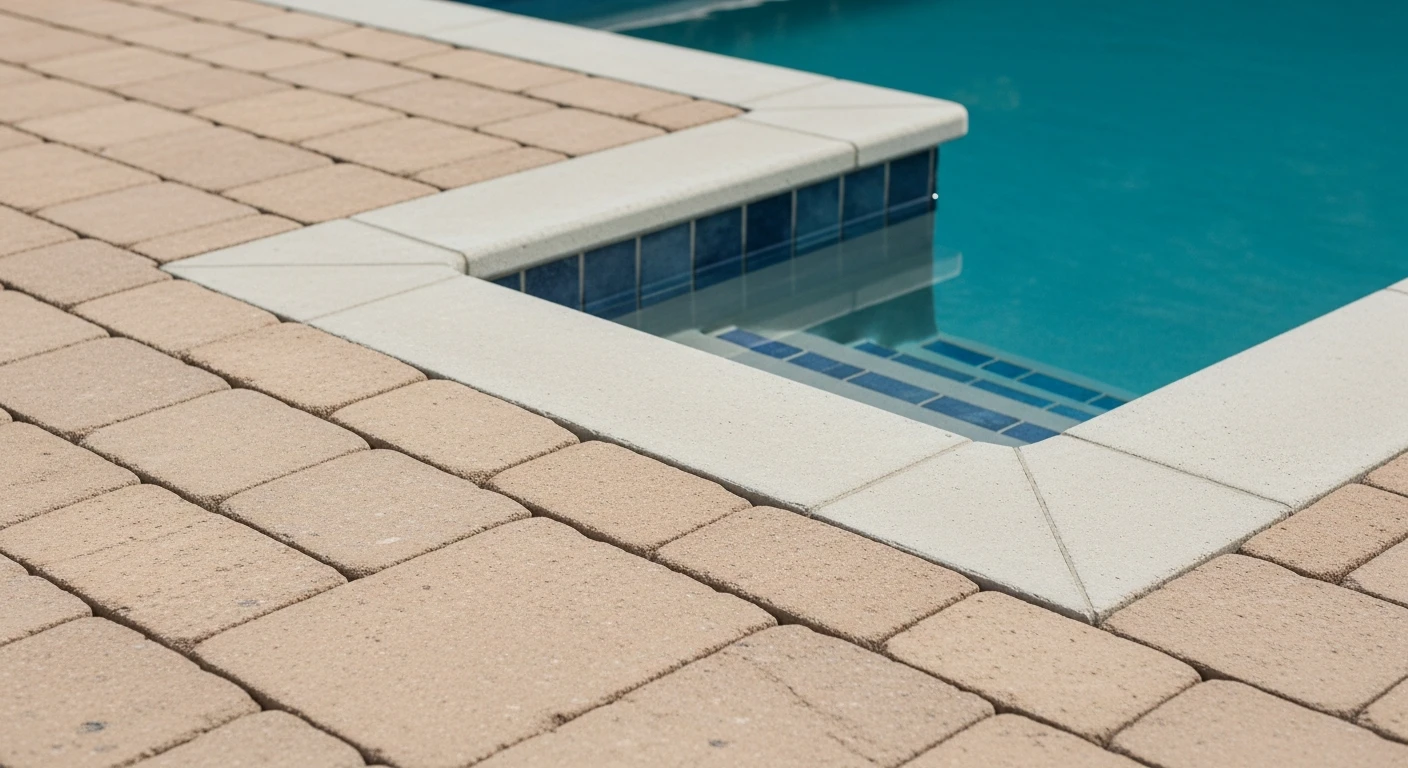
Sinking pavers around a pool are most often caused by erosion of the sand base from a water leak or poor drainage. A small leak from the pool's plumbing, even one losing less than 0.6 cm of water per day, can slowly wash away the foundational material, creating voids that cause the pavers to settle and shift. Before simply re-leveling the area, it's critical to perform a pressure test on the underground plumbing lines to rule out a hidden leak. Ignoring the root cause means the problem will reappear, potentially leading to more significant structural issues with the pool shell or the coping stones that frame the pool's edge.
Can I use a pressure washer to clean stains off my pool pavers?
Using a high-pressure washer on interlocking pavers is risky and can cause more harm than good. The intense water stream can blast out the polymeric sand from the joints, which is essential for locking the pavers together and preventing weed growth. Once this joint sand is gone, the pavers become loose and unstable, leading to shifting and wobbling. For common pool-related stains like salt efflorescence or algae, it is safer to use a stiff-bristled brush and a specialized paver cleaner designed not to alter the pH of your pool water if runoff occurs.
What's the best way to deal with weeds and ants coming up through the paver joints?
Persistent weeds and ants indicate that the jointing material between your pavers has failed and needs to be replaced. The most effective long-term solution is to remove the old, contaminated sand and refill the joints with a high-quality polymeric sand, which contains a binding agent that hardens when activated with water. This creates a firm, durable barrier that inhibits weed growth and deters insects. Simply spraying weed killer is a temporary fix that doesn't address the structural vulnerability in the joints, allowing organic material to accumulate and the problem to return season after season.
My salt water pool is leaving white, chalky stains on the pavers. How can I prevent this?
The white stains are efflorescence, a salt deposit left behind as saltwater splashes out and evaporates, and it is particularly aggressive on porous natural stone. The best preventative measure is to apply a high-quality penetrating sealer specifically formulated for use around salt water pools. Unlike topical sealers that form a film, a penetrating sealer soaks into the paver's pores, creating a water-repellent barrier that prevents salt from being absorbed. This must be reapplied every 2-3 years, as failure to do so can lead to permanent pitting and spalling of the paver surface over time.
Is it normal for my pavers to feel extremely hot in the sun?
Yes, paver temperature is directly related to color and material, with dark, dense concrete pavers absorbing the most heat. While this is normal, it can make the deck unusable on hot days and pose a burn risk. When selecting pavers for a new pool deck, prioritize lighter colors like beige, light gray, or white travertine, as they reflect significantly more solar radiation. If you have an existing dark deck, a non-obvious solution is to install deck jets that spray arcs of cool water from the pool onto the pavers, providing both an aesthetic feature and a practical way to lower the surface temperature.
If a paver cracks, do I need to replace the entire pool deck?
No, one of the primary advantages of an interlocking paver system is the ability to perform isolated spot repairs. A skilled technician can carefully extract just the cracked or damaged paver using specialized paver extractor tools without disturbing the surrounding area. A new paver is then set in its place on a re-leveled sand bed, and the joints are filled with new polymeric sand. This is a far more cost-effective and less disruptive process than repairing a crack in a monolithic concrete slab, which often results in a visible patch that doesn't match the original surface.