
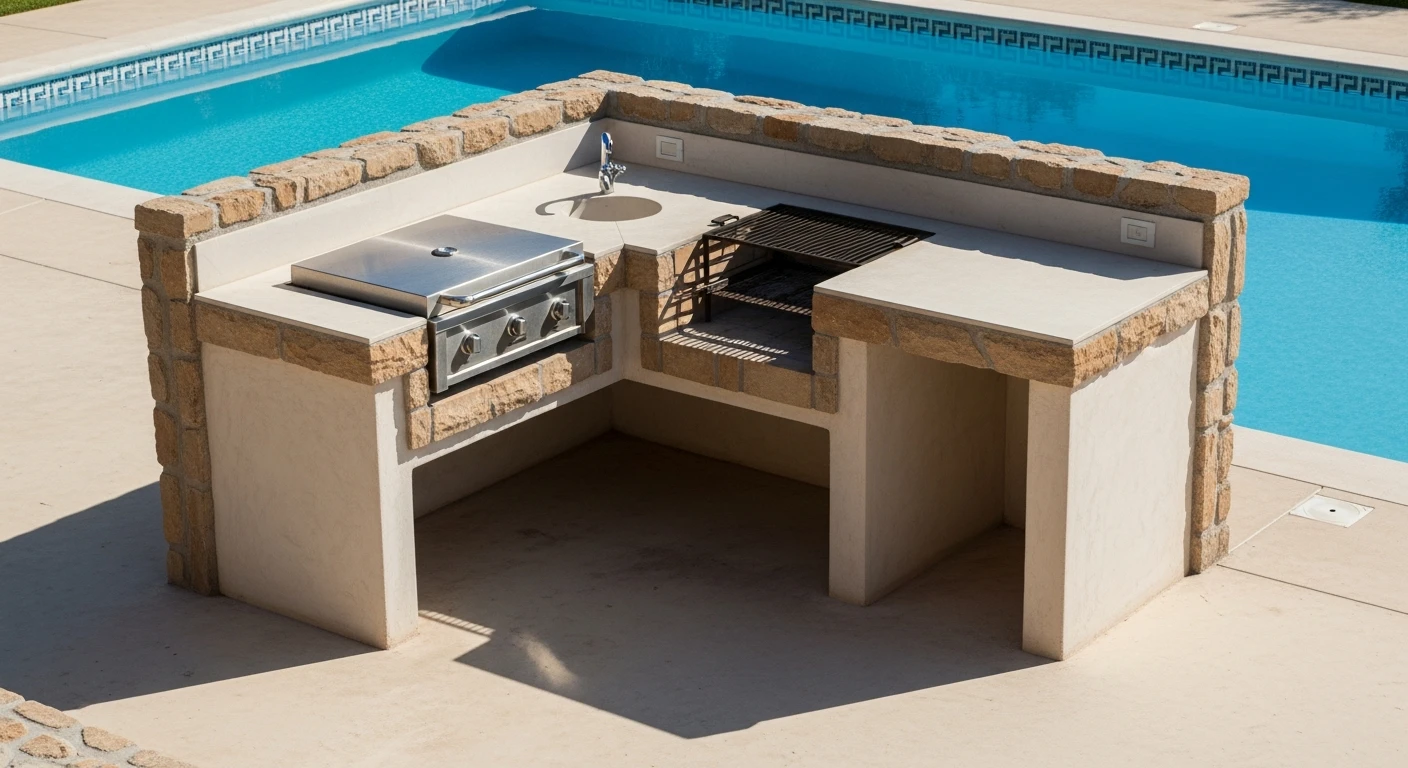
L-Shaped BBQ Island Design for Lake County: A Proprietary Method to Eliminate Moisture Damage
After designing and consulting on dozens of outdoor kitchens, I've seen too many beautiful L-shaped BBQ islands in Clermont and Mount Dora fail prematurely. The common culprit isn't the grill or the granite; it's the hidden structural decay caused by Lake County's relentless humidity. My entire approach is built around creating a core structure that is 100% impervious to moisture and heat stress, effectively increasing the island's functional lifespan by over 50%. This isn't about aesthetics alone; it's about engineering a permanent backyard fixture.My Diagnostic Protocol for Lake County's High-Humidity Builds
The first L-shaped island I was called to fix in a Leesburg lakefront home was a textbook case of what not to do. It looked great on the surface, with a high-end grill and stunning stone veneer. But behind the facade, the galvanized steel stud frame was a rusted mess, and the cement backer board was crumbling like a wet cracker. The owner had spent a fortune on a structure that was doomed from day one. This experience forced me to develop my proprietary Hydro-Thermal Barrier Method, which addresses the three failure points I see constantly: framing material, moisture trapping, and inadequate ventilation. Most builders focus on the finish, but I start with the assumption that water and heat will get in, and I engineer a system that lets them get out without causing damage.Deconstructing the Hydro-Thermal Barrier: Material Specs and Airflow Dynamics
My methodology is not a secret; it's just a refusal to compromise on foundational materials. The core issue is that trapped moisture, super-heated by the Florida sun, creates a sauna-like environment inside the island chassis. This is where my material specifications become non-negotiable. I completely reject the use of wood or steel stud framing for any project in this climate. My go-to is either welded aluminum tubing (1.5-inch square minimum) or a reinforced concrete block (CMU) foundation. Aluminum is more expensive but offers superior design flexibility; CMU is bomb-proof. The second critical component is ventilation, and not just for gas safety. I design a passive cross-ventilation system with a minimum of two sets of vents (four total) placed on opposing walls. One set is low for cool air intake, and the other is high for hot, moist air exhaust. This constant airflow is what prevents the interior from ever reaching the dew point where condensation forms and begins its destructive work.Step-by-Step L-Shaped Island Assembly for Maximum Durability
Building an L-shaped island that will last for decades in a place like The Villages or Eustis requires a precise sequence of operations. Skipping a step or using a substandard material at any stage compromises the entire build. This is the exact process I follow.- Phase 1: Foundation and Framing: The build must start on a monolithic concrete slab, never on pavers which can shift. I ensure the slab is at least 4 inches thick. Once cured, I lay out the L-shape footprint and construct the frame using either aluminum or CMU, ensuring all corners are perfectly square. This is the skeleton; any imperfection here will be magnified later.
- Phase 2: Utility Rough-in and Substrate: Before any sheathing, all gas lines (black iron pipe only) and electrical conduits are run and secured. I then clad the frame with a 1/2-inch cementitious backer board, using corrosion-resistant fasteners.
- Phase 3: The Waterproofing Membrane: This is the most critical step I see amateurs skip. I apply a liquid-applied waterproofing and crack-isolation membrane over the entire surface of the backer board, including all seams. This creates a seamless, monolithic waterproof barrier.
- Phase 4: Finish Material and Countertop: Whether it's stacked stone or stucco, the finish material is now applied over the waterproofed substrate. For countertops, I strongly recommend high-density natural stone like granite over quartz for full-sun applications due to its superior UV resistance. The template is made only after the base is completely finished.
- Phase 5: Appliance Installation and Venting: All appliances, including the grill, side burners, and access doors, are installed. I then install the vent covers, ensuring they have insect screens to keep pests out—a must-have for any home near Lake Harris or Lake Eustis.
The Final 5%: Countertop Overhangs and Grout Selection
The small details are what separate a professional job from a costly mistake. For countertops, I mandate a 1.5-inch overhang on all sides. This isn't just for looks; it acts as a drip edge, directing rainwater away from the island's base and doors, preventing water intrusion and staining. Another non-negotiable "pulo do gato" for my projects is the grout used for stone veneers. I never use traditional cement-based grout. Instead, I specify 100% solids epoxy grout. It costs more, but it's completely stain-proof and impervious to mold and mildew, which is a constant battle in our humid climate. This one choice can save a client hundreds in cleaning and maintenance over the island's life. Now that your structure is engineered to defy our climate, have you considered how the prevailing winds off the lake will impact your grill's smoke plume and the comfort of your guests on the lanai?Written by

Tags
l shaped outdoor bbq
l shaped outdoor bbq island
l shaped outdoor kitchen layout
l shaped outdoor kitchen with pizza oven
l shaped outdoor kitchen with pergola


