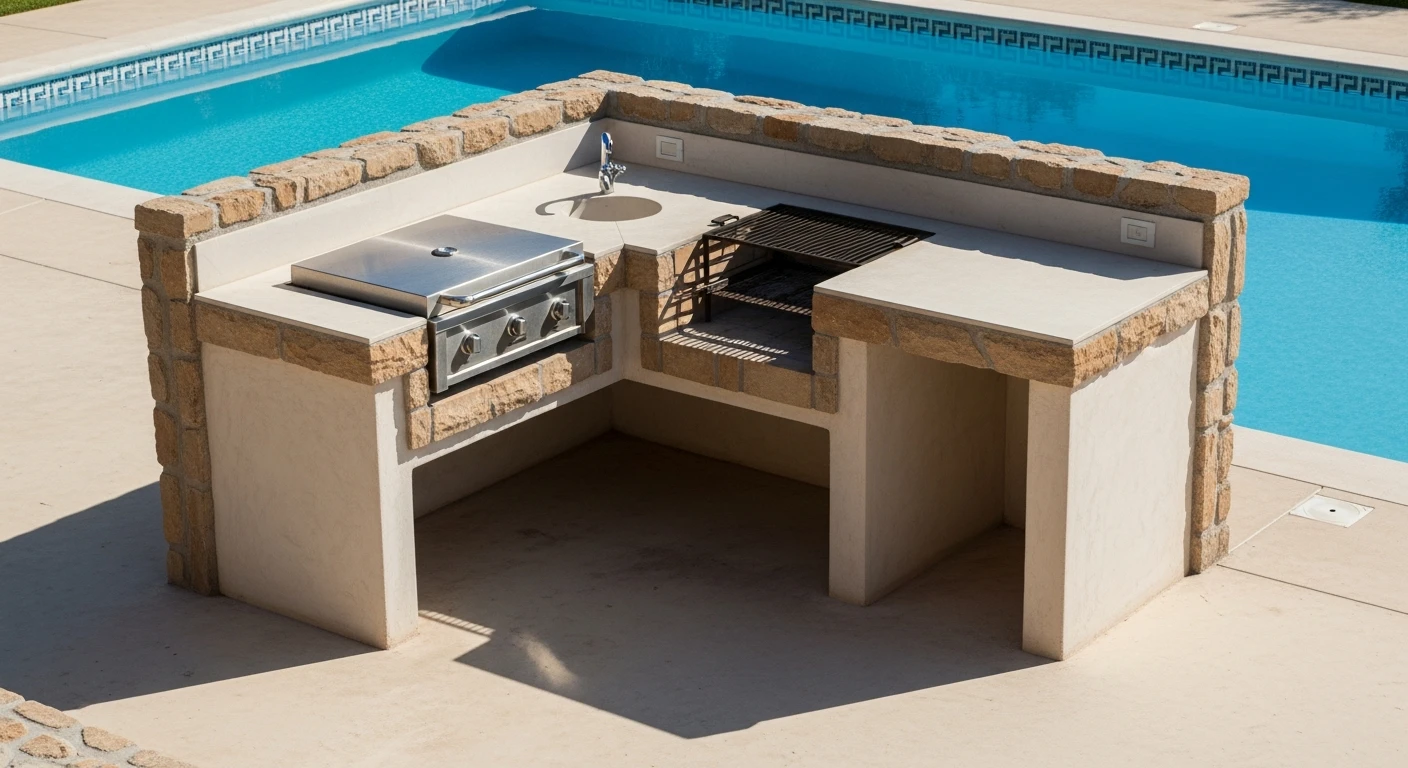
L-Shaped Grill Island: My Protocol for a 20-Year Lifespan in Sarasota's Salty Air
When designing an L-shaped grill island for a waterfront home in Sarasota, the single biggest point of failure isn't the grill itself—it's the substructure. I've been called to far too many projects in Siesta Key and Lido Key where beautiful granite countertops are cracking and stainless steel doors are bleeding rust streaks after just two years. The cause is almost always the same: a frame and material selection that was never designed to withstand our region's specific combination of high humidity, intense UV exposure, and relentless salt spray. My entire approach is built on preventing this premature decay. It’s not about just building an outdoor kitchen; it's about engineering a permanent outdoor fixture that performs like a marine vessel. The common mistake I see is using standard galvanized steel studs or, even worse, pressure-treated wood, which inevitably succumbs to moisture and corrosion. My methodology focuses on material science first, ensuring the core of your island is impervious to the very elements that make living in Sarasota so desirable.My Diagnostic Framework: The Coastal Durability Audit
Before I even sketch a design, I perform what I call the Coastal Durability Audit. This isn't just about measuring space; it's a technical assessment of the micro-environment. I developed this after seeing a high-end island in a beautiful Lakewood Ranch home fail because, despite being further inland, a saltwater pool's splash-out created a corrosive microclimate the builder didn't account for. The audit is based on three core principles that dictate every subsequent decision.Material Science and Corrosion Points
This is the most critical stage. My analysis goes beyond simply choosing "outdoor-rated" materials.- Structural Frame: I exclusively specify welded T6061 aluminum framing for any project within a mile of the coast. For projects further inland, heavy-gauge galvanized steel studs are a minimum, but every screw and fastener must be 316-grade stainless steel. Using a lower grade, like 304, is a guaranteed failure point I've seen countless times.
- Cladding and Backer Board: Standard cement board will hold moisture. I insist on a high-density, water-impermeable backer board, creating a true vapor barrier. This prevents the humid Sarasota air from penetrating the island's core and condensing on the cooler metal frame.
- Countertop Selection: Granite is porous and requires constant sealing here. I steer my clients toward sintered stone (like Dekton) or high-performance, non-porous concrete. These materials offer a near-zero absorption rate, preventing staining from summer mango drops and resisting the microscopic salt crystals that degrade stone over time.
Implementation: The 5-Step Execution Blueprint
Building the island is a matter of precision and sequence. Deviating from this order is how hidden water traps are created, leading to internal corrosion that you won't see until it's too late.- Foundation and Leveling: I start with a reinforced concrete pad, ensuring it's pitched at a nearly imperceptible 1.5-degree slope away from the house. This single detail is crucial for managing the runoff from our intense summer downpours.
- Frame Assembly and Appliance Cutouts: The aluminum frame is assembled on-site. All appliance openings for grills, side burners, or outdoor refrigerators are framed with an additional 1/8-inch clearance. This isn't for fit; it's to accommodate the metal's thermal expansion under the Florida sun, preventing stress fractures in the cladding.
- Utility Rough-In and Venting: Before any cladding is attached, I ensure all gas and electrical lines are secured and that proper ventilation is installed. I mandate at least two sets of vents (one high, one low) on opposing sides of the island to create natural convection, which purges corrosive, humid air. This is a non-negotiable step for component longevity.
- Backer Board and Cladding Installation: The waterproof backer board is attached using ceramic-coated fasteners. A flexible, marine-grade sealant is used at every seam, creating a monolithic, waterproof box.
- Countertop and Appliance Placement: The countertop is installed with a specific silicone-based adhesive that allows for expansion and contraction. Finally, appliances are installed, ensuring their insulating jackets are properly seated to protect the structure from high heat.
Precision Adjustments and Quality Control
Once the island is built, I perform a final quality check. One of my signature tests is the "overnight moisture test." I place a calibrated hygrometer inside the main cabinet, seal the doors, and leave it overnight. In the morning, if the internal humidity is more than 10% higher than the ambient humidity, it indicates a seal failure somewhere in the system. I also check that the countertop has a minimum 1.5-inch overhang. This small detail directs water to drip straight to the ground, rather than running down the face of the island, which prevents staining and erosion over time. Now that the structure is engineered to survive the coastal environment, have you considered how the specific L-shape orientation will affect smoke ventilation and heat zones based on Sarasota's prevailing sea breeze?Written by

Tags
l shaped outdoor kitchen with bar plans
small l shaped outdoor kitchen
l shaped outdoor kitchen island
outdoor kitchen l
outdoor kitchen island l shape