
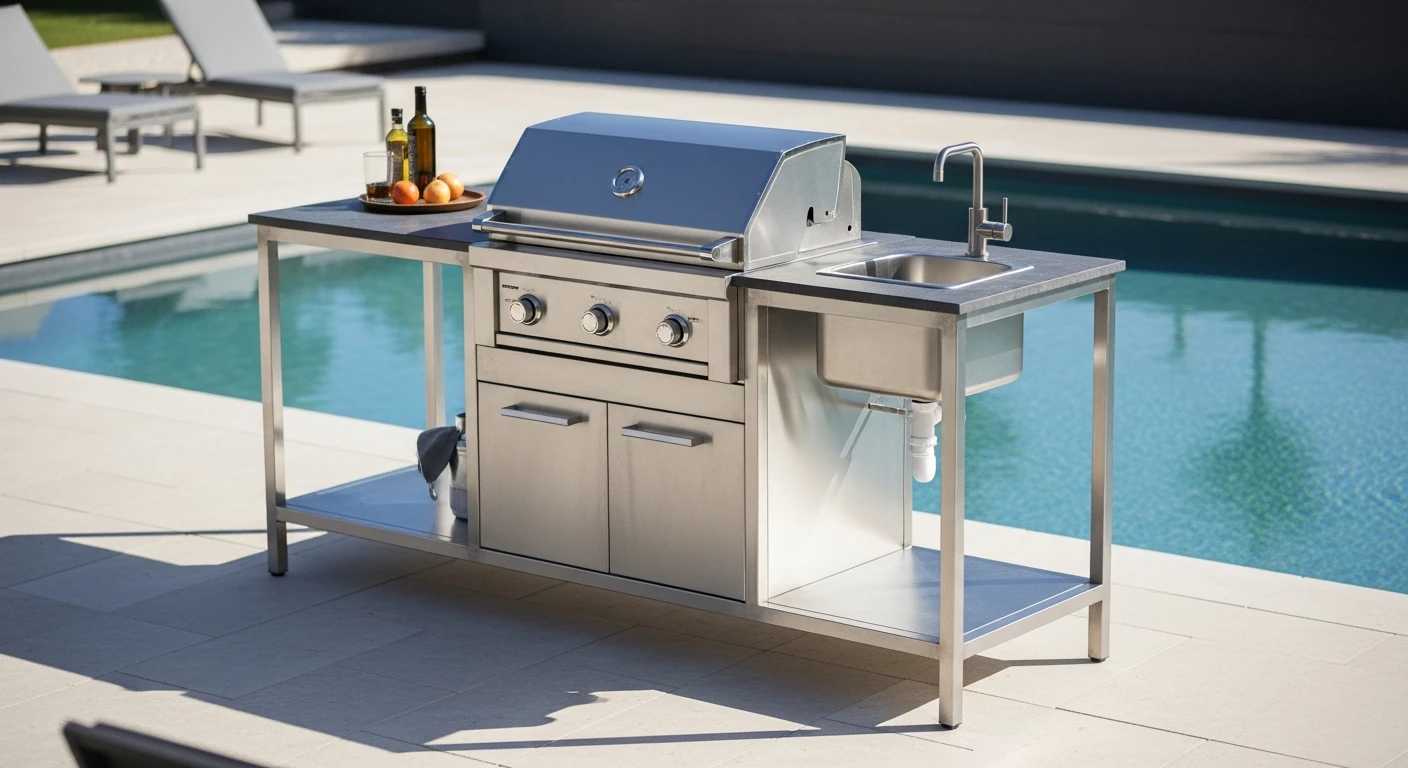
Metal Outdoor Kitchen Island: A Corrosion-Proof Framework for Sarasota's Salty Air
As a designer specializing in high-performance outdoor structures, the most common failure I see in Sarasota is a metal outdoor kitchen island surrendering to our climate. The combination of intense humidity, high UV exposure, and the corrosive salt spray, especially in waterfront properties on Lido Key and Siesta Key, creates a uniquely hostile environment. My approach is not about just choosing "stainless steel"; it's about engineering a system that treats our coastal air as the primary adversary from the very first weld. The critical oversight I've corrected on multi-million dollar projects is the assumption that all stainless steel is created equal. A builder might use 304-grade steel, which is fine for inland areas, but it will inevitably show tea staining and pitting when exposed to the chloride-rich air from the Gulf. This isn't a defect in the material, but a critical mismatch of specification to environment. My entire methodology is built on preventing this and other climate-induced failures before a single piece of metal is cut.My Diagnostic Protocol for High-Humidity Outdoor Kitchens
My process begins with a material and environmental audit. Before I design the first cabinet, I analyze the specific microclimate of the property. Is it a home in Lakewood Ranch with high humidity but less salt, or a Casey Key estate getting direct salt spray? This dictates everything. My proprietary methodology focuses on two failure points: crevice corrosion at the fasteners and weld decay at the joints, the two areas where moisture and salt love to hide. I once took over a project in a downtown Sarasota condo where the owner's beautiful, powder-coated island was bubbling after just one year. The original fabricator used standard steel fasteners hidden underneath. Condensation, driven by our diurnal temperature swings, collected in these crevices and the corrosion pushed the coating right off from underneath. My audit identified this immediately. My solution is a framework with zero mechanical fasteners exposed to the elements; every joint is a sealed, continuous weld.Material Specification: The Non-Negotiable Choice Between 304 and 316L Grade Steel
The technical core of a durable Sarasota outdoor kitchen lies in the metal's composition. For any project west of I-75, I mandate 316L marine-grade stainless steel. The "L" signifies low carbon content for better weldability, but the key is the addition of molybdenum. This element dramatically increases resistance to chloride corrosion. Using 304 steel is a planned obsolescence; using 316L is an investment in permanence. This single choice can increase the rust-free lifespan of the island's core structure by over 300%. Furthermore, if the client desires a colored finish, I don't just specify "powder coating." I demand a coating that meets the AAMA 2605 standard, the highest architectural grade available. This is the same specification used on high-rise curtain walls to resist fading and degradation under intense Florida sun. A standard powder coat will chalk and lose its color in as little as two seasons here; AAMA 2605 is warrantied for decades. This is a technical detail that separates a temporary aesthetic from a long-term structural finish.Fabrication and Installation: A Blueprint for Longevity
Executing the design requires a level of precision that goes beyond typical fabrication. My build process is standardized to mitigate the risks our climate presents. Each island I design follows this strict sequence:- Structural Framing: The entire cabinet chassis is constructed from 316L steel. All structural joints are TIG-welded for a clean, strong, and fully sealed seam. No spot welds or stitch welds are permitted, as they leave gaps for moisture ingress. -
- Weld Passivation: After welding, every seam undergoes a chemical passivation process. This step is critical and often skipped to save costs. It removes free iron from the surface and rebuilds the chromium oxide passive layer, making the weld itself as corrosion-resistant as the parent metal. -
- Surface Preparation: Before any coating, the frame is subjected to a multi-stage chemical pre-treatment. This creates a microscopic profile on the metal, ensuring the powder coat achieves a mechanical bond, which is essential to prevent bubbling or peeling in high humidity. -
- Anchoring and Leveling: The completed island is anchored using 316L stainless steel fasteners into the concrete lanai or patio. I account for wind uplift loads, ensuring the unit is stable even during tropical storm-force gusts. Non-corroding, adjustable feet allow for perfect leveling and prevent water from pooling at the base.
Counteracting Thermal Expansion and Internal Condensation
A final layer of technical refinement addresses two subtle but destructive forces: thermal expansion and internal condensation. A metal frame under the Sarasota sun can expand and contract significantly. If a granite or quartz countertop is bonded directly to it, the differential movement will eventually crack the stone. I solve this by designing a floating countertop support system with a flexible, high-temperature silicone layer that absorbs the movement. Inside the sealed cabinets, humidity can still lead to condensation. To combat this, I integrate a passive ventilation system. Discreet, water-resistant vents are placed at the top and bottom of the cabinet backs, creating a natural convection current that keeps the interior dry. This protects sensitive electronics in high-end grills and prevents musty odors, a common complaint I hear from owners of improperly designed units. Considering the specific dew point and daily temperature fluctuations in Sarasota, have you specified a ventilation design for your island's interior that can guarantee a moisture-free environment for integrated appliances?Written by

Tags
outdoor kitchen steel
outdoor steel kitchen
outdoor kitchen stainless steel
outdoor stainless steel sink cabinet
outdoor stainless sink


