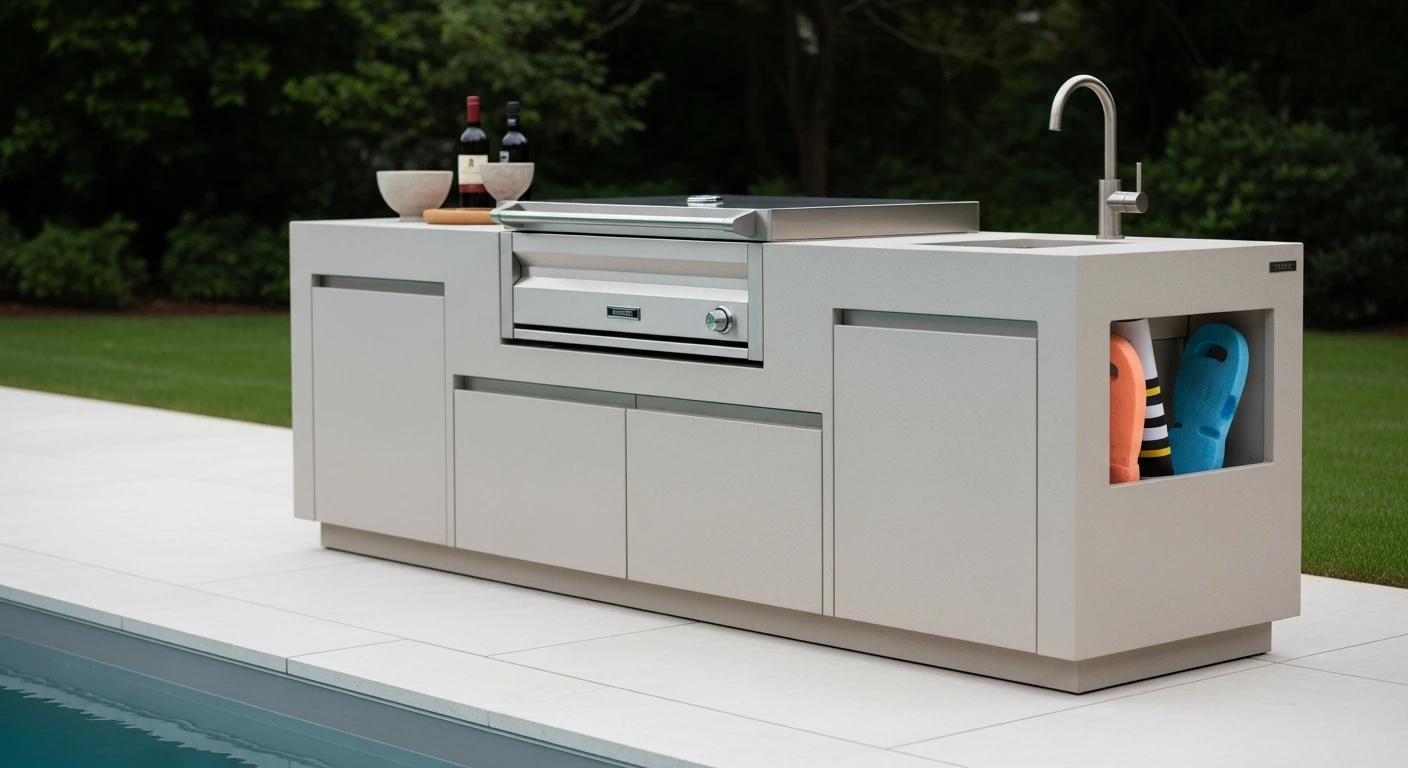
Modular Outdoor Kitchen Cabinets in Charlotte County: My Framework for 30-Year Corrosion-Proofing
After a decade designing and installing outdoor kitchens here in Charlotte County, I’ve seen the same expensive failure pattern repeat itself from Englewood to the waterfront homes in Punta Gorda Isles. A beautiful outdoor kitchen, just two or three years old, begins showing signs of rust, warping, and delamination. The culprit is almost never poor craftsmanship; it's a fundamental misunderstanding of our unique coastal climate. The combination of intense UV exposure, high humidity, and pervasive salt spray creates an environment that standard "outdoor-rated" materials simply cannot survive. My entire approach is built on preventing this premature decay. I developed a material specification and installation protocol that doesn't just resist the Charlotte County environment but is engineered to be impervious to it. This isn't about choosing a better brand; it’s about a complete shift in material science, focusing on marine-grade polymers for cabinet construction and 316L stainless steel for all hardware, ensuring a 25-30 year functional lifespan without aesthetic degradation.The Critical Flaw in Standard Outdoor Cabinet Installations
The most common mistake I encounter is the over-reliance on 304-grade stainless steel and powder-coated aluminum. While these are acceptable materials for inland climates, here in Port Charlotte, they are a liability. I once had to completely replace a high-end kitchen where the 304-grade stainless steel drawer pulls and hinges showed significant pitting and corrosion creep within 18 months due to proximity to the saltwater canal. The powder coating on the aluminum frames had also started to bubble and flake, allowing the salt air to attack the raw metal underneath. My methodology was born from diagnosing these failures. It’s a two-part system: First, Material Immunity, which dictates the core components must be chemically non-reactive to salt and moisture. Second, Structural Integrity, which ensures the assembly can withstand thermal expansion from the Florida sun and the uplift forces of hurricane-season winds.Material Specification: Beyond Stainless Steel to Marine-Grade Polymers
To achieve true longevity, I moved away from metal cabinet boxes entirely. My primary specification is now High-Density Polyethylene (HDPE), a marine-grade polymer. Unlike wood, it will not absorb moisture, swell, or warp. Unlike metal, it cannot rust or corrode. The color and UV inhibitors are integrated throughout the material, not just a surface coating, so scratches don't compromise its integrity. This is a critical distinction that most installers miss. For all hardware—hinges, screws, fasteners, and drawer slides—I mandate the use of 316L marine-grade stainless steel. The "L" signifies low carbon content, and the key difference from 304 is the addition of molybdenum. This element drastically increases resistance to chloride corrosion, which is exactly what salt spray is. Using anything less in a lanai or open-air kitchen in our region is a predictable point of failure.My Proprietary Installation Checklist for a Hurricane-Resistant Build
A correct material choice can be undermined by a flawed installation. Over the years, I've refined my process into a non-negotiable checklist that addresses the specific challenges of our local environment.- Frame Anchoring: The modular base frame must be anchored directly to the concrete slab with stainless steel fasteners. This prevents shifting or uplift during severe weather events, a lesson learned from projects I've had to repair post-hurricane.
- Ventilation Channels: I integrate passive cross-ventilation channels into the cabinet design. This prevents stagnant, humid air from being trapped inside, which is the primary cause of mold and mildew growth on utensils and surfaces, even within polymer cabinets.
- Countertop Sealant Protocol: All seams and mounting points for countertops (especially heavy granite or quartz) must be sealed with a marine-grade polyurethane sealant, not standard silicone. This provides a flexible, waterproof bond that accommodates thermal expansion and prevents water intrusion into the cabinet structure.
- Appliance Isolation: Every appliance, like a grill or side burner, is installed with a non-combustible insulating liner and proper gapping. This protects the HDPE cabinet material from excessive heat, preventing any potential long-term deformation.
Post-Installation Audit: The 3-Point Check for Longevity
Before I consider a project complete, I perform a final audit. This isn't just a simple walkthrough; it's a technical verification that ensures the system will perform as designed. First, I use a precision level to check for zero-tolerance settling across the entire countertop. Even a 1% deviation can cause water to pool. Second, I test every door and drawer for alignment and resistance-free operation, ensuring the weight is properly distributed on the 316L hardware. Finally, I verify that all ventilation ports are unobstructed, guaranteeing the system can breathe and expel moisture effectively. This final check is what separates a good-looking kitchen from one that will last for decades. Given the relentless humidity and salt exposure from the Gulf, are you confident your cabinet’s core material is truly waterproof, or is it just water-resistant with a surface coating that will inevitably fail?Written by

Tags
modern modular outdoor kitchen
modular outdoor bbq island
outdoor modular kitchen island
modular outdoor kitchen grill
outdoor grill modular