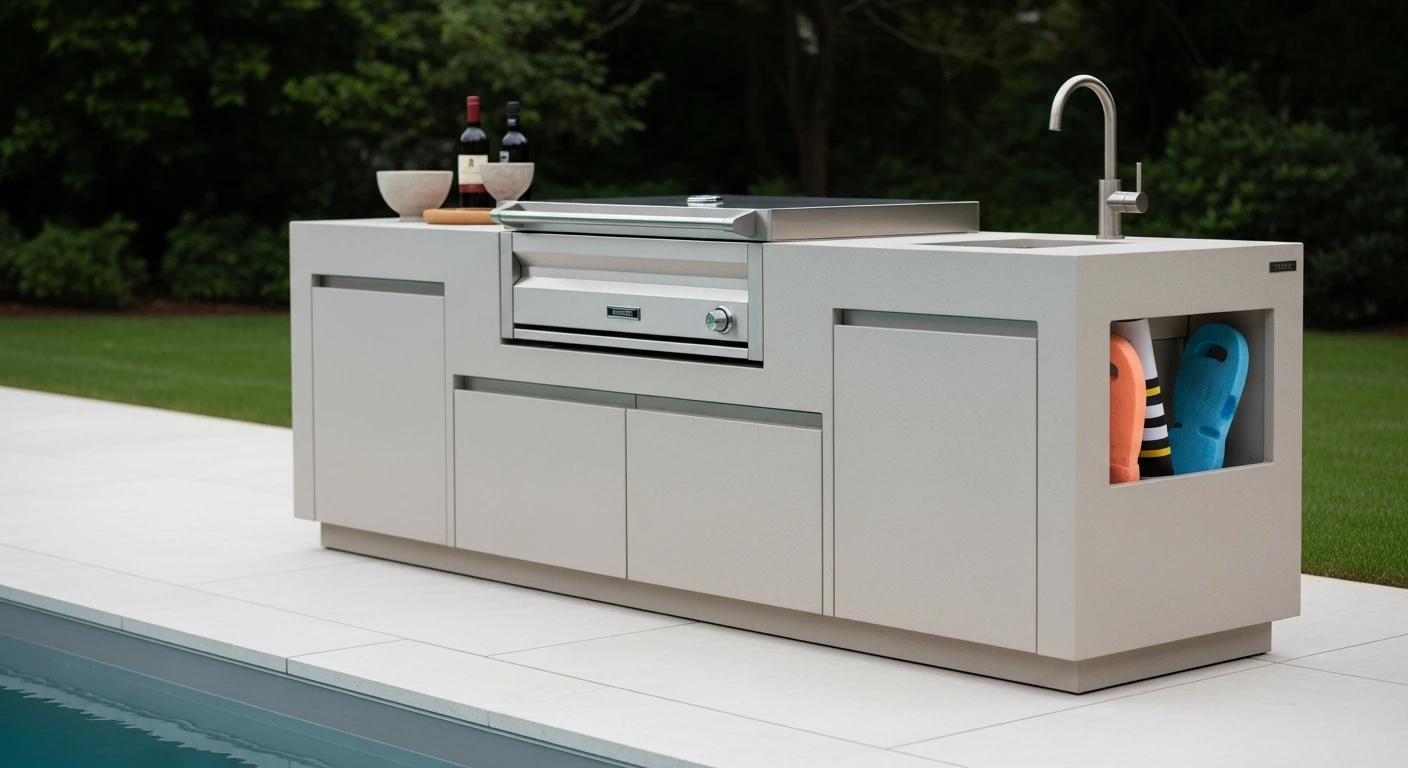
Modular Stainless Steel Outdoor Kitchen Cabinets: My Protocol for 15+ Year Corrosion-Free Performance in Charlotte County
After years of designing and specifying outdoor kitchens, particularly for waterfront properties in Punta Gorda and Englewood, I’ve seen one costly mistake repeat itself: focusing on the appliance brand instead of the cabinet’s material integrity. An outdoor kitchen in Charlotte County isn’t just an amenity; it's a long-term investment exposed to some of Florida’s harshest conditions—intense UV, oppressive humidity, and the pervasive salt air from Charlotte Harbor. The common approach fails because it overlooks the specific grade of stainless steel and the installation methodology required to combat galvanic corrosion and rust staining. My entire process is built around a single goal: ensuring your modular cabinet system looks as good in its tenth year as it did on day one. This isn't about aesthetics alone; it's about preserving the structural and financial value of your lanai or patio space.The Core Diagnostic Flaw: The "Stainless Steel is Stainless Steel" Myth
The most significant error I've had to correct on-site, especially in new construction homes in the Babcock Ranch area, is the assumption that all stainless steel is created equal. A developer or homeowner will invest in a high-end grill but install it into cabinets made from 430-grade stainless steel. This type is magnetic and has a low chromium/nickel content, making it highly susceptible to surface rust when exposed to the salty humidity we get year-round. I've seen these "new" kitchens show rust spots within a single summer season. My methodology, the "Coastal Durability Framework," directly addresses this by focusing on three non-negotiable pillars: the material grade, the fastener integrity, and the isolation of components. It’s a system designed specifically to counteract the accelerated decay caused by our local climate.Technical Material & Fastener Specification Breakdown
The science behind longevity is in the metallurgy. For any project within a few miles of the coast or the Peace River, my baseline specification is 304-grade stainless steel. It contains sufficient chromium and nickel to resist most corrosion. However, for properties directly on the water, like many in Punta Gorda Isles, I mandate 316-grade ("marine-grade") stainless steel. The key difference is the addition of molybdenum, an element that provides a dramatic increase in resistance to chlorides, which is essentially airborne salt. This specification increases material cost by about 15-20%, but it extends the corrosion-free lifespan by well over 100%. Furthermore, cabinet integrity is only as strong as its weakest point: the fasteners. Using zinc-plated or even 304-grade screws to assemble 316-grade panels creates a point of galvanic corrosion. I exclusively specify 316-grade stainless steel fasteners for all connections, from cabinet-to-cabinet bolts to drawer-pull screws. This prevents the ugly rust streaks that bleed down from screw heads and guarantees the joints won't fail.My Pre-Installation Protocol for a Zero-Failure Outcome
Executing a flawless installation is a process of precision and preemptive problem-solving. Before a single cabinet is unboxed on a Charlotte County property, I run through a strict five-point checklist. This isn't just assembly; it's environmental hardening.- Substrate Integrity Analysis: I first verify the lanai's concrete pad. It must be properly sealed and sloped away from the home. Any standing water will accelerate under-cabinet corrosion.
- Component Isolation Check: Each modular cabinet leg must rest on a non-abrasive, high-density polymer foot. Direct concrete contact can wear down the steel's passive layer and invite moisture.
- Hardware & Fastener Audit: I personally inspect a sample of the provided screws and bolts with a magnet. If they are magnetic, they are likely a lower grade (like 400-series) and are immediately rejected. This is a critical quality gate.
- Panel Passivation: After assembly, I require a final cleaning with a citric acid-based solution. This process, known as passivation, removes any free iron particles left from the manufacturing or installation tools and chemically enhances the steel's natural chromium-oxide protective layer.
- Sealant Application: Any seams where cabinets meet a wall or countertop are sealed with a high-quality, UV-stable polyurethane sealant, not basic silicone. This prevents saltwater intrusion into unseen crevices.
Precision Tuning for Florida's Climate
The final 10% of the job is what separates a standard installation from a bespoke one. I pay close attention to the functional elements that are most affected by our climate. Drawer slides and cabinet hinges are a major point of failure. I ensure they are also full 304 or 316-grade stainless steel and apply a light coating of a marine-grade, non-petroleum lubricant. This prevents the "stiffening" that occurs as humidity and heat cause metal components to expand and contract. My standard for panel gaps is a consistent 3mm tolerance, allowing for this thermal expansion without compromising the kitchen's aesthetic lines. So, when you evaluate a proposal for your outdoor kitchen, are you simply looking at the brand name on the grill, or are you scrutinizing the metallurgical grade of the unseen screws that will ultimately determine its survival in our demanding coastal environment?Written by

Tags
prefabricated outdoor grill islands
prefabricated outdoor kitchen
prefab bbq islands
prefab outdoor kitchen
prefab outdoor kitchen island