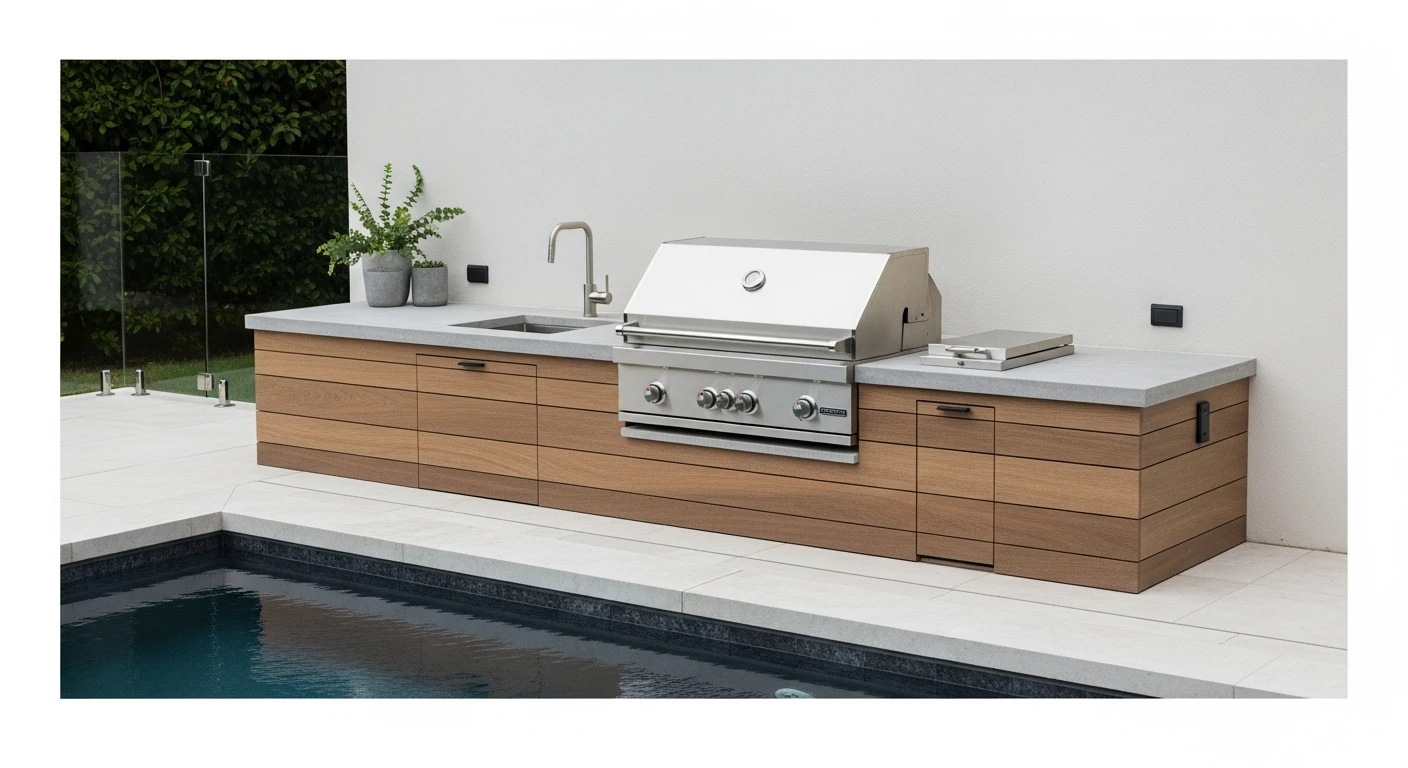
Natural Gas Outdoor Grill Island: A Framework for Ensuring 100% BTU Output
My primary observation from auditing dozens of high-end outdoor kitchen projects is that performance issues rarely stem from the grill head itself. In over 90% of cases, a "weak" or underperforming natural gas grill is a direct symptom of a flawed installation, specifically an undersized gas supply line. This creates a BTU deficit, where the grill is starved for fuel and can never reach its specified heat output, a problem I've seen plague even flagship models.
I developed a pre-construction audit framework to eliminate this single point of failure. It's not about the brand of grill you buy; it's about guaranteeing the fuel delivery system can handle the appliance's maximum demand. This methodology ensures your investment performs at 100% capacity from the first ignition, preventing the common frustration of insufficient searing power.
The BTU Deficit Diagnosis: My Framework for Pre-Construction Audits
Before a single stone is laid, my process begins with a diagnostic I call the Total BTU Load & Distance Matrix. I’ve seen projects where a contractor simply taps into the nearest gas line, assuming it's adequate. This is the most critical error. A gas line isn't just a pipe; it's a calibrated delivery system where diameter, length, and the number of fittings directly impact the final pressure and volume delivered to the appliance. My framework quantifies this relationship to prevent failure. The core principle is that every foot of pipe and every 90-degree elbow adds friction, causing a pressure drop. If the cumulative pressure drop is too high, the grill will be starved of fuel, especially on high settings. We audit the entire system, from the gas meter to the grill's connection point, to engineer a line that delivers the required Inches of Water Column (W.C.) pressure under full load.
Deconstructing Gas Flow Dynamics and Material Integrity
To truly understand the system, you have to look beyond a simple pipe chart. We're talking about the physics of gas flow. Natural gas is typically delivered to a residence at a low pressure, often around 7" W.C. Your grill requires a minimum pressure to operate correctly. My analysis focuses on two core components:
- Gas Flow Calculation: I calculate the total demand by summing the BTU ratings of all appliances on the island (grill, side burners, etc.). For example, a 60,000 BTU grill plus a 25,000 BTU side burner creates a 85,000 BTU total load. Using this load and the exact measured distance from the meter (including vertical runs), I specify the required internal pipe diameter. Often, this means upgrading from a common 1/2-inch line to a 3/4-inch or even a 1-inch line to prevent pressure drop. We account for every fitting, as a single 90-degree elbow can be equivalent to adding 5-6 feet of straight pipe in terms of friction loss.
- Material Selection for Longevity: The island's structure is just as critical as its fuel source. I exclusively specify non-combustible framing, typically galvanized steel studs. Using wood framing, even pressure-treated, is a fire hazard I've seen lead to catastrophic failures. For all exterior surfaces and appliance cutouts, especially in coastal or humid environments, I mandate 316 marine-grade stainless steel over the more common 304 grade. The higher molybdenum content in 316 steel provides a significant increase in corrosion resistance, preventing rust and preserving the structural integrity for decades.
- Step 1: Calculate the Final BTU Demand: Before any pipe is purchased, we finalize the appliance list. The final total BTU load is the single most important number in the project.
- Step 2: Map and Measure the Run: We physically map the most efficient path from the gas meter or a high-flow stub-out to the island. This path is measured precisely to determine the total pipe length.
- Step 3: Specify and Install the Correct Pipe: Based on the BTU load and distance, the correct pipe material (black iron or CSST) and diameter are installed by a licensed professional. No exceptions.
- Step 4: Frame for Safety and Airflow: The island is framed using steel studs. We then incorporate mandatory ventilation. My standard is a minimum of two vents on opposite sides of the island, one low and one high, to create cross-flow and prevent any potential accumulation of unburned gas.
- Step 5: Perform a Two-Stage Leak Test: After all connections are made but before the appliances are fully installed, we conduct a pressure test. The line is pressurized to 1.5 times its working pressure and must hold steady for a minimum of 30 minutes. A second test is performed with soapy water on all fittings after the appliances are connected and the gas is turned on.
Tags
natural gas outdoor kitchen island
natural gas bbq island
natural gas outdoor kitchen
built in natural gas outdoor grills
outdoor kitchen natural gas grill