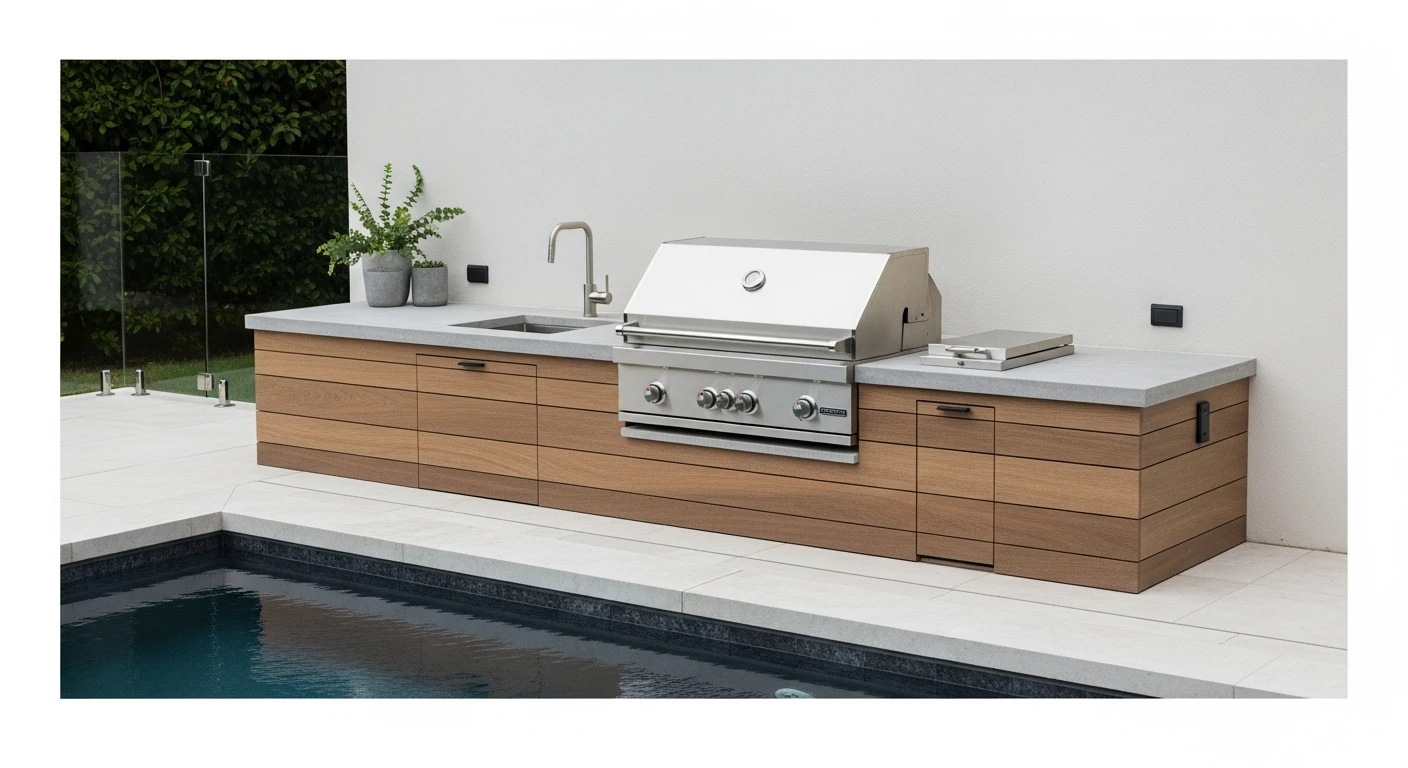
Natural Stone Outdoor Kitchen: The Substrate Protocol for 30-Year Durability
Most natural stone outdoor kitchens I'm called to repair fail not because of the stone itself, but due to a fundamental misunderstanding of the substrate and moisture management. The common approach of simply cladding a metal frame with stone veneer is a recipe for disaster within 5-7 years. My entire methodology is built around creating a monolithic, weatherproof core that treats the outdoor kitchen like a permanent architectural feature, not a piece of furniture.
This focus on the internal structure—specifically the use of a reinforced concrete masonry unit (CMU) block frame and a multi-layer waterproofing system—is what separates a project that looks good for a season from one that performs for decades. I've seen projects with premium quartzite countertops crack in half because the underlying structure couldn't handle the thermal expansion and contraction cycles. This is an expensive, yet completely avoidable, failure.
Diagnosing Inevitable Failure: My Elemental Shield Methodology
Before I even consider stone selection with a client, I perform what I call the Elemental Shield analysis. This isn't about aesthetics; it's about physics and environmental exposure. The biggest mistake I see is designing an outdoor kitchen as if it lives in a climate-controlled indoor space. The two primary failure vectors I diagnose are thermal stress and moisture ingress. A standard steel stud frame has a drastically different coefficient of thermal expansion than the mortar and stone attached to it. Over hundreds of cycles of heating and cooling, this differential movement creates micro-fractures in the grout and mortar beds, creating a pathway for water. Once water gets behind the stone and freezes, spalling and delamination are inevitable. My methodology's first step is to eliminate this material conflict from the design.
The Technical Triad: Stone Porosity, Substrate Integrity, and Mortar Elasticity
To build a structure that lasts, I focus on a "Technical Triad" of components that must work in harmony.
- Stone Porosity Analysis: Not all granite or marble is created equal. Before final selection, I test samples for their absorption rate. A stone with an absorption rate over 0.5% will require a more aggressive sealing schedule and is more susceptible to freeze-thaw damage. I often steer clients towards denser stones like specific granites, quartzite, or even soapstone, which have inherently lower porosity and require less long-term maintenance.
- Substrate Integrity via CMU Core: This is the non-negotiable heart of my projects. A CMU block structure moves monolithically with the concrete foundation and has thermal properties far more compatible with stone and mortar. This isn't just a frame; it's a fortress. We build it on a proper concrete footing below the frost line and integrate a weeping system at the base to manage any potential internal condensation.
- Mortar Elasticity and Bond Strength: Standard mortar is too rigid for outdoor applications. I specify a custom polymer-modified thin-set mortar with a high latex content. This provides a significantly stronger bond but, more importantly, introduces a degree of flexibility—a crucial factor for absorbing the daily and seasonal thermal cycles without compromising the bond between the CMU core and the stone cladding. This alone can increase the shear strength of the bond by over 40%.
- Foundation First: We pour a reinforced concrete slab, a minimum of 6 inches thick, with integrated footings that extend below the regional frost line. This prevents seasonal heaving from fracturing the structure.
- Construct the CMU Core: Using Type S mortar, we build the walls of the kitchen island and counters. We fill the cells with rebar and concrete at critical junctures, such as corners and around appliance cutouts, to create an integrated, reinforced concrete and block skeleton.
- Apply a Fluid Waterproofing Membrane: This is a step almost everyone skips. Before any cladding is applied, the entire exterior surface of the CMU block is coated with a liquid-applied waterproofing and crack-isolation membrane, the same type used in commercial shower construction. This creates a seamless barrier, ensuring that even if moisture gets past the stone and grout, it never reaches the core structure.
- Cladding with Polymer-Modified Mortar: We then apply the selected natural stone veneer or slabs using the specified high-flexibility, polymer-modified mortar. We ensure 100% mortar coverage on the back of each stone piece to eliminate any voids where water could collect.
Tags
luxury modern outdoor kitchen
natural gas grill island
natural gas outdoor grill island
outdoor natural gas oven
natural gas stove outdoor