
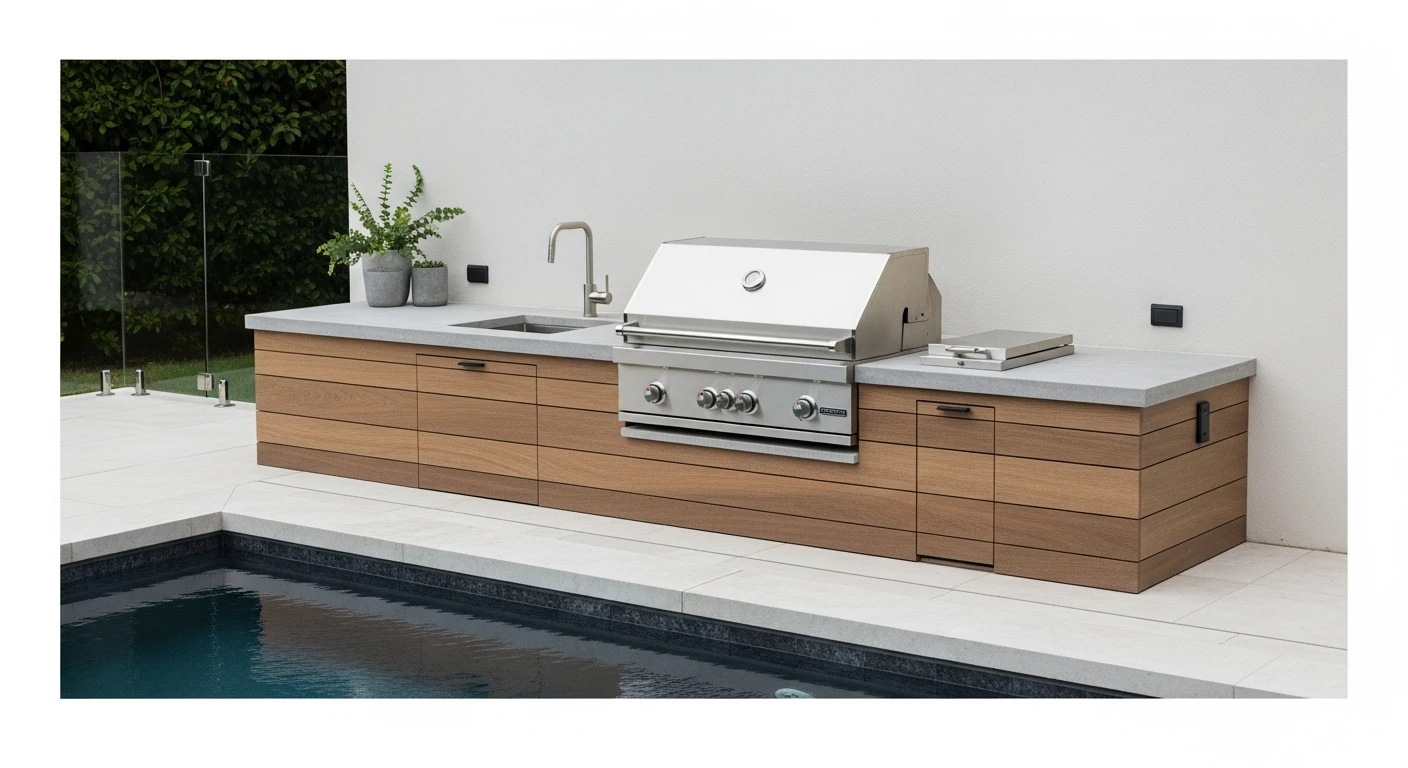
Outdoor Kitchen Natural Gas Grill: Engineering for Zero BTU Drop-off and Perfect Searing
The single greatest point of failure in an outdoor kitchen natural gas grill installation isn't the grill itself—it's the fuel supply line. I’ve seen six-figure outdoor kitchen projects crippled by underpowered flames simply because the gas line was an afterthought, typically a standard 1/2-inch pipe run too far from the meter. This leads to significant BTU drop-off, preventing high-end grills from ever reaching their advertised searing temperatures.
My entire approach is built on reversing this dynamic. We don't just connect a grill; we engineer a dedicated fuel delivery system. This methodology ensures that a grill rated for 80,000 BTUs actually delivers 80,000 BTUs at the burner, guaranteeing consistent performance, eliminating ignition failures, and extending the lifespan of the components by preventing inefficient combustion. This is about transforming a "grill hookup" into a calculated performance installation.
The Gas Flow Efficacy Protocol: My Diagnostic Framework
Before any hardware is even considered, I deploy what I call the Gas Flow Efficacy Protocol. It's a diagnostic framework I developed after identifying a recurring error pattern in underperforming luxury installations: installers were treating a powerful outdoor grill like a simple indoor cooktop. The protocol’s core principle is that the gas line’s capacity must exceed the total potential demand of all connected appliances, factoring in a 20% performance buffer. Most performance complaints I've troubleshooted—uneven heat, yellow flames, delayed ignition—trace back to a violation of this principle. The protocol is not about guessing; it's a series of calculations to map the entire gas system from the meter to the grill’s manifold.
BTU Load vs. Pipe Diameter: The Non-Negotiable Calculation
This is where the technical work truly begins. The critical error is assuming a 1/2-inch pipe is sufficient. For a typical 60,000 BTU main grill, plus a 15,000 BTU side burner, located 40 feet from the gas meter, a 1/2-inch line will suffer a significant pressure drop. My standard is to mandate a 3/4-inch dedicated line for any total load exceeding 50,000 BTUs at distances over 25 feet. This isn't a recommendation; it's a structural requirement for peak performance. I also scrutinize the grill's material composition. I insist on 304-grade stainless steel for all burner and grate components, especially in coastal areas. While cheaper 430-grade steel looks similar initially, it lacks the nickel content to resist corrosion, leading to component failure in as little as two years. This material specification alone can increase the grill's functional lifespan by over 50%.
From Blueprint to Flame: A 5-Step Installation Checklist
Executing this correctly is a matter of precision and sequence. I've refined my on-site process into a checklist that eliminates variables and ensures predictable outcomes. Following this sequence prevents costly retrofits and performance issues.
- Total Appliance BTU Audit: We begin at the gas meter. We sum the BTU rating of every single gas appliance in the home—furnace, water heater, cooktop, and the proposed outdoor kitchen appliances. This gives us the Maximum Potential Load.
- Gas Line Mapping & Sizing: With the total load calculated, we map the new line's path. We measure the exact distance and count every fitting and elbow, as each adds "equivalent feet" of resistance. Based on this map, we specify the pipe diameter (usually 3/4-inch or even 1-inch) to ensure zero pressure drop at the grill manifold.
- Material Vetting and Component Integrity: Before installation, I personally inspect the grill's key components. I verify the burners are indeed 304-grade stainless steel and that the igniter is a reliable hot-surface or flame-thrower type, not a cheap piezo sparker prone to moisture failure.
- The Manometer Leak Test: Post-installation, we don't just check for leaks with soap bubbles. We connect a manometer to the system, pressurize it, and let it sit for 15 minutes. Any drop in pressure, no matter how small, indicates a leak that must be rectified. This is a non-negotiable quality gate.
- Initial Burner Calibration: The final step is to fire up the grill and calibrate the burners. We adjust the air shutters at the base of each burner until we achieve a perfect, stable blue flame with slight yellow tips. This indicates an optimal air-to-fuel ratio for maximum heat and efficiency.
Tags
luxury outdoor pizza oven
outdoor luxury kitchen
high end luxury outdoor kitchen
outdoor kitchen grill natural gas
natural gas outdoor kitchen grill


