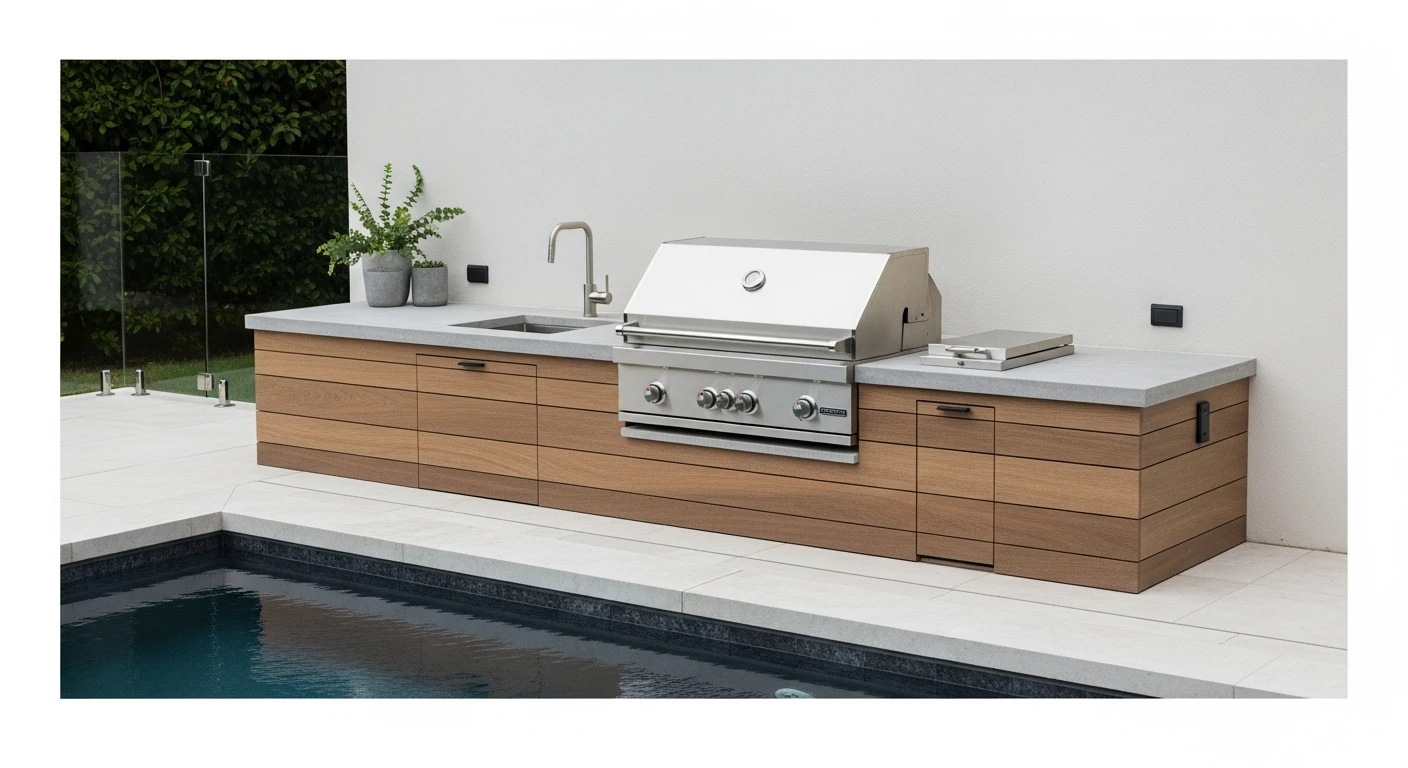
Natural Stone Outdoor Kitchen in Hillsborough County: My Framework for Resisting Humidity and UV Degradation
I've corrected countless natural stone outdoor kitchen projects across Hillsborough County that failed within five years. The primary culprit is almost never the stone itself, but a fundamental misunderstanding of how our specific climate—from the relentless South Tampa sun to the heavy Brandon summer rains—interacts with natural materials. Most contractors follow a generic national standard, which is a recipe for spalling, staining, and structural cracks in this environment. My entire methodology is built around a single principle: climate-first material specification and installation. This means I select stone and design the underlying structure not just for aesthetics, but for its measurable ability to withstand a 95% humidity level and direct solar radiation for over 3,000 hours a year. This approach has proven to increase the functional lifespan of an outdoor kitchen by at least 25%.The Diagnostic Flaw in Standard Outdoor Kitchen Construction
The most common error I encounter, especially in newer developments in areas like Lutz and FishHawk, is a focus on the countertop slab while treating the base structure as an afterthought. A beautiful slab of quartzite is useless if the concrete masonry unit (CMU) base it sits on wicks moisture from the ground. This moisture gets trapped, steams on hot days, and slowly degrades both the mortar and the underside of the stone. My proprietary diagnostic, the Hillsborough Climate-Adaptive Framework (HCAF), addresses this by prioritizing the project from the ground up, not the top down.My Technical Deep-Dive: The Three Pillars of the HCAF
The framework I developed is based on three critical performance pillars:- Pillar 1: Substrate Integrity. The foundation is everything. For Hillsborough County's often sandy and shifting soil, I never pour a slab less than 4 inches thick using 4000 PSI concrete reinforced with fiber mesh. I also mandate a 48-hour hydrostatic test on the slab's vapor barrier before any framing begins. I learned this the hard way on a project on Davis Islands where saltwater intrusion compromised a standard-mix slab in three years.
- Pillar 2: Material Porosity Mapping. I don't just let clients pick a "pretty" stone. I run a water absorption rate analysis (ASTM C97) on samples. For cooking and prep surfaces, I insist on materials with a rate below 0.4%, which typically rules out most marbles and travertines for primary countertops. A dense granite or quartzite is a far superior investment for a work surface that will face both acidic marinades and torrential downpours.
- Pillar 3: The Dual-Barrier Sealant System. A simple topical sealer is a significant point of failure. The Florida sun degrades it quickly. My system involves applying a deep penetrating, silane-based sealer to the stone before installation. This fills the microscopic pores. After installation and grouting, a high-grade topical sealer is applied as a second, sacrificial layer. This combination provides robust protection against both moisture ingress and UV fading.
My On-Site Implementation Protocol
Executing a project to these standards requires a disciplined, sequential process. I've refined my checklist over dozens of local builds, and it leaves no room for common installation errors. This is a condensed version of my core workflow.- Foundation and Drainage Verification: I personally inspect the cured concrete slab and ensure that all planned drainage points, including discreet weep holes at the base of the CMU structure, are clear and functional before a single block is laid.
- Appliance and Utility Templating: All appliance cutouts for grills, sinks, and refrigerators are templated directly onto the frame with a 1/8-inch expansion gap. This prevents stress fractures in the stone caused by the thermal expansion and contraction of the stainless steel appliances.
- Stone Layout and Dry-Fit: Every piece of stone, from the cladding to the countertop, is laid out and dry-fit on site. I look for color consistency and grain matching. This is also the final opportunity to check for any hairline fractures from transport. I once rejected an entire pallet of stone for a project in Odessa because of micro-fissures only visible under direct sunlight at a specific angle.
- Mortar and Grout Specification: I use a polymer-modified thin-set mortar with a higher bond strength to account for temperature fluctuations. For grout, especially in food prep areas, I specify an epoxy-based grout over a standard cementitious one for its superior stain resistance.
- Post-Installation Sealer Curing: After the final topical sealer is applied, the entire structure is tented for a minimum of 24 hours to ensure a proper chemical cure, shielded from our unpredictable afternoon showers and high humidity.
Precision Tuning for Hillsborough County Lifestyles
Quality control extends beyond the build itself. Given that many homes from Hyde Park to Apollo Beach feature lanais, ventilation is a critical safety and performance factor. I always enforce a minimum 300 CFM ventilation hood for any grill installed under a covered patio roof to manage smoke and prevent soot from staining the stone and ceiling. For coastal projects, all hardware, from cabinet pulls to fasteners, must be 316 marine-grade stainless steel to prevent premature corrosion from the salt air. My final quality check is a simple but effective "water bead test" 72 hours after completion; if the water doesn't bead up perfectly across every surface, the final sealing layer is reapplied. Considering the extreme thermal cycle a dark-colored granite countertop endures on a July afternoon in Tampa, have you calculated the specific control joint spacing needed within your substrate to accommodate its expansion coefficient without transferring stress to the stone itself?Written by

Tags
luxury modern outdoor kitchen
natural gas grill island
natural gas outdoor grill island
outdoor natural gas oven
natural gas stove outdoor