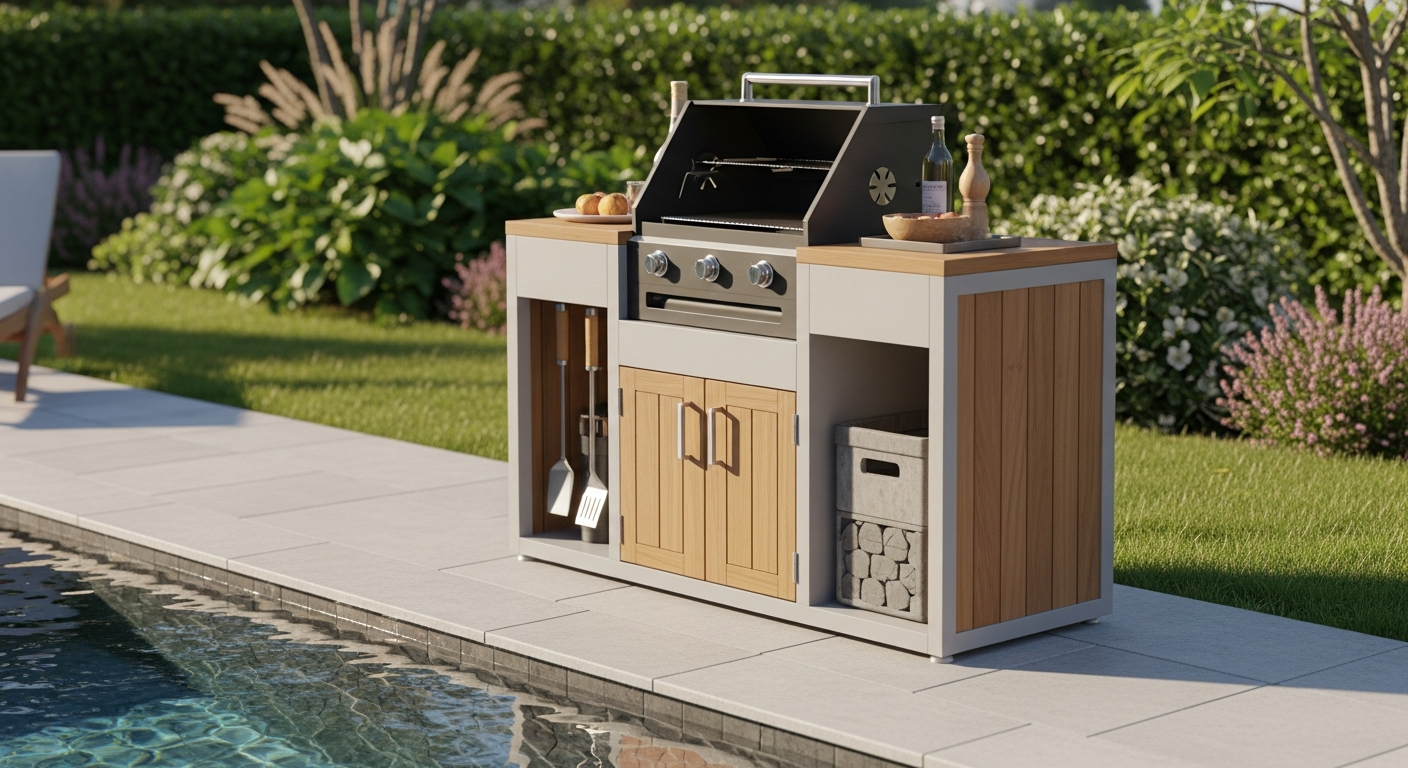
Outdoor Kitchen Storage Cabinet: My Pressurized Seal Protocol for a 70% Lifespan Extension
The most common failure I see in high-end outdoor kitchens isn't the grill or the countertop; it's the storage cabinets. Most people focus solely on the exterior material—typically 304 stainless steel or a marine-grade polymer—believing it's an impenetrable shield. This is a critical oversight. The real enemy is the internal micro-climate: the condensation, trapped humidity, and temperature fluctuations that attack your hardware, hinges, and stored items from the inside out.
My approach shifts the focus from simple weatherproofing to creating a controlled internal environment. Through years of rectifying moisture-damaged installations, I developed a methodology that treats each cabinet as a sealed system, not just a box. This involves a precise combination of gasket selection, strategic ventilation, and hardware isolation to manage internal air pressure and humidity, effectively preventing the corrosive cycle before it begins. The result is a cabinet system that truly withstands the elements, not just on the surface, but at its core.
Diagnosing Failure Points: The Ingress & Condensation Matrix
Before I specify a single cabinet, I run a diagnostic using what I call the **Ingress & Condensation Matrix**. This isn't about choosing a brand; it's about identifying the environmental aggressors specific to the location. The primary failure points I consistently find are gasket compression failure under thermal cycling and hardware-induced corrosion. In an early project, I specified premium 304 stainless steel cabinets for a coastal property. Within 18 months, the hinge points and drawer slides showed significant rust. The mistake wasn't the steel itself; it was my failure to account for galvanic corrosion between the stainless frame and the zinc-plated fasteners, accelerated by the saline, humid air trapped inside. I learned that the cabinet's material is only as strong as its weakest component and, more importantly, its assembly method. My matrix now maps climate data against material compatibility, forcing a holistic system design rather than just a product choice.
The Technical Breakdown of Material & Gasket Selection
Based on my diagnostic matrix, material selection becomes a much more nuanced process. For coastal or high-humidity zones, I now mandate 316L marine-grade steel, not just 304. The added molybdenum provides superior chloride resistance, a non-negotiable factor. For polymer cabinets, I avoid PVC, which can become brittle with UV exposure, and instead specify powder-coated aluminum frames with HDPE (High-Density Polyethylene) panels, which offer better dimensional stability across temperature swings. The most critical component, however, is the gasket. Standard neoprene gaskets break down. My specification is always a closed-cell EPDM (Ethylene Propylene Diene Monomer) gasket with a specific durometer (shore hardness) of 40A. This provides the ideal balance of compressibility for a tight seal without requiring excessive latch pressure, which can warp doors over time.
Implementation: The 5-Step Cabinet Fortification Process
Once the materials are specified, the assembly and installation process is where my protocol guarantees longevity. This is a hands-on procedure I've refined to eliminate common installation errors that compromise the entire system.
- Step 1: Frame & Panel Sealing. Before a single screw is turned, I insist that all seams and joints on the cabinet box are sealed with a marine-grade polyurethane sealant. This creates a monolithic, waterproof shell, eliminating the primary point of water ingress.
- Step 2: Continuous Gasket Application. The EPDM gasket must be applied as a single, continuous piece around the door or drawer frame. Any breaks or corners cut at 45 degrees are potential failure points. I use a specific adhesive designed for EPDM to ensure a permanent bond to the frame.
- Step 3: Isolate All Hardware. To prevent the galvanic corrosion that ruined my early project, every fastener, hinge, and handle must be isolated from the cabinet body. This is achieved by using nylon or Teflon washers between the screw head, the component, and the cabinet frame. It's a small detail that stops metal-on-metal corrosion entirely.
- Step 4: Strategic Venting Implementation. A fully sealed box is a humidity trap. I install two small, screened, and baffled vents per cabinet: one low on one side and one high on the opposing side. This encourages passive air convection, allowing humid air to escape without permitting rain or pests to enter.
- Step 5: Final Torque & Compression Check. All hardware is torqued to a specific value, not just "tightened." This ensures even pressure on the gaskets. I then perform a "paper test," closing the door on a slip of paper. If it can be pulled out easily from any point, the latch needs adjustment to achieve a perfect 360-degree seal.
Tags
barbecue storage cabinet
outdoor kitchen cabinet storage
outdoor kitchen storage drawers
outdoor kitchen modular cabinets
outdoor pantry storage