
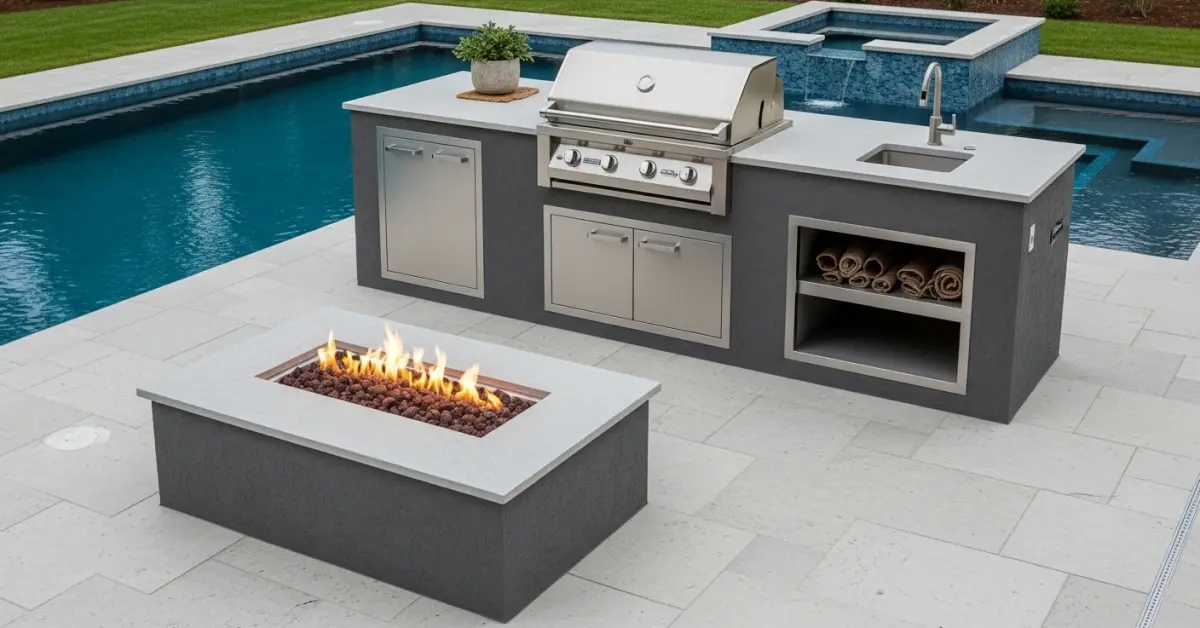
Outdoor Kitchen with Fire Pit: A Material Selection Protocol for 30-Year Durability in Polk County
For anyone in Polk County planning an outdoor kitchen with a fire pit, the most common point of failure isn't the design or the appliances; it's the premature decay of materials that simply can't handle our relentless humidity and intense UV exposure. I’ve seen beautiful installations in Winter Haven and Lakeland look a decade old in just three years because the builder applied indoor logic to an outdoor environment. They failed to account for the constant moisture expansion and contraction cycles. My entire approach is built on a single principle: **moisture management through material science and strategic airflow**. This isn't just about choosing "outdoor-rated" products; it's about creating a system where every component actively resists or sheds moisture. This methodology shifts the expected lifespan of your project from a mere 5-10 years to a potential 30-year+ asset for your home, whether you're on a lakefront property in Lake Wales or a new build in Bartow.The Critical Flaw in Standard Polk County Outdoor Kitchens: My Airflow-First Design Audit
The biggest mistake I consistently correct is a sealed-box design. Contractors often frame an outdoor kitchen island like an indoor cabinet set, trapping humid air inside. This creates a perfect breeding ground for mold and causes delamination in wood-based substrates. My initial audit on any project starts not with the layout, but with the atmospheric conditions of the specific property. A home on the south side of a lake in Lakeland will have a different moisture profile than a more sheltered property in a subdivision. My proprietary methodology, the **Airflow-First Design Audit**, focuses on creating passive ventilation within the kitchen's structure. This involves analyzing prevailing breezes and the proximity to the home's structure to design concealed vents and air gaps. I once salvaged a project in a high-end Haines City community where the stainless steel cabinet doors were already showing signs of tea-staining (surface corrosion) within 18 months. The cause wasn't the steel itself, but the trapped, stagnant, humid air behind them. A simple reconfiguration to introduce cross-ventilation could have prevented a $5,000 replacement cost.Material Science Breakdown: Why Marine-Grade Polymers Outperform Stainless Steel
Most clients initially request 304-grade stainless steel for their cabinetry, believing it's the pinnacle of durability. In the Polk County climate, I’ve found this to be a technical misconception. While good, it's not the optimal choice for maximum longevity against our specific environmental pressures. Here's my material hierarchy based on years of field testing:- Cabinetry & Structure: I advocate for High-Density Polyethylene (HDPE), a marine-grade polymer. It is completely impervious to water, will not swell or delaminate, and its color is integrated throughout, so scratches don't show. It costs more upfront than pressure-treated wood framing, but it eliminates the primary failure point.
- Countertops: Quartz is popular indoors, but its resins can yellow under intense Florida sun over time. I specify either a heavily sealed, high-grade granite or, for ultimate performance, a sintered stone like Dekton. Sintered stone is virtually non-porous and has extreme resistance to UV rays, thermal shock, and scratches.
- Fire Pit Construction: Using standard landscaping pavers for a fire pit is a common error; they can crack from thermal shock. I mandate the use of fire-rated concrete block for the structure, lined with professional-grade fire brick. This assembly properly manages the intense, focused heat.
My 5-Phase Implementation Framework for a Humidity-Resistant Build
A successful project hinges on execution. A great design with poor implementation will still fail. I operate on a strict, phase-gated process to ensure every detail is addressed correctly.- Foundation and Drainage: We begin with a monolithic concrete slab, not individual pavers. The crucial detail is engineering a subtle 2% slope away from any adjacent structures. This single step is the most effective defense against standing water pooling at the base.
- Framing and Ventilation: The frame must be non-organic. I use either welded aluminum studs or galvanized steel. At this stage, I integrate the concealed ventilation ports at the top and bottom of the cabinet structures to create a natural thermal convection that cycles air.
- Utility Rough-In: All electrical outlets must be exterior-rated, in-use covered, and on a GFCI-protected circuit. For gas fire pits, I always install a dedicated emergency shut-off valve that is easily accessible but not immediately obvious to guests.
- Cladding and Countertop Install: We use a high-performance, flexible, polymer-modified thin-set mortar for any stone or brick veneer. For countertops, we create a template on-site to ensure a perfect fit, leaving a precise expansion joint against the house wall, which is then filled with a UV-stable silicone caulk, not rigid grout.
- Appliance Integration and Fire Pit Commissioning: Every heat-producing appliance, especially the grill, requires a properly installed insulated jacket if set into a combustible structure (even HDPE). We then perform a controlled burn-in for the fire pit to cure the materials and test the gas flow for a clean, consistent flame.
Post-Installation QA: The 1-Inch Air Gap Rule and Sealant Integrity Testing
My job isn't done when the last screw is tightened. I have a quality assurance checklist that ensures the project is not just built, but built to last. The most important check is what I call the **1-Inch Air Gap Rule**. I verify there is a minimum of a one-inch gap between the back of the entire kitchen structure and the exterior wall of the home. This channel is critical for preventing moisture from getting trapped against the house's stucco or siding. Next, I perform a water-bead test on all sealed stone surfaces. Water should bead up tightly. If it soaks in or spreads out, the sealant is insufficient, and we re-apply. This simple, five-minute test can prevent years of staining and degradation. We provide the client with a small kit and instructions to perform this test themselves every six months, empowering them to maintain the integrity of their investment. Are you accounting for the dew point differential inside your cabinet structures, or are you just trapping future mold growth?Written by

Tags
fire pit outdoor kitchen
outdoor fire pit kitchen
outdoor kitchen and fire pit
l shaped outdoor kitchen
brick outdoor kitchen
Outdoor Kitchen with Fire Pit in Polk FL FAQ
How far does my fire pit need to be from my pool and house for safety?
Your fire pit must be a minimum of 3 meters (10 feet) away from your house, pool edge, and any combustible structures like a deck or fence. This distance is a standard fire code requirement to prevent radiant heat from damaging surfaces or igniting materials. A common mistake is placing it too close to the pool, which can cause thermal shock and crack the pool's coping or tile line, especially with concrete pools. Also, consider the prevailing wind direction to ensure smoke and embers are consistently blown away from your main seating areas and the house itself.
Can I use the same gas line for my pool heater and my new outdoor kitchen grill?
Tapping into your existing pool heater's gas line is often possible but requires a professional load calculation to ensure adequate gas volume and pressure. Your gas line must be sized to handle the simultaneous demand of all appliances; an undersized line will cause poor performance, like a weak flame on the grill when the heater kicks on. A critical, often overlooked detail is the need for a separate, accessible shut-off valve for each appliance, which is a non-negotiable safety requirement for emergency situations and routine maintenance.
What countertop material won't get ruined by pool water and direct sun?
For durability against both chlorinated water and UV rays, sealed granite or concrete are superior choices for outdoor kitchen countertops near a pool. While quartz is popular indoors, most are not warrantied for outdoor use as the resins can yellow and degrade in direct sunlight. A key factor people miss is thermal expansion; dark-colored granite can become extremely hot, posing a burn risk. Lighter-colored, properly sealed natural stone offers the best balance of longevity, stain resistance from food and pool chemicals, and manageable surface temperature.
Do I need special drainage for my outdoor kitchen sink and prep area?
Yes, you must install a dedicated drainage system for your outdoor kitchen that does not run off onto the pool deck or into the pool. Allowing grease, cleaning agents, and food waste to enter the pool will create a constant battle with water chemistry, leading to algae blooms and high chlorine demand. A proper installation involves tying into your home's main sewer line or installing a dry well. This prevents staining of your deck material and protects the pool's plaster from being etched by acidic food and drink spills.
What type of pavers or decking is best around a fire pit and kitchen area?
Concrete pavers or natural stone like travertine are the best choices for flooring around a fire pit and kitchen due to their high fire resistance and durability. Avoid using composite decking or wood immediately around a fire pit, as stray embers can easily melt or ignite the surface. A critical consideration often missed is the sealant; use a non-slip, matte-finish sealant instead of a high-gloss one. High-gloss sealants become extremely slippery when wet from pool splash-out or kitchen spills, creating a significant safety hazard.
Are there regulations for the electrical outlets in an outdoor kitchen near a pool?
All electrical outlets in your outdoor kitchen must be Ground Fault Circuit Interrupter (GFCI) protected and housed in weatherproof, in-use covers. National electrical codes mandate that any outlet within 6 meters (20 feet) of the water's edge must have GFCI protection to prevent electrocution risk. Homeowners often underestimate the need for multiple, dedicated circuits. Running a refrigerator, lighting, and a rotisserie on a single circuit can lead to frequent breaker trips, so plan for at least two separate 20-amp circuits for the kitchen area alone.


