
Patio Paver Cleaning And Sealing In Charlotte County: A Protocol for 300% Longer Protection Against Humidity
If you're looking for paver cleaning and sealing in Charlotte County, you've likely seen the damage our relentless humidity and sun can do. I’ve seen countless paver patios in Punta Gorda and lanai decks in Port Charlotte turn green with algae and white with efflorescence in under a year. The common approach is to blast it with a high-pressure washer, but that’s the single biggest mistake I see professionals and homeowners make. It erodes the paver surface and, more critically, blows out the jointing sand, compromising the entire interlocking system. My work is based on a fundamental principle: preservation over abrasion. The goal isn't just to make your pavers look clean for a few months; it's to fortify them against the specific environmental pressures of our area, from the salty air in Englewood to the intense summer rains. My methodology focuses on a deep clean that respects the material's integrity, followed by a sealing process that creates a micro-barrier, effectively extending the paver’s pristine look and structural stability.My Diagnostic Framework for Charlotte County Pavers
Before I even mix a cleaning solution, my first step is a thorough on-site diagnosis. I’ve learned that a paver patio in Deep Creek exposed to full sun has a completely different set of problems than a shaded lanai by the canals in Punta Gorda Isles. My assessment isn't just a glance; it's a technical evaluation. I look for three key indicators: joint sand integrity, efflorescence levels, and organic growth penetration. A common error is treating surface-level mildew the same way as deep-set black mold. This misdiagnosis leads to recurring problems. My proprietary method, the Hydro-Kinetic Saturation & Seal Protocol, begins by identifying the root cause, not just the symptom.Decoding Paver Porosity and Contaminant Profiles
Understanding paver porosity is critical. The concrete pavers commonly used in our local housing developments have a specific absorption rate. If you apply a sealer to a paver that is still retaining moisture from a pressure wash, you trap that water. This is what causes that cloudy, white haze—a phenomenon called sealer blushing—that I'm often called in to fix. My process involves using a digital moisture meter to ensure the surface is below a 5% moisture threshold before any sealant is even considered. I also analyze the contaminant type. Is it organic (algae, mold)? Or is it mineral (efflorescence)? Organic stains require a sodium hypochlorite-based solution at a specific, low concentration to kill the spores, while mineral deposits must be treated with an acid-based efflorescence remover, then fully neutralized to prevent a chemical reaction with the sealer.The Hydro-Kinetic Saturation & Seal Protocol: A Step-by-Step Breakdown
Executing a flawless and durable finish requires a precise sequence of actions. Deviating from this order is what separates a job that lasts one year from one that lasts three or more, even under the intense Florida sun. I've refined this process over hundreds of projects across Charlotte County.- Surface Decontamination: I begin with a fungicidal pre-treatment that dwells on the surface for 10-15 minutes. This kills algae and mold spores at a biological level, preventing them from growing back underneath the new sealer. This step is non-negotiable for our humid climate.
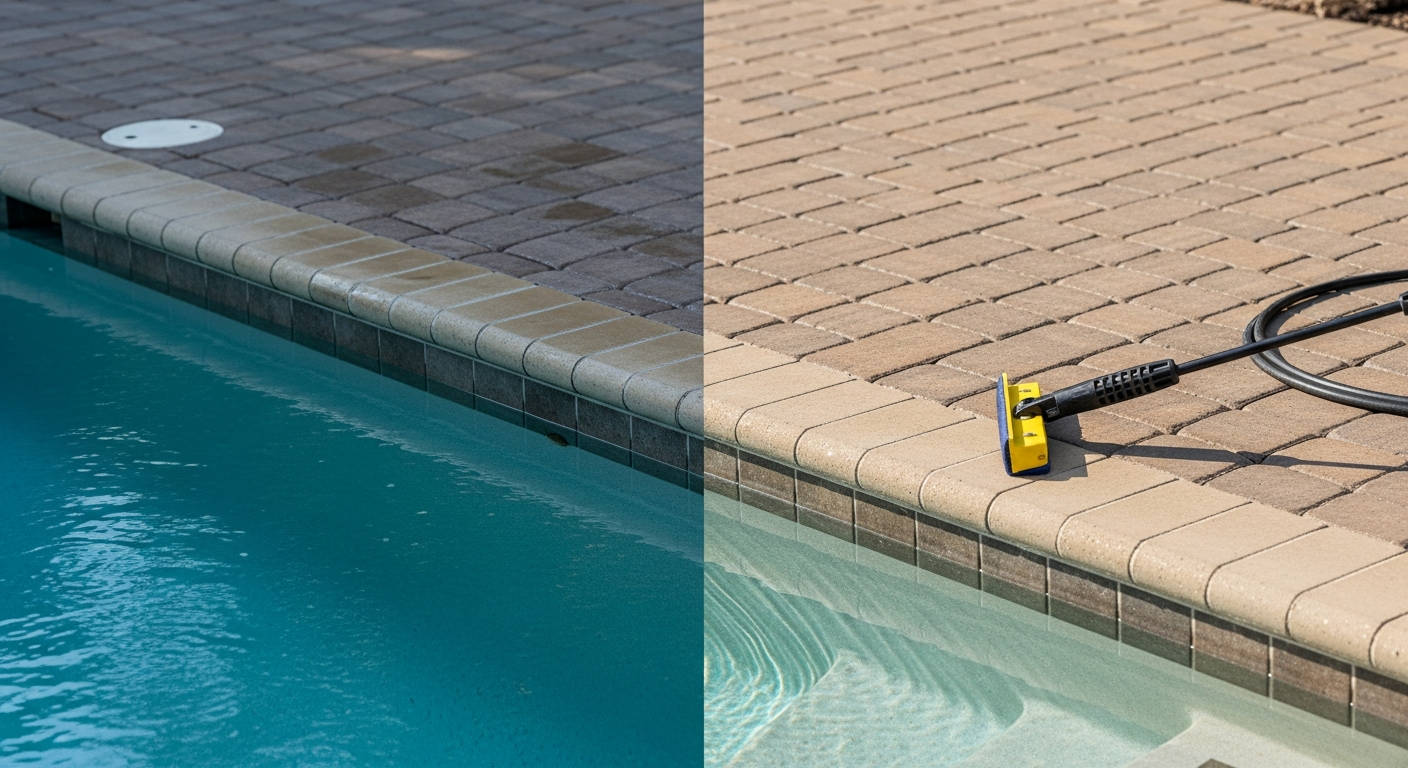
- Low-Pressure, High-Volume Rinse: Instead of high PSI, I use a specialized surface cleaner attachment that distributes water evenly at a much lower pressure. The focus is on a high-volume rinse to lift dirt and the neutralized organic matter without damaging the paver's cream layer or dislodging the base sand.
- Joint Sand Stabilization: This is the most critical structural step. After the pavers are completely dry, I install new ASTM C144 polymeric sand. I sweep it into the joints, then use a plate compactor to vibrate the sand, eliminating air pockets and ensuring a dense, locked-in joint. A light mist of water activates the polymers, creating a firm yet flexible grout that resists weed growth and insect intrusion.
- Sealer Application: I exclusively use a two-thin-coat, cross-hatch application method with a solvent-based, UV-inhibiting sealer for most jobs. The first coat is applied north-to-south, and after it’s absorbed, the second is applied east-to-west. This ensures 100% surface coverage without the roller marks and pooling I see in so many failed DIY jobs.
Sealer Selection and Curing: The Final 10% That Defines Quality
Not all sealers are created equal, and the right choice is entirely context-dependent. For a pool deck, where safety is paramount, I will always integrate a polymer non-slip additive into the final coat. This creates a texture similar to fine-grit sandpaper that is almost invisible but drastically increases the coefficient of friction when wet. For a dark-colored driveway that gets baked in the sun all day, a high-solids "wet look" sealer with maximum UV inhibitors is essential to prevent fading and chalking. The final, crucial step is monitoring the cure. I insist on a 48-hour moisture-free window post-application. Applying a sealer when there's a 60% chance of an afternoon thunderstorm is a recipe for immediate failure, and it's a risk I never take. What is the precise dew point threshold at which applying a solvent-based sealer in Charlotte County's humidity becomes a guarantee for sealer blushing?Written by

Tags
patio paver cleaning and sealing
cleaning and sealing patio pavers
paver patio cleaning and sealing
paver driveway sealing
paver sealers


