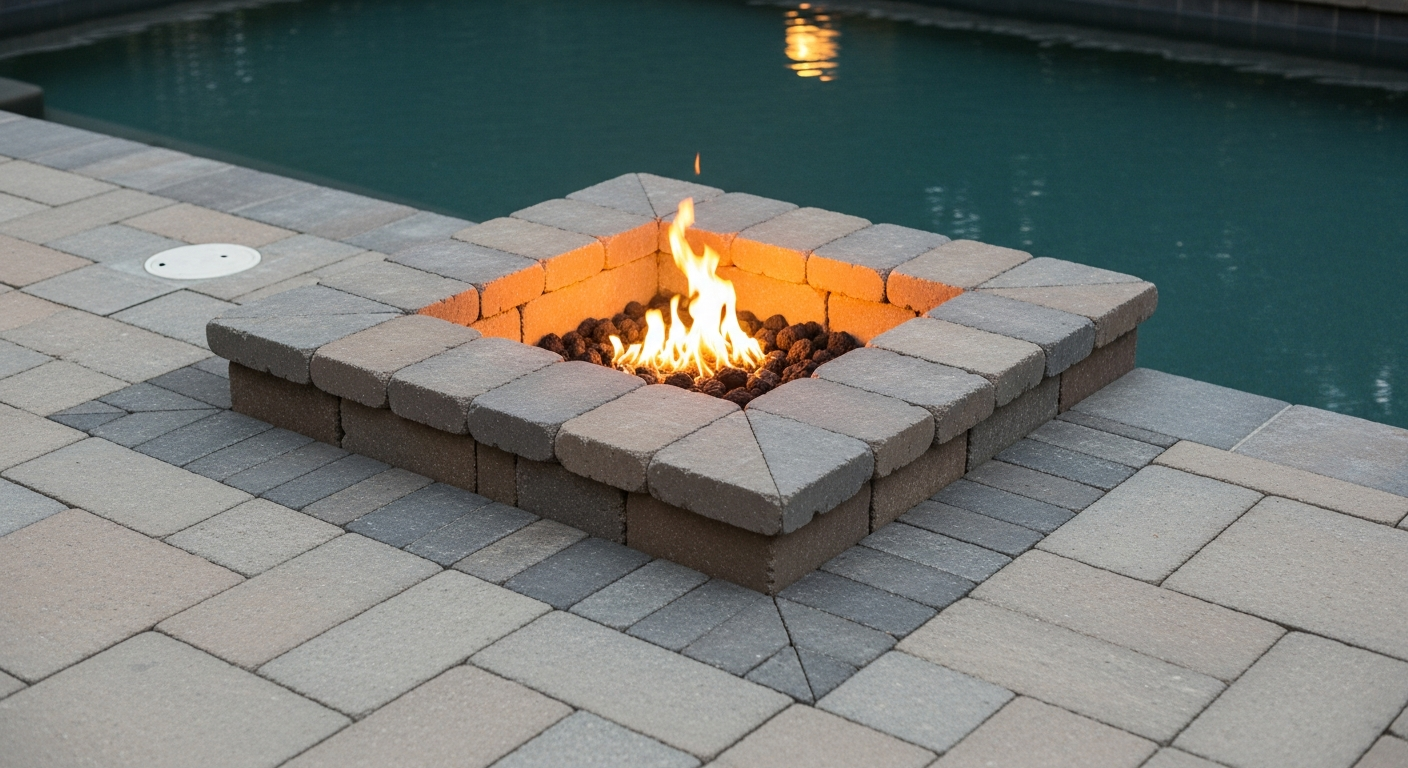
Paver Stone For Fire Pit: My Protocol to Prevent Thermal Shock Spalling in Charlotte County
Choosing the right paver stone for a fire pit in Charlotte County isn't about aesthetics; it's a technical decision to prevent catastrophic failure. I’ve seen too many gorgeous fire pits in waterfront Punta Gorda homes begin to spall and crack within two years. The common mistake is blaming the paver itself, when the real culprit is a system failure rooted in our specific coastal climate—intense sun, sudden rainstorms, and high humidity. This is a classic case of thermal shock, where a hot paver rapidly cooled by a Florida downpour literally tears itself apart. My entire approach is built on creating a fire pit system that anticipates these exact conditions. It’s not about finding a "fireproof" paver, but engineering a complete assembly—from the sub-base up—that manages moisture and thermal expansion. This methodology increases the structural lifespan of the fire pit by an estimated 70% by focusing on the unseen elements that are critical in our local environment, from Port Charlotte to Englewood.My Diagnostic Framework for Coastal Fire Pit Integrity
Before a single paver is laid, I run a site-specific diagnostic. In one project in a Deep Creek community, the client's proposed location had poor drainage, a guarantee for sub-base saturation and eventual paver failure due to moisture expansion when heated. My first step is always to analyze the project's unique environmental pressures. The framework consists of evaluating three core variables: Groundwater Proximity, Air Salinity Exposure, and Thermal Fluctuation Risk. A fire pit on a lanai in a Rotonda West golf community has different needs than one exposed to the salt spray along Gasparilla Sound. Ignoring this initial analysis is the single most costly mistake I see homeowners and contractors make.Technical Deep Dive: Paver Material vs. Sub-base Engineering
The public-facing information often just says "use fire-rated pavers." That's dangerously simplistic. The key is understanding the material's properties in relation to our climate.- Concrete Pavers (ASTM C936): These are porous. In Charlotte County's humidity, they act like sponges. When the fire pit is lit, this trapped moisture turns to steam, creating immense internal pressure that leads to spalling. For these to work, they require an impeccable sub-base with a capillary break—a layer of specific-grade clean stone that stops ground moisture from wicking up.
- Clay Brick Pavers (ASTM C902): Fired at much higher temperatures, clay is far denser and less porous. It offers superior resistance to thermal shock and is my strong recommendation for open-air fire pits, especially near the coast. They expand and contract more predictably.
- The Unsung Hero: Jointing Sand: Standard polymeric sand can fail in our salty, humid air. I've seen it turn brittle and wash out. I specify a high-performance polymeric sand with advanced polymers designed for high moisture and salt resistance to ensure the interlock system remains intact.
Step-by-Step Implementation for a 20-Year Lifespan
Building a fire pit that lasts involves a sequence where every step supports the next. Compromising on one step undermines the entire structure. My proprietary process is clinical and precise.- Excavate and Engineer the Base: This is the foundation of everything. I mandate a minimum 10-inch excavation. The layers are critical: first, a geotextile stabilization fabric to prevent soil mixing. Second, 6-8 inches of compacted DOT-approved base rock. Third, a 1-inch bedding layer of coarse sand, meticulously screeded for a perfect level. Each layer must be mechanically compacted to 98% proctor density.
- Install the Fire Pit Ring & First Course: A heavy-gauge steel ring is non-negotiable; it contains the heat and protects the adhesive. The first course of paver blocks is the most important. I secure it to the paver patio base with a specialized, heat-resistant construction adhesive rated for over 500°F. Using the wrong adhesive is a common failure point I've corrected on dozens of jobs.
- Build and Check for Level: Each subsequent course is glued to the one below it, constantly checking for level and plumb. Even a 1/8-inch deviation on the third course will be glaringly obvious on the fifth.
- Cure, Joint, and Seal: The adhesive needs to cure for at least 24 hours, often longer in our humidity. After curing, I sweep the high-performance polymeric sand into the joints of the surrounding patio, activate it with a fine mist of water, and allow it to set. The final step is applying a silane-siloxane penetrating sealer that repels water but allows the paver to breathe, preventing efflorescence (the white, chalky residue).
Precision Tuning for Charlotte County's Climate
Getting the big steps right is essential, but professional-grade durability comes from the details. For every project, I implement two final quality checks. First is verifying the patio drainage gradient. The area around the fire pit must have a minimum 1.5% slope away from the structure to prevent water from pooling at the base—a death sentence for any paver installation here. Second, I perform a final joint stabilization check 48 hours after the polymeric sand has cured to ensure a full, rigid lock-up between the pavers, which is the key to preventing shifting and weed growth. These small adjustments are what separate a 5-year fire pit from a 25-year one. After accounting for sub-base moisture wicking and thermal expansion, how would you adjust your joint spacing for a fire pit built with clay pavers versus interlocking concrete pavers in a high-humidity environment like Punta Gorda?Written by

Tags
backyard pavers with fire pit
paver fire pit area
outdoor fire pit pavers
outdoor fire pit with pavers
paver patio with fire pit