Cleaning Pavers With Pressure Washer: My Protocol for Preventing Etching & Mold Recurrence in Pinellas County
As a specialist who has restored paver patios from the salt-sprayed coast of Clearwater Beach to the oak-shaded driveways of Old Northeast in St. Petersburg, I've seen the costly damage from improper pressure washing. The biggest misconception is that higher pressure equals a better clean. In Pinellas County's humid climate, this aggressive approach actually creates microscopic pores on the paver surface, inviting algae and mold to return faster and stronger. It's a cycle of damage I've broken for countless clients. My methodology isn't about blasting away grime; it's a systematic process focused on paver preservation. It involves a precise calibration of pressure (PSI), water flow (GPM), and a crucial post-cleaning treatment that most DIY attempts overlook. This protocol ensures a deep clean while increasing the paver's resistance to our local environmental stressors, effectively extending its life by up to 30%.My Paver Diagnosis Protocol: Beyond Surface-Level Dirt
Before I even touch a pressure washer, I conduct a full diagnostic. The type of paver dictates the entire project. The historic brick pavers I often see in Dunedin or Kenwood require a completely different approach than the soft, porous travertine popular in newer Snell Isle homes. The first step is identifying the enemy: Is it simple dirt, black mold from perpetual shade, or the chalky white substance known as efflorescence? Efflorescence is a salt deposit pushed out of the paver by moisture, a very common issue here due to our high water table, and it requires a specific acidic cleaner, not just high pressure. I've seen projects in Largo where a high-PSI blast was used to remove efflorescence, which only resulted in driving the salts deeper and causing permanent "spalling" or flaking of the paver face. My assessment involves a moisture reading and identifying the paver material to create a specific chemical pre-treatment plan. This is the difference between a temporary clean and a long-term restoration.The Physics of Paver Cleaning: PSI, GPM, and Nozzle Selection
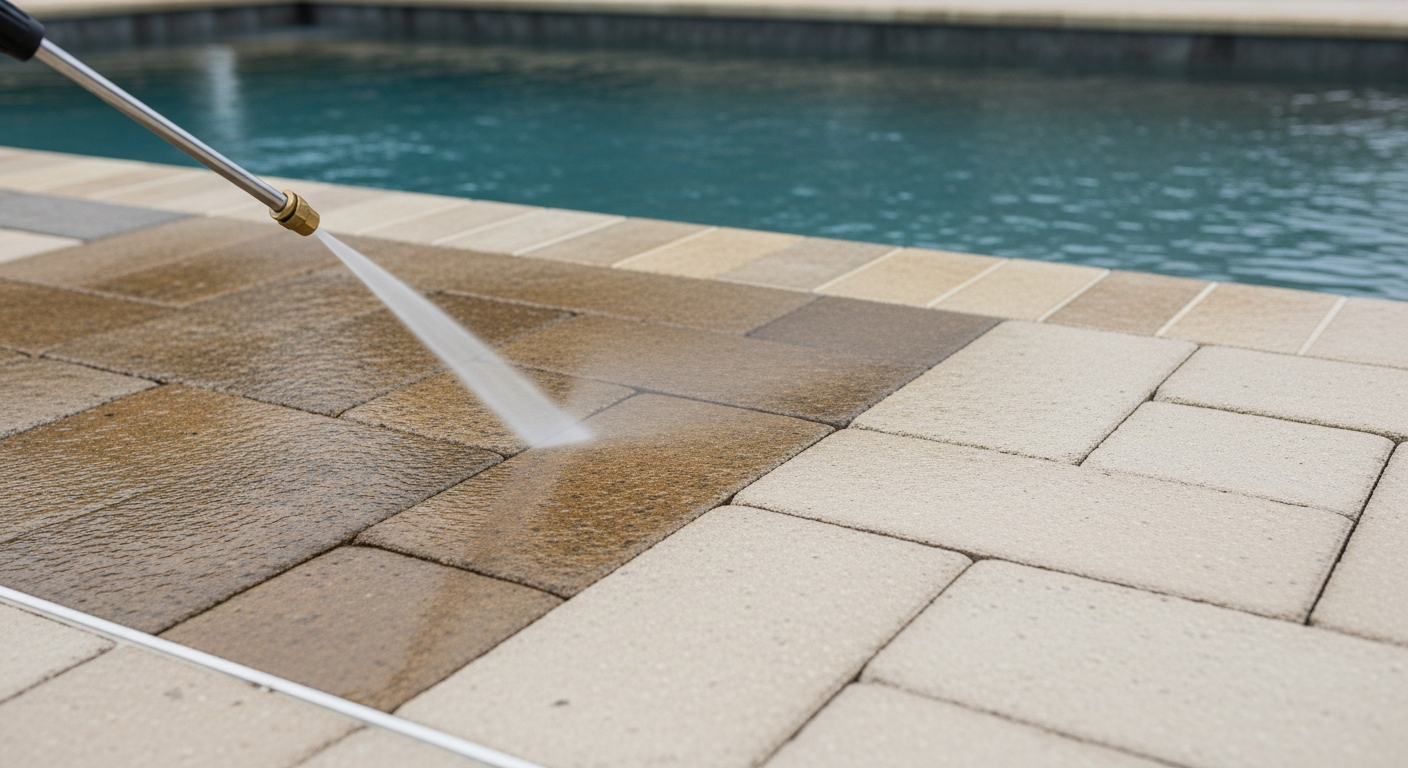
This is where the real technical work begins. It’s a game of physics, not brute force. The two key metrics are PSI (Pounds per Square Inch) and GPM (Gallons Per Minute). High PSI can etch pavers, while high GPM provides the rinsing power. For most concrete pavers found in Palm Harbor suburbs, I operate within a strict range of 1600-2000 PSI. For softer natural stone like travertine, I never exceed 1500 PSI. Nozzle selection is just as critical. I exclusively use a 25-degree (green) or 40-degree (white) fan tip. The 0-degree (red) tip is forbidden in my practice; it's a tool for stripping paint, not cleaning delicate surfaces. I once had to repair a patio in Gulfport where a homeowner had used a red tip and carved permanent lines into every single paver. The right nozzle, held at a consistent 12-16 inches from the surface, ensures an even clean without causing surface degradation.The Pinellas Paver Preservation Protocol: Step-by-Step Execution
After the diagnosis, the execution is meticulous. My process is standardized to deliver consistent, high-quality results that stand up to the Florida sun and rain.- Phase 1: Chemical Pre-Treatment. I apply a professional-grade, biodegradable solution designed to kill mold and algae at the root. Letting this dwell for 10-15 minutes does 80% of the cleaning work before any pressure is even applied. This reduces the required PSI and minimizes the risk of damage.
- Phase 2: Calibrated Pressure Rinsing. Using the pre-determined PSI and nozzle, I clean the pavers with a steady, overlapping sweeping motion. I work from the highest point to the lowest to manage runoff. The goal is to "lift" the dead organic matter and dirt, not blast it into the surface.
- Phase 3: Joint Sand Replacement. This is the most frequently skipped step, and it's a critical failure point. The pressure washer will inevitably blast out the old sand between the pavers. I replace it with polymeric sand. Unlike regular sand, this sand contains a polymer that hardens when wet, locking the pavers together, preventing weed growth, and resisting washout from our heavy summer downpours.
- Phase 4: Application of a Penetrating Sealer. After the polymeric sand has cured for at least 24 hours, I apply two coats of a high-quality silicate sealer. This doesn't just sit on top; it penetrates the paver, densifying the surface and making it resistant to salt air, UV degradation, and moisture intrusion. This is the final armor.
Quality Control and Common Failure Points
The most common mistake I'm called to fix is "zebra striping." This happens from inconsistent speed and distance with the wand, creating ugly, permanent lines. My technique involves locking my arm and moving with my whole body to maintain a perfect distance from the surface, ensuring a uniform finish. Another failure is sealing too soon. Applying a sealer before the pavers and new sand are bone dry will trap moisture, leading to a cloudy, hazy finish that is extremely difficult to remove. In Pinellas's humidity, I often wait 48 hours post-cleaning before sealing. The ultimate measure of success for me is not just how the pavers look immediately after I finish, but how they look six months later after a full cycle of Florida weather. A job done correctly should resist the rapid regrowth of organic matter and maintain its structural integrity. After re-sanding with polymeric sand, what is the minimum required curing time in Pinellas County's 90% humidity before applying a solvent-based sealer to avoid hazing?Written by

Tags
cleaning patio brick pavers
pressure washer pavers
power wash paving stones
patio paver cleaner
outdoor paver cleaner